


Forget the ponytail. Forget the glasses. Forget every stereotype of a hacker, despite the sci-fi-geek pseudonym “Neo.”
A clean-shaven, 31-year-old married Latvian wearing a buttoned-up shirt sat down this week to explain why he leaked the pay details of public officials onto the Internet.
Ilmars Poikans’ exposure of alleged flaws in an austerity drive grabbed headlines and embarrassed the elite in this Baltic nation, which has only just edged out of recession.
Snared last week after two months of drip-feeding data via microblogging service Twitter, IT researcher Poikans risks prison. He is unbowed, however, and claims he simply wanted more transparency.
“Yes, I acknowledge I risked a lot,” he told said at his first press conference since being released on bail. “I knew the police would come after me sooner or later.”
But why, he asked, should he be afraid to give the public the information they needed?
Poikans said he stumbled on a basic security loophole on the Latvian tax service’s Web site and decided to exploit it to download millions of documents.
Arrested on Tuesday last week, he was released two days later. Police said he was accused of connecting illegally to a database and distributing its information, a crime carrying up to 10 years in prison.
His detention sparked protests, fuelled by concerns over press freedom after police last week raided the home of a journalist who first reported on the cyber-vigilante campaign in February. Until last month, Poikans gradually posted details of officials’ pay, several showing golden parachutes that contrasted sharply with the crisis-fuelled wage cuts faced by most Latvians.
Political scientist Nils Muiznieks said Poikans struck a chord because trust in the authorities is rock-bottom in this nation of 2.2 million people.
“He is engaged in activism not for materialism, but because of his idealism,” Muiznieks added.
Latvian media labeled Poikans “Robin Hood.”
Latvia’s interior minister Linda Murniece has faced opposition and media calls to quit, notably due to her defense of the raid on the journalist’s home even though police only sought a court order afterwards. She dismissed claims that Poikans was a hero, saying investigators had found that the tax details of ordinary Latvians and private firms had been snatched.
“It’s a picture very different from the reports about a good Robin Hood who really wants to save the world,” she told Latvian radio.
He claims he found the loophole accidently last summer as he struggled to view an online tax document that his accountant had been able to see but he could not access.
He decided to try cutting and pasting the document’s Internet address into the browser. That enabled him to view it, despite lacking authorization and he realized he could access other documents without having to be logged into the system.
He adopted the nickname “Neo” after the hero in the cult sci-fi movie trilogy The Matrix.
Poikans said he decided not to inform the tax service because it needed to learn a lesson and not just sweep the problem under the rug.

Through the noise of rushing papers and whirring belts at a print factory in Kyoto, two creators watch their photo essay come to life in broadsheet form — part of an effort to win new audiences in the age of artificial intelligence (AI). Despite the decline of the publishing industry, self-publication and handmade “zine” magazines are growing in popularity in Japan, reflecting the nation’s enduring love of paper in the digital era. While speaking to Agence France-Presse at the plant, his hands black with ink, one of the creators, Kazuma Obara, said: “I think [paper] is a medium that engages all five
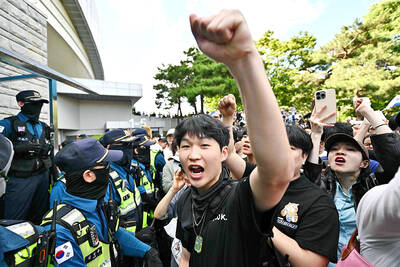
‘ABSURD MISTAKE’: The election commission said that there had been a failure to anticipate turnout after 14 polling stations ran short of ballot papers South Korean riot police yesterday cleared protesters from a Seoul polling station after a 35-hour blockade sparked by a shortage of ballot papers during local elections earlier this week. Wednesday’s election was the first nationwide vote since South Korean President Lee Jae-myung took office following the ouster of Yoon Suk-yeol over his short-lived martial law declaration. Lee’s ruling Democratic Party swept most races, but failed to flip the crucial Seoul mayoral seat. The South Korean National Election Commission apologized, blaming a failure to anticipate turnout after 14 polling stations in Seoul ran short of ballot papers. Some polling stations stayed open until 10pm to

Australian researchers have trained lab-grown brain cells on a silicon computer chip to play the 1990s shooter game Doom and said they are just scratching the surface of what the neurons could be capable of doing. It is the science-fiction work of biotech boffins at Cortical Labs, who researched and developed the technology that harnesses the workings of the brain’s networking system. Each so-called “biological computer” contains about 200,000 living human brain cells, grown from stem cells that were harvested from blood donations. Having mastered the simple computer game Pong, where a paddle is moved up and down to send a ball

France experienced its hottest spring on record, the French weather service said on Tuesday, after an exceptional early heat wave that also broke highs for the season in England and Wales. Meteo-France said the average nationwide temperature over March to May was 13.8°C — about 1.7°C above the norm, and surpassing records set in 2011 and 2020. “The warmest spring since records began in 1900,” it said in a bulletin. All three months were warmer than average, but the onset of an “unprecedented heatwave” late last month pushed the mercury to highs typically seen at the height of the summer. “Our country had never


 RSS
RSS