


Children as young as eight in poor Mexican border cities yearn to grow up to be drug lords and hitmen as the adrenalin and wealth linked to the trafficking world seeps deep into their lives.
Parents in the violent cities of Ciudad Juarez and Tijuana on the US border say primary school kids are captivated by the drug gangs they see on the street and TV news brandishing guns, driving flashy black SUVs and outsmarting soldiers.
Rather than playing cops and robbers and admiring firemen or train drivers, children are inventing kidnapping games and forming playground gangs named after brutal drug cartels as they idolize the power of kingpins whose turf wars have killed some 23,000 people since late 2006.
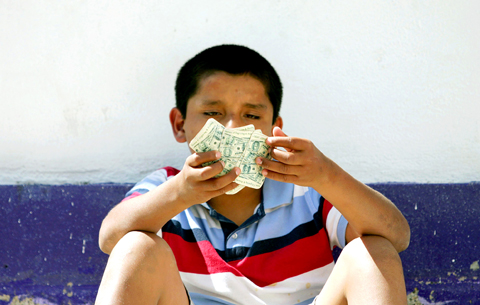
PHOTO: REUTERS
The kids risk becoming a new generation of the adolescent hitmen prized by drug cartels as cheap labor, police say.
Crimes committed by minors, ranging from shoplifting to murders for the cartels, have jumped by a third this year in Tijuana, near San Diego, the Baja California state attorney general’s office said. In nearby Mexicali, more than half of the 10,000 minors arrested last year were under 13, police say.
“One of my son’s classmates told the children to bring pistols to school because they were going to form a drug gang and play at kidnapping children,” said the mother of an eight-year-old boy in Ciudad Juarez, Mexico’s most violent city, with about 5,200 drug war killings since January 2008.
Another mother said her nine-year-old son recently told her he wanted to be a drug trafficker.
“My son came home and said to me: ‘Mom, I want to be like them. They’ve got lots of money,’” the mother, who asked not to be identified by name, said in a Ciudad Juarez community center.
At the same time, many children are traumatized by the horrific violence as rival gangs kill police, dump heads by roadsides and string up naked bodies from bridges. Troops have fought hitmen on streets outside schools, with bullets occasionally straying into playgrounds.
Hitmen shot a man around 100 times outside a kindergarten in Ciudad Juarez last week just as children were arriving.
Mexican President Felipe Calderon has staked his presidency on crushing the drug gangs, deploying about 70,000 troops and police across Mexico, with strong US support.
Escalating violence is frightening tourists away from beach resorts, prompting some businesses to freeze investment in border factories and causing the US to wonder whether its neighbor may be overwhelmed by the violence.
However, children in depressed border towns can also see that drug gangs are flush with cash from the trafficking that brings up to US$40 billion a year into Mexico. With scant role models or access to good schools, children see their parents struggling to get by in manufacturing cities where thousands were made jobless by last year’s deep recession.
“The narcos earn loads of money and nothing happens to them,” said a girl called Rubi, 14, in Tijuana, who dreams of being a top smuggler.
“Even the police help them,” she said.
In Ciudad Juarez, social workers blame parental absence, as workers toil long hours in assembly-for-export plants, for children as young as 11 joining gangs.
“The conflictive behavior starts because the kids spend so much time alone,” social worker Aida Arellano said. “They meet older youngsters, they take drugs and get hold of guns.”
Calderon has promised more schools and welfare for border cities like Ciudad Juarez, where residents are sick of gruesome violence. But the plan is moving slowly and school dropouts are getting sucked into the criminal underworld.

SPEAKING OUT: After Siranudh Scott’s allegations surfaced, celebrities and public figures took to social media to share their own experiences of sexual misconduct and abuse A high-profile alleged sexual abuse case within a wealthy Thai beer brewing family has prompted a wave of painful accounts from survivors of unconnected abuse in the conservative nation. Siranudh Scott, a member of the billionaire Thai family that founded the ubiquitous Singha beer brand, posted an emotional video this month accusing his elder brother Sunit of repeatedly abusing him when he was a teenager. Sunit, who is in his 30s, later denied the allegations in a video posted online, but Singha parent Boonrawd dismissed him from his executive role with the company on Tuesday last week. “I felt I needed to speak

SEEKING ORDER: Rodrigo Paz said that ‘anyone who wants to destroy the nation will have to deal with this president and the full force of the constitution’ Bolivian President Rodrigo Paz on Wednesday said that the nation was at a “breaking point” after nearly a month of protests that have caused shortages of food, fuel and medicine. Paz, who took office six months ago amid the worst economic crisis there in four decades, is battling a groundswell of fury over his policies. The political capital, La Paz, has been besieged by low-income workers and members of the indigenous majority calling for his resignation. “The country needs order and is reaching breaking point,” the 58-year-old said at a public event in La Paz, renewing his appeal for dialogue. On Tuesday, the Bolivian
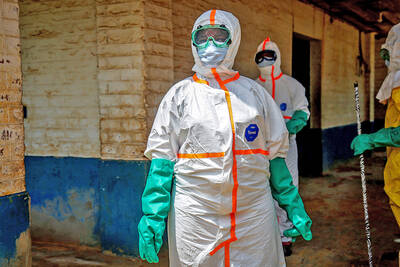
COMMUNITY CONFLICT: Concerns about disease spread from corpses has run up against friends and families’ desire to bury their dead as infection spreads in the area Angry residents of a town at the epicenter of the Ebola outbreak in the Democratic Republic of the Congo (DR Congo) attacked and burned a tent that was part of a health center where people are being treated for the virus, the staff there said Saturday. It was the second such attack in the region in a week. No one was hurt in the attack, according to reports but as patients ran out to escape the fire, 18 people with suspected Ebola infections fled the facility and are unaccounted for, a hospital director said. Angry residents arrived at the clinic in the
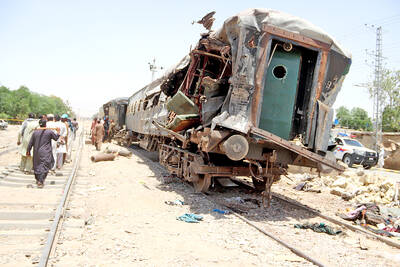
INSURGENT ACTION: A local independence movement in Balochistan, alleged by Pakistan’s government to be backed by India, claimed responsibility for the strike A suicide bomber detonated an vehicle-borne IED near a railway as a passenger train passed through the southwestern Pakistani city of Quetta yesterday, killing at least 23 people and wounding over 70, officials said. The explosion caused two of the train cars to overturn and catch fire, according to footage shared online. The attack happened in an area where security forces are usually stationed, badly damaging several nearby buildings and smashing more than a dozen vehicles parked along the road, according to witnesses and images circulating on social media. Doctors at local hospitals said they had received the wounded, with 20 in critical


 RSS
RSS