


Pakistan’s pugnacious media world was plunged into controversy on Monday when a leaked audio tape apparently linked its most popular television presenter with the execution of a Taliban hostage.
The tape purports to be a recording of a phone conversation between the journalist, Hamid Mir, and a Taliban spokesman about the fate of Khalid Khawaja, a former intelligence agent being held by the Taliban.
In the tape Mir describes Khawaja as a CIA collaborator, questions his Islamic credentials and accuses him of playing a treacherous role in the 2007 Red Mosque siege in which more than 100 people, including the chief cleric, were killed. When the abductor asks the journalist whether Khawaja should be released, he urges him to further interrogate him.
Last month Khawaja’s bullet-pocked body was found on a roadside in Waziristan with a warning note to other “American spies.”
As debate about the tape swirled in media circles, Mir issued a strenuous denial saying the tape had been fabricated by his enemies in government to destroy his reputation and silence him.
“I never said these things to these people. This is a concocted tape,” he said. “They took my voice, sampled it and manufactured this conspiracy against me.”
However, several senior journalists said the tape sounded authentic and one called on the government to investigate further.
“There are serious allegations to be answered,” said Rashed Rahman, editor of the English-language Daily Times newspaper. “If this tape turns out to be genuine, it suggests a journalist instigated the murder of a kidnapee. A line must be drawn somewhere.”
The Taliban added to the controversy by issuing a statement that denied the tape was real but, confusingly, threatened the state telephone company for having taped the conversation.
The acrid arguments have thrown Pakistan’s normally tight-knit media community into a spin as some of the country’s most contentious issues — militancy, politics and the role of the powerful, overwhelmingly rightwing media — have come into focus around the death of Khawaja.
Khawaja, a former Inter Services Intelligence (ISI) agent and chief coordinator of a human rights group, who claimed to have met Osama bin Laden, traveled to the tribal belt in March with Sultan Amir Tarar, another former ISI agent, and Asad Qureshi, a documentary filmmaker. Khawaja had promised the journalist an interview with Hakimullah Mehsud, the Taliban leader who was almost killed in a CIA drone strike in Pakistan in January.
However, the three men were kidnapped, and the Taliban demanded money and prisoners in return for their freedom.
On April 24, the Taliban issued a video showing Khawaja admitting to having worked for the CIA and betrayed the Red Mosque clerics.
A week later, after his execution, Mir wrote a detailed account of Khawaja’s life. He recycled the allegations against the former ISI agent, attributing them to militant sources.

‘CROSSING THE LINE’: China’s embassy in Seoul criticized US Forces Korea Commander General Xavier Brunson, asking if his ‘hostile’ remarks were authorized by Washington South Korea and the US are in talks over recent public remarks by the commander of US Forces Korea, Seoul’s presidential office said yesterday, after the comments drew sharp criticism from China. In a recent podcast interview, US Forces Korea Commander General Xavier Brunson described South Korea as “the dagger in the heart of Asia” from China’s east coast, prompting the Chinese embassy in Seoul to say that he had “truly crossed the line.” The interview came amid growing speculation that Washington might seek to expand the role of US Forces Korea in countering the growing regional influence of China, a key

Through the noise of rushing papers and whirring belts at a print factory in Kyoto, two creators watch their photo essay come to life in broadsheet form — part of an effort to win new audiences in the age of artificial intelligence (AI). Despite the decline of the publishing industry, self-publication and handmade “zine” magazines are growing in popularity in Japan, reflecting the nation’s enduring love of paper in the digital era. While speaking to Agence France-Presse at the plant, his hands black with ink, one of the creators, Kazuma Obara, said: “I think [paper] is a medium that engages all five

Australian researchers have trained lab-grown brain cells on a silicon computer chip to play the 1990s shooter game Doom and said they are just scratching the surface of what the neurons could be capable of doing. It is the science-fiction work of biotech boffins at Cortical Labs, who researched and developed the technology that harnesses the workings of the brain’s networking system. Each so-called “biological computer” contains about 200,000 living human brain cells, grown from stem cells that were harvested from blood donations. Having mastered the simple computer game Pong, where a paddle is moved up and down to send a ball
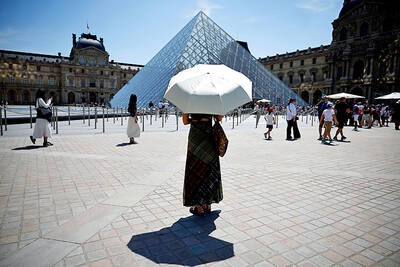
France experienced its hottest spring on record, the French weather service said on Tuesday, after an exceptional early heat wave that also broke highs for the season in England and Wales. Meteo-France said the average nationwide temperature over March to May was 13.8°C — about 1.7°C above the norm, and surpassing records set in 2011 and 2020. “The warmest spring since records began in 1900,” it said in a bulletin. All three months were warmer than average, but the onset of an “unprecedented heatwave” late last month pushed the mercury to highs typically seen at the height of the summer. “Our country had never


 RSS
RSS