


Sudanese authorities yesterday arrested Islamist opposition leader Hassan al-Turabi and closed down his newspaper a month after the country’s first competitive polls in two decades, party officials said.
“At around midnight, a group of security officers arriving in three cars, came and took Hassan al-Turabi from his home,” his secretary Awad Babakir said.
In a dawn raid a few hours later, authorities confiscated the newspaper of Turabi’s Popular Congress Party (PCP) and arrested the paper’s editor-in-chief.
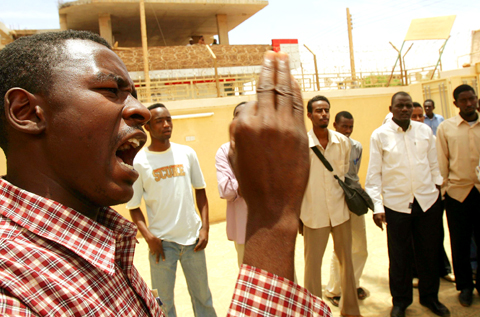
PHOTO: AFP
“After the arrest of the secretary general of the Popular Congress Party, security authorities stormed the printing house of the daily Rai al-Shaab and confiscated all copies of the paper,” said Kamal Omar, head of the PCP’s politburo.
“Authorities then took over the newspaper offices in central Khartoum and ordered all the journalists to leave,” he said.
Editor-in-chief, Abuzerr Ali al-Amin told reporters by telephone that he had been detained.
“At around 9:10am, a group of security and intelligence officials came to my house, put me in a car and took me to one of their offices,” Amin said.
“They have not told me the reason for my detention and after two hours I have still not been questioned,” he said.
The former southern rebel Sudan People’s Liberation Movement (SPLM) — partners in a coalition government — condemned Turabi’s arrest as illegal.
“The arrest is outside the law, it is rejected. It is a violation of the Constitution,” SPLM senior member and former presidential candidate Yasser Arman said.
“After stealing the election, [the ruling National Congress Party] should not be stealing freedoms. This arrest exposes their weakness,” Arman said. “Constitutional rights must be respected for Dr. Turabi and others.”
Turabi, once Sudanese President Omar al-Beshir’s mentor but now one of his fiercest critics, had denounced last month’s elections as fraudulent and said his party would not join a future government.
Beshir was declared winner with 68 percent of the vote in Sudan’s first multi-party election since 1986, a vote marred by an opposition boycott, logistical problems and accusations of fraud.
Turabi was last detained in January last year, two days after he urged Beshir to surrender to the International Criminal Court. He has frequently been arrested by the authorities.
In March last year, the world court issued an arrest warrant against Beshir for alleged war crimes and crimes against humanity in Darfur.
Turabi did not run in the country’s presidential race himself.
The PCP was instead represented by Abdallah Deng Nial, a Muslim from the mainly Christian south.
The voting and the counting process are fraudulent,” said Turabi two days after the elections ended on April 15.
“We will take the matter to court and if the judge does not rule in our favor, we may have to use other alternatives than the ballot boxes,” he said.
Beshir’s victory had been virtually guaranteed by the withdrawal of his two key challengers in the presidential race.
The elections also included polls for parliamentary and state representatives as well as for the president.
Observers from the EU and the Carter Center — headed by former US president Jimmy Carter— said after the five days of polling ended that the election had failed to reach international standards.

An American scientist convicted of lying to US authorities about payments from China while he was at Harvard University has rebuilt his research lab in Shenzhen, China, to pursue technology the Chinese government has identified as a national priority: embedding electronics into the human brain. Charles Lieber, 67, is among the world’s leading researchers in brain-computer interfaces. The technology has shown promise in treating conditions such as amyotrophic lateral sclerosis and restoring movement in paralyzed people. It also has potential military applications: Scientists at the Chinese People’s Liberation Army have investigated brain interfaces as a way to engineer super soldiers by boosting

Indonesian police have arrested 13 people after shocking images of alleged abuse against small children at a daycare center went viral, sparking outrage across the nation, officials said on Monday. Police on Friday last week raided Little Aresha, a daycare center in Yogyakarta on Java island, following a report from a former employee. CCTV footage circulating on social media showed children, most younger than two, lying on the floor wearing only diapers, their hands and feet bound with rags. The police have confirmed that the footage is authentic. Police said they also found 20 children crammed into a room just 3m by 3m. “So
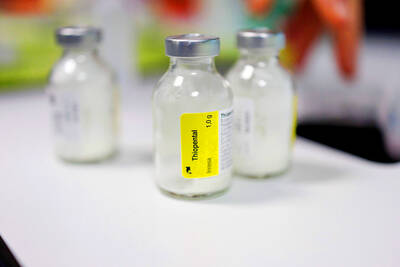
A grieving mother has ended her life at a clinic in Switzerland four years after the death of her only child. Wendy Duffy, 56, a physically healthy woman, died at the Pegasos clinic in Basel after struggling to cope with the death of her 23-year-old son, Marcus. The former care worker, from the West Midlands, England, had previously attempted to take her own life. The case comes as assisted dying would not become law in England and Wales after proposed legislation, branded “hopelessly flawed” by opponents, ran out of time. Ruedi Habegger, the founder of Pegasos, described Duffy’s death as

From post offices and parks to stations and even the summit of Mount Fuji, Japan’s vending machines are ubiquitous, but with the rapid pace of inflation cooling demand for their drinks, operators are being forced to rethink the business. Last month beverage giant DyDo Group Holdings announced it would remove about 20,000 vending machines — about 7 percent of their stock nationwide — by January next year, to “reconstruct a profitable network.” Pokka Sapporo Food & Beverage, based in Nagoya, also said last month it would sell its 40,000-machine operation to Osaka-based Lifedrink Co. “The strength of the vending machine


 RSS
RSS