


An Indonesian Islamic cleric accused of being the spiritual leader of the Jemaah Islamiyah terror group has denied links with a group of militant suspects arrested in raids this month, reports said yesterday.
Local media reports alleged that several suspects detained this month in connection with the discovery in February of a militant training camp in Aceh Province were linked to Abu Bakar Bashir’s Jemaah Anshorut Tauhid (JAT) group.
The suspects were reportedly arrested on May 6 in an anti-terrorist operation on a building in South Jakarta, a city in the country’s capital region, that served as a base for JAT, a group Bashir founded in 2008.
However, Bashir told the Indopos newspaper that there was no such link.
“I’ve been framed. I didn’t know and wasn’t involved in any movement or training in Aceh,” the paper quoted Bashir as saying.
DIFFERENT GROUPS
“In terms of organization and activities, JAT is different from the terrorist group in Aceh. Despite this, JAT is still being linked to terrorist movements,” he added.
Police had indicated the suspects could be linked to Jemaah Islamiyah.
The discovery of the Aceh camp in February triggered a series of anti-terror operations nationwide.
National police chief Bambang Hendarso Danuri said on Friday last week 58 terror suspects had been arrested and 13 people killed in the raids over the past three months.
CREATING A CALIPHATE
Jemaah Islamiyah and related Southeast Asian militant groups want to unite much of the region under an Islamic caliphate and believe they must kill Westerners to defend Muslims from oppression.
Bashir was jailed for links with Jemaah Islamiyah but was subsequently acquitted and released.

An American scientist convicted of lying to US authorities about payments from China while he was at Harvard University has rebuilt his research lab in Shenzhen, China, to pursue technology the Chinese government has identified as a national priority: embedding electronics into the human brain. Charles Lieber, 67, is among the world’s leading researchers in brain-computer interfaces. The technology has shown promise in treating conditions such as amyotrophic lateral sclerosis and restoring movement in paralyzed people. It also has potential military applications: Scientists at the Chinese People’s Liberation Army have investigated brain interfaces as a way to engineer super soldiers by boosting

Indonesian police have arrested 13 people after shocking images of alleged abuse against small children at a daycare center went viral, sparking outrage across the nation, officials said on Monday. Police on Friday last week raided Little Aresha, a daycare center in Yogyakarta on Java island, following a report from a former employee. CCTV footage circulating on social media showed children, most younger than two, lying on the floor wearing only diapers, their hands and feet bound with rags. The police have confirmed that the footage is authentic. Police said they also found 20 children crammed into a room just 3m by 3m. “So
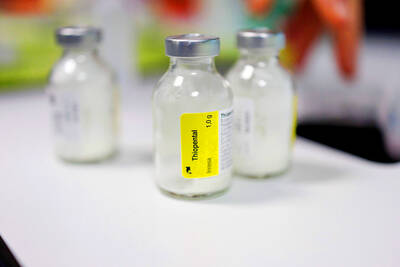
A grieving mother has ended her life at a clinic in Switzerland four years after the death of her only child. Wendy Duffy, 56, a physically healthy woman, died at the Pegasos clinic in Basel after struggling to cope with the death of her 23-year-old son, Marcus. The former care worker, from the West Midlands, England, had previously attempted to take her own life. The case comes as assisted dying would not become law in England and Wales after proposed legislation, branded “hopelessly flawed” by opponents, ran out of time. Ruedi Habegger, the founder of Pegasos, described Duffy’s death as
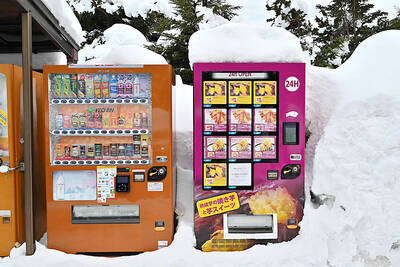
From post offices and parks to stations and even the summit of Mount Fuji, Japan’s vending machines are ubiquitous, but with the rapid pace of inflation cooling demand for their drinks, operators are being forced to rethink the business. Last month beverage giant DyDo Group Holdings announced it would remove about 20,000 vending machines — about 7 percent of their stock nationwide — by January next year, to “reconstruct a profitable network.” Pokka Sapporo Food & Beverage, based in Nagoya, also said last month it would sell its 40,000-machine operation to Osaka-based Lifedrink Co. “The strength of the vending machine


 RSS
RSS