

China’s riot-torn western region of Xinjiang said it fully restored the Internet yesterday, 10 months after shutting down access over allegations that agitators used the Web to stir up ethnic violence that killed nearly 200 people.
Internet access and text messaging services were cut in the wake of the July riots in Xinjiang that wounded an additional 1,600 people and sparked a massive security crackdown still in place.
Almost 200 accused rioters have been tried and several dozen death sentences handed down.
China blamed the rioting on overseas-based groups agitating for broader rights for Xinjiang’s traditional majority Uighur ethnic group and cut Internet service in the region, saying the Web had been used to foment unrest.
Internet services were partially restored at the end of last year, while limited phone texting services began last month.
“For the stability, economic development and the needs of people from all ethnic backgrounds of the autonomous region, the Communist Party and the government of Xinjiang decided to fully resume Internet services beginning May 14,” the news office of the Xinjiang government said in a statement posted on a government Web site.
The severing of Internet connections in Xinjiang was more than just an inconvenience. Businesses who trade throughout Central Asia were forced to use faxes or send staff into neighboring provinces to access e-mail, while scientists found themselves shut off from research partners elsewhere. Many ordinary people relied on friends and family elsewhere in China to download their e-mails and pass the information on to them.
Even with services restored, China’s countrywide blocks on Web sites it considers politically sensitive continue to restrict access to news and other information.
At the China International Electronic Commerce Center in the regional capital, Urumqi, a woman who refused to give her name yesterday confirmed that YouTube and Facebook were blocked in Xinjiang.

Beijing yesterday dismissed as “groundless speculation” a report that said Nvidia CEO Jensen Huang (黃仁勳) was the target of a Chinese spy plot. The article by the New York Times, published on Thursday, said that US intelligence officials concluded that a Chinese executive linked to a Singapore-based data center company had been funneling information to Beijing. “The report in question is based on groundless speculation and is nothing more than an attempt to smear China,” Chinese Ministry of Foreign Affairs spokesman Guo Jiakun (郭嘉昆) told a regular briefing. China is in a race for tech dominance with the US, which restricts the export
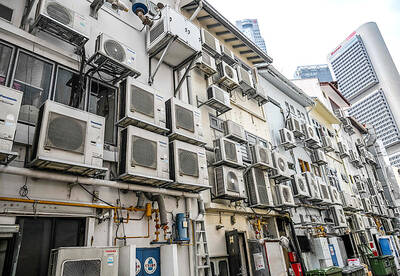
Long dubbed an “air-conditioned nation,” Singapore is experimenting with cooling alternatives from chilled beams to “passive displacement” to curb its thirst for energy-guzzling air-conditioning. The city-state has the highest per-capita air-conditioner ownership rate in Southeast Asia, with about 99 percent of private residences equipped with cooling units. Singapore’s local building sector accounts for one-fifth of its emissions, while cooling itself accounts for 40 to 60 percent of a building’s energy consumption, according to studies. A stroll down Orchard Road highlights that dependence. Shoppers are greeted by blasts of cool air that waft into the street as doors swing open — a major draw

Ethiopian online influencers are pushing for their government to invade neighboring Eritrea and seize access to the sea, following its success against rebel and Eritrean forces in the past few weeks. The Ethiopian army has advanced right up to the border after repelling an offensive by rebels in the northern Tigray State who were supported by Eritrean troops. Ethiopian Prime Minister Abiy Ahmed has repeatedly said that securing a base on the Red Sea is a vital national objective for Ethiopia, which lost its coastline when Eritrea gained independence in 1993. Some online influencers say that the opportunity to invade has arrived. “The time

33 MISSING: The unprecedented number of empty seats at the fifth plenum, an annual gathering of top officials, serve as a symbol of the extent of the purges under Xi Jinping China expelled a record number of officials from the Chinese Communist party (CCP) as it concluded a major political gathering, which saw an unprecedented number of empty seats indicating the scale of the purges under Chinese President Xi Jinping (習近平). A record 33 members were expelled at this week’s fifth plenum, a gathering of top officials that takes place roughly once a year. Just 279 of the full and alternate members of the CCP’s Central Committee attended this week’s gathering, compared with the 376 originally named as members in 2022. That means that more than 25 percent of the original cohort were


 RSS