


Egypt extended an emergency law for two years on Tuesday while promising to limit its use, but analysts said it could still be used to stifle dissent and Washington urged Cairo to repeal the measure.
Ending the emergency law has long been a call of government critics and it has been a rallying cry of protests in Cairo since April 6 — which have been small by global standards but unusual in Egypt, where security quickly quashes dissent.
The state has long said terror and drug cases were the focus of the law, in force since the 1981 assassination of then-president Anwar Sadat. Analysts say it is a legal ploy that masks the law’s violation of basic human rights.
Egypt’s parliament, dominated by President Hosni Mubarak’s National Democratic Party, passed the extension with about three-quarters of the vote after intense debate led by the opposition.
About 200 protesters — including former presidential candidate Ayman Nour, Muslim Brotherhood lawmakers and labor leaders — gathered outside parliament before the vote.
“Down, down with emergency law. Down, down with military rule,” chanted protesters, surrounded by hundreds of police.
The US, a major donor and close ally, said it was “disappointed” over the law’s extension and called on Egypt to replace it with a counterterrorism law that “protects the civil liberties and dignity of Egyptian citizens.”
“We urge Egypt to complete its promised counterterrorism legislation on an urgent basis and repeal the State of Emergency,” Robert Gibbs, US President Barack Obama’s press secretary, said in a statement. “We believe Egypt missed an opportunity today to signal its embrace of these universal values to the rest of the world.”
Sarah Leah Whitson, Middle East and North Africa director at New York-based Human Rights Watch, said: “Instead of cosmetic changes to the emergency law, the government needs to repeal it and restore the basic rights of its citizens.”
The group said Egypt had promised before to curb the law but had reneged. It said the law had been used against the Muslim Brotherhood, rights activists and bloggers.
Egyptian Prime Minister Ahmed Nazif told parliament the extension request came with a commitment the government would only use it to deal with “the threat of terrorism and narcotics, and only to the extent necessary to confront these dangers.”
“The emergency law will not be used to undermine freedoms or infringe upon rights if these two threats are not involved,” he said in a speech before parliament voted.

Through the noise of rushing papers and whirring belts at a print factory in Kyoto, two creators watch their photo essay come to life in broadsheet form — part of an effort to win new audiences in the age of artificial intelligence (AI). Despite the decline of the publishing industry, self-publication and handmade “zine” magazines are growing in popularity in Japan, reflecting the nation’s enduring love of paper in the digital era. While speaking to Agence France-Presse at the plant, his hands black with ink, one of the creators, Kazuma Obara, said: “I think [paper] is a medium that engages all five
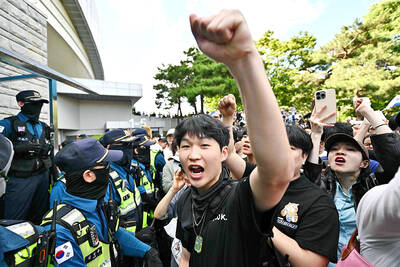
‘ABSURD MISTAKE’: The election commission said that there had been a failure to anticipate turnout after 14 polling stations ran short of ballot papers South Korean riot police yesterday cleared protesters from a Seoul polling station after a 35-hour blockade sparked by a shortage of ballot papers during local elections earlier this week. Wednesday’s election was the first nationwide vote since South Korean President Lee Jae-myung took office following the ouster of Yoon Suk-yeol over his short-lived martial law declaration. Lee’s ruling Democratic Party swept most races, but failed to flip the crucial Seoul mayoral seat. The South Korean National Election Commission apologized, blaming a failure to anticipate turnout after 14 polling stations in Seoul ran short of ballot papers. Some polling stations stayed open until 10pm to

Australian researchers have trained lab-grown brain cells on a silicon computer chip to play the 1990s shooter game Doom and said they are just scratching the surface of what the neurons could be capable of doing. It is the science-fiction work of biotech boffins at Cortical Labs, who researched and developed the technology that harnesses the workings of the brain’s networking system. Each so-called “biological computer” contains about 200,000 living human brain cells, grown from stem cells that were harvested from blood donations. Having mastered the simple computer game Pong, where a paddle is moved up and down to send a ball

France experienced its hottest spring on record, the French weather service said on Tuesday, after an exceptional early heat wave that also broke highs for the season in England and Wales. Meteo-France said the average nationwide temperature over March to May was 13.8°C — about 1.7°C above the norm, and surpassing records set in 2011 and 2020. “The warmest spring since records began in 1900,” it said in a bulletin. All three months were warmer than average, but the onset of an “unprecedented heatwave” late last month pushed the mercury to highs typically seen at the height of the summer. “Our country had never


 RSS
RSS