

A top aide to Japanese Prime Minister Yukio Hatoyama denied a report yesterday that the government had dropped an end-of-the-month deadline for resolving a row over a US Marine base, though there was still no solution in sight.
Kyodo news agency had said, without citing sources, that the government had given up on Hatoyama’s self-imposed deadline in the belief that it would be difficult to get the agreement of local people by then.
“The prime minister is saying he will resolve the issue by the end of May, that he will do his best for that,” Japanese Chief Cabinet Secretary Hirofumi Hirano told a news conference.
However, he said it would be hard to complete a plan by then.
“It will be very tough to decide on all the technical issues and other details on what will happen,” Hirano said. “But we need to set a clear direction for our thinking and on other issues, or otherwise we won’t be able to say we’ve resolved this.”
Hatoyama said before a meeting with Cabinet ministers on the row that he would stick to the deadline, but left unclear what form the resolution would take.
Dissatisfaction with his handling of the dispute has been one of the triggers for evaporating voter support in the run-up to an upper house election expected in July.
The Democrats’ chances of winning a majority in that election are receding, raising the possibility of policy deadlock as the country struggles to maintain a fragile economic recovery and control ballooning public debt.
Disillusioned by funding scandals in the ruling party and Hatoyama’s perceived inability to take hard decisions, less than a fifth of Japanese plan to vote for the Democratic Party in the election, a newspaper poll showed yesterday.
“There is no way to raise support, so the Democrats are going into damage control mode,” said Tsuneo Watanabe, senior fellow the Tokyo Foundation think tank. That could include blaming Hatoyama personally so as to deflect criticism from the party, he said.
About a quarter of respondents to the Yomiuri poll said they supported Hatoyama and his Cabinet, down on 33 percent in a poll last month and compared with 67 percent who said they did not.
About half respondents to the Yomiuri poll said Hatoyama should resign if he misses the deadline.
The chances of a deal had already seemed remote after residents of both Okinawa and the tiny island of Tokunoshima about 150km away reacted angrily to Hatoyama’s suggestion that they share the burden of Futenma airbase.
That idea was a modification of a 2006 deal, still favored by the US, which would move the Futenma base from a city center to a remoter part of Okinawa.
But Hatoyama raised hopes during last year’s election campaign it could be moved off the island. Members of Hatoyama’s Cabinet have blurred the definition of what he has promised and some analysts say the best that can be expected is for talks to continue with the aim of reaching a deal before US President Barack Obama visits in November.
Japan and the US are set to hold the second round of working-level talks on Futenma in Washington tomorrow.
The row has hit the Democratic Party, whose support had already been weakened by a series of funding scandals involving party lawmakers.
The scandals hit the headlines again last month when a judicial review panel said Democratic Party kingpin Ichiro Ozawa, seen by many as the real power behind the government, should be charged over misreporting of his political funds. Ozawa has repeatedly said he will not step down.

CRACKED SCREEN: The problem is an embarrassing setback for Apple, which spent more than a decade developing the device and touted its durability The iPhone Duo, one of Apple’s biggest new products in years, is drawing a growing number of complaints from customers who say the foldable display cracked after just hours or days of use. In these cases, customers reported hearing a crunching sound when unfolding the phone, followed by a large crack forming along the center crease. Some users also experienced a white patch or other display malfunction on the right side of the screen. Reports of the problem first surfaced on Reddit and other social media platforms. Bloomberg News has since independently verified the issue with more than half a
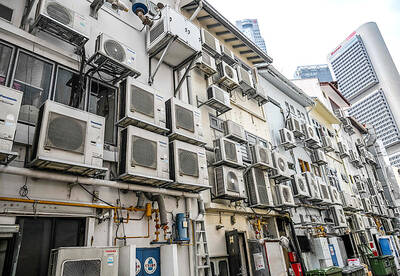
Long dubbed an “air-conditioned nation,” Singapore is experimenting with cooling alternatives from chilled beams to “passive displacement” to curb its thirst for energy-guzzling air-conditioning. The city-state has the highest per-capita air-conditioner ownership rate in Southeast Asia, with about 99 percent of private residences equipped with cooling units. Singapore’s local building sector accounts for one-fifth of its emissions, while cooling itself accounts for 40 to 60 percent of a building’s energy consumption, according to studies. A stroll down Orchard Road highlights that dependence. Shoppers are greeted by blasts of cool air that waft into the street as doors swing open — a major draw

Ethiopian online influencers are pushing for their government to invade neighboring Eritrea and seize access to the sea, following its success against rebel and Eritrean forces in the past few weeks. The Ethiopian army has advanced right up to the border after repelling an offensive by rebels in the northern Tigray State who were supported by Eritrean troops. Ethiopian Prime Minister Abiy Ahmed has repeatedly said that securing a base on the Red Sea is a vital national objective for Ethiopia, which lost its coastline when Eritrea gained independence in 1993. Some online influencers say that the opportunity to invade has arrived. “The time

Beijing yesterday dismissed as “groundless speculation” a report that said Nvidia CEO Jensen Huang (黃仁勳) was the target of a Chinese spy plot. The article by the New York Times, published on Thursday, said that US intelligence officials concluded that a Chinese executive linked to a Singapore-based data center company had been funneling information to Beijing. “The report in question is based on groundless speculation and is nothing more than an attempt to smear China,” Chinese Ministry of Foreign Affairs spokesman Guo Jiakun (郭嘉昆) told a regular briefing. China is in a race for tech dominance with the US, which restricts the export


 RSS