


On this small island, long a place of desolation, classical music’s most famous first four notes — played by one of its most famous orchestras — pounded into the warm spring day.
“I felt the flow of music was wonderful. My heart seemed to be purified,” one elderly man said in this once-isolated leper colony.
He was speaking to a visiting reporter after a performance of Ludwig van Beethoven’s Fifth Symphony by Britain’s Philharmonia Orchestra on Wednesday under the baton of renowned conductor and pianist Vladimir Ashkenazy.
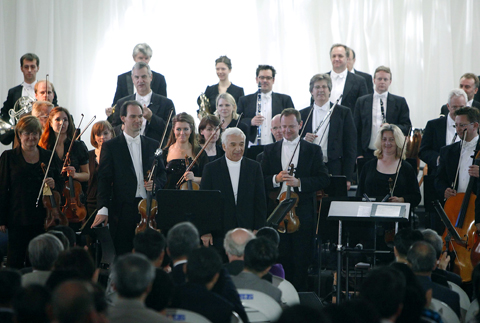
PHOTO: REUTERS
In a reminder of living so long as an outcast in this island in the far south of South Korea, the man, his limbs twisted by leprosy, asked not to be named or filmed.
“You can never be indifferent listening to this symphony. It lifts you up every time ... It is one of the greatest pieces ever composed by one of the greatest composers who ever lived on this miserable earth,” said a beaming Ashkenazy, who donated time out of his Asia tour with the orchestra for the concert.
The symphony’s startling introduction has been likened to fate knocking on the door. Ashkenazy politely rebuffed attempts to allot a meaning.
“If you say that, fine, but it’s still great music. We still feel what it’s supposed to mean ... Because music can’t be put into words,” he said.
He also led the orchestra for two songs by one of South Korea’s longest surviving pop stars, Cho Yong-pil.
Established in 1916 in the early years of Japan’s colonial rule over the Korean Peninsula, the leper colony was chosen for its isolation, not as a hospital.
Most of its residents were sent to keep them away from society, not to seek a cure, shunned by their own families, facing forced labor and, for a time, forced sterilization.
Until last year, the only way to the mainland was over water by an intermittent ferry.
“Last year, the government completed a beautiful bridge between Sorokdo island and the mainland. This year, my foundation is setting up to build another bridge, our spiritual bridge,” said Lady Maiko Rothemere, a South Korean citizen whose Lady R Foundation organized the concert.
All 600 patients, their average age 73, have been cured of what is now called Hansen’s disease, but most show the ravages of the illness that has disfigured faces and wrecked limbs, often leaving no more than gnarled stumps in place of hands.
An estimated 14,000 Hansen’s patients live in South Korea. Around the world, mostly in its poorer parts, there are an estimated quarter of a million new cases a year of leprosy.
Caused by the mycobacterium group of germs — which also lead to tuberculosis — leprosy can relatively easily be treated by drugs before it wreaks havoc on the body.
A large part of the job now, said Park Hyung-cheol, who heads the island hospital, is to heal the psychological wounds of his elderly patients after being ostracized most of their lives.
“With lots of people coming here [for the concert], this will be a moment for them to feel part of normal society,” he said.
Although prejudice was less, it remained, he said.
“Even family members and parents try to avoid Hansen patients,” said Lee Nam-chul, who arrived in Sorok as a teenager and is now 61.
“How is it that these people from abroad come here to make us happy. I couldn’t even dream of this. It’s okay if I die now,” Lee said, in between taking photographs, a skill he has mastered despite his leprosy-tangled fingers.

‘IN A DIFFERENT PLACE’: The envoy first visited Shanghai, where he attended a Chinese basketball playoff match, and is to meet top officials in Beijing tomorrow US Secretary of State Antony Blinken yesterday arrived in China on his second visit in a year as the US ramps up pressure on its rival over its support for Russia while also seeking to manage tensions with Beijing. The US diplomat tomorrow is to meet China’s top brass in Beijing, where he is also expected to plead for restraint as Taiwan inaugurates president-elect William Lai (賴清德), and to raise US concerns on Chinese trade practices. However, Blinken is also seeking to stabilize ties, with tensions between the world’s two largest economies easing since his previous visit in June last year. At the
Nearly half of China’s major cities are suffering “moderate to severe” levels of subsidence, putting millions of people at risk of flooding, especially as sea levels rise, according to a study of nationwide satellite data released yesterday. The authors of the paper, published by the journal Science, found that 45 percent of China’s urban land was sinking faster than 3mm per year, with 16 percent at more than 10mm per year, driven not only by declining water tables, but also the sheer weight of the built environment. With China’s urban population already in excess of 900 million people, “even a small portion

UNSETTLING IMAGES: The scene took place in front of TV crews covering the Trump trial, with a CNN anchor calling it an ‘emotional and unbelievably disturbing moment’ A man who doused himself in an accelerant and set himself on fire outside the courthouse where former US president Donald Trump is on trial has died, police said yesterday. The New York City Police Department (NYPD) said the man was declared dead by staff at an area hospital. The man was in Collect Pond Park at about 1:30pm on Friday when he took out pamphlets espousing conspiracy theories, tossed them around, then doused himself in an accelerant and set himself on fire, officials and witnesses said. A large number of police officers were nearby when it happened. Some officers and bystanders rushed

Beijing is continuing to commit genocide and crimes against humanity against Uyghurs and other Muslim minorities in its western Xinjiang province, U.S. Secretary of State Antony Blinken said in a report published on Monday, ahead of his planned visit to China this week. The State Department’s annual human rights report, which documents abuses recorded all over the world during the previous calendar year, repeated language from previous years on the treatment of Muslims in Xinjiang, but the publication raises the issue ahead of delicate talks, including on the war in Ukraine and global trade, between the top U.S. diplomat and Chinese


 RSS
RSS