


Bangladesh has lifted a four-decade ban on Indian films in a bid to boost attendance at cinemas, a government minister said on Saturday, drawing loud complaints from local actors and directors.
Films produced by India’s huge Bollywood entertainment industry have been banned from Bangladesh’s cinemas since 1972, a year after the country’s independence, to protect the local movie industry.
“We lifted the ban to boost the cinema industry,” Bangladesh Commerce Minister Faruk Khan said.
Cinema hall owners, who have been clamoring to be allowed to show Indian films, said they expected to start showing Indian films shortly.
Kazi Firoz Rashid, president of Bangladesh Cinema Hall Owners Association, said the government’s decision was “the best thing to have happened” to the country’s cinemas.
The number of cinema theaters has slid to 600 this year from 1,600 in 2000 in the country with Bangladeshi films and soft-porn English-language films shown in movie houses failing to draw viewers.
“Film enthusiasts can easily see good Indian films on cable television so why should we stop Indian films being screened in our cinemas?” Rashid said.
“By contrast, the standards, scripts and production of Bangladeshi films are so stale and poor they have trouble winning hearts or making enough money,” he said.
Pirated DVD copies of Bollywood movies circulate widely in Bangladesh in the absence of them being shown in cinemas and the films are hugely popular.
The lifting of the ban comes amid warming relations between India and Bangladesh after ties worsened between the neighbors when an Islamist-allied government was in power in Dhaka from 2001 to 2006.
“The new order scraps the ban and allows screening of Indian and other South Asian films in local cinemas provided they have English subtitles,” the government’s Film Censor Board chief Surat Kumar Sarker said.
However, not everyone supports the move.
“Indian films will completely destroy our film industry and our culture. At least 25,000 people will be jobless,” said Masum Parvez Rubel, a leading star and a co-coordinator of a newly created front against Indian films.
“We have appealed to the commerce minister and the authorities to reverse the decision. Otherwise, we’ll protest until the last drop of blood,” he said.
India’s prolific film industry churns out about 1,000 new releases a year.

Hungarian authorities temporarily detained seven Ukrainian citizens and seized two armored cars carrying tens of millions of euros in cash across Hungary on suspicion of money laundering, officials said on Friday. The Ukrainians were released on Friday, following their detention on Thursday, but Hungarian officials held onto the cash, prompting Ukraine to accuse Hungary’s Russia-friendly government of illegally seizing the money. “We will not tolerate this state banditism,” Ukrainian Minister of Foreign Affairs Andrii Sybiha said. The seven detained Ukrainians were employees of the Ukrainian state-owned Oschadbank, who were traveling in the two armored cars that were carrying the money between Austria and
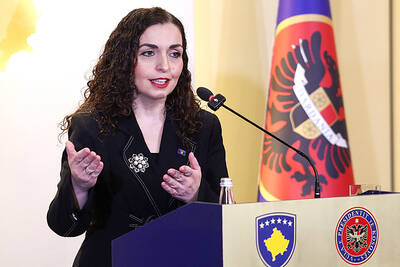
Kosovar President Vjosa Osmani on Friday after dissolving the Kosovar parliament said a snap election should be held as soon as possible to avoid another prolonged political crisis in the Balkan country at a time of global turmoil. Osmani said it is important for Kosovo to wrap up the upcoming election process and form functional institutions for political stability as the war rages in the Middle East. “Precisely because the geopolitical situation is that complex, it is important to finish this electoral process which is coming up,” she said. “It is very hard now to imagine what will happen next.” Kosovo, which declared

MORE BANS: Australia last year required sites to remove accounts held by under-16s, with a few countries pushing for similar action at an EU level and India considering its own ban Indonesia on Friday said it would ban social media access for children under 16, citing threats from online pornography, cyberbullying, online fraud and Internet addiction. “Accounts belonging to children under 16 on high-risk platforms will start to be deactivated, beginning with YouTube, TikTok, Facebook, Instagram, Threads, X, Bigo Live and Roblox,” Indonesian Minister of Communications and Digital Meutya Hafid said. “The government is stepping in so that parents no longer have to fight alone against the giants of the algorithm. Implementation will begin on March 28, 2026,” she said. The social media ban would be introduced in stages “until all platforms fulfill their
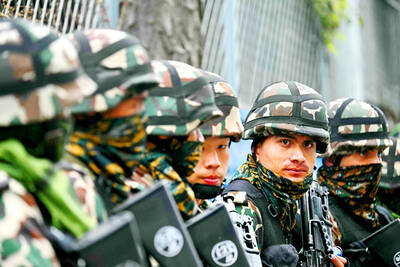
Counting was under way in Nepal yesterday, after a high-stakes parliamentary election to reshape the country’s leadership following protests last year that toppled the government. Key figures vying for power include former Nepalese prime minister K. P. Sharma Oli, rapper-turned-mayor Balendra Shah, who is bidding for the youth vote, and newly elected Nepali Congress party leader Gagan Thapa. In Kathmandu’s tea shops and city squares, people were glued to their phones, checking results as early trends flashed up — suggesting Shah’s centrist Rastriya Swatantra Party (RSP) was ahead. Nepalese Election Commission spokesman Prakash Nyupane said the counting was ongoing “in a peaceful manner”


 RSS
RSS