


Environmental activists, indigenous leaders and Hollywood celebrities gathered in Bolivia yesterday ahead of the first self-styled “people’s conference” on climate change.
Attendees said the summit would focus on the plight of the world’s poorest, which they said went largely ignored at official UN-sponsored climate talks in Copenhagen in December.
The Copenhagen meeting was widely drubbed for failing to produce a new treaty to limit greenhouse gas emissions and critics said the deal it produced would not avert a climate catastrophe.

PHOTO: EPA
The “People’s World Conference on Climate Change and Mother Earth Rights,” which runs until tomorrow, will draft new proposals to be offered for consideration at the next UN climate talks in Mexico at the end of the year.
Bolivian Ambassador to the UN Pablo Solon said the summit, which was expected to draw 18,000 people, was “the only way to get the climate change talks back on track.”
Developing nations have resisted a legally binding climate treaty, arguing that wealthy nations must bear the primary responsibility for climate change.
Nearly 130 countries, including many of the world’s poorest, will be represented at the Cochabamba conference. Anti-globalization activists Naomi Klein of Canada and Jose Bove of France were set to attend. Organizers have also invited James Cameron, director of the blockbuster film Avatar, and James Hansen, a US researcher who was among the first to warn about climate change.
Indigenous leaders, including Nilo Cayuqueo, an indigenous Mapuche from Argentina, were also in town, concerned about the impact of climate change on their homelands.
“We have great extremes of heat and cold, and as a result we’re seeing illnesses and outbreaks that once had disappeared,” Cayuqueo said.
This week’s gathering will also give a giant megaphone to a left-leaning bloc of Latin American leaders, including Ecuadorean President Rafael Correa, Paraguayan President Fernando Lugo, Nicaraguan President Daniel Ortega, Venezuelan President Hugo Chavez and Bolivian President Evo Morales.
The conference will seek to refine proposals presented by Morales in Copenhagen that included the creation of a world tribunal for climate issues and a global referendum on environmental choices.
The conference begins the day after representatives from the world’s leading economies gathered in Washington for a preparatory meeting ahead of the December UN summit in Cancun.
The US-led Major Economies Forum comprises 17 countries responsible for the bulk of global emissions and excludes smaller nations such as Sudan whose firebrand negotiators held up sessions at last year’s Copenhagen summit.
Washington hopes the closed-door talks will allow key nations to quietly assess what they can achieve heading into the next major climate summit in Cancun.
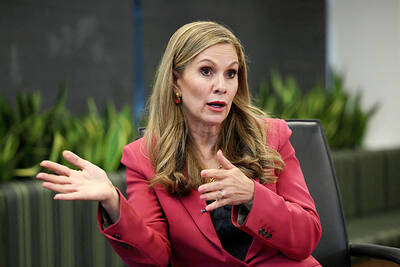
Australians were downloading virtual private networks (VPNs) in droves, while one of the world’s largest porn distributors said it was blocking users from its platforms as the country yesterday rolled out sweeping online age restriction. Australia in December became the first country to impose a nationwide ban on teenagers using social media. A separate law now requires artificial intelligence (AI)-powered chatbot services to keep certain content — including pornography, extreme violence and self-harm and eating disorder material — from minors or face fines of up to A$49.5 million (US$34.6 million). The country also joined Britain, France and dozens of US states requiring
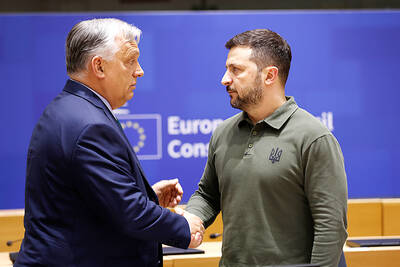
Hungarian authorities temporarily detained seven Ukrainian citizens and seized two armored cars carrying tens of millions of euros in cash across Hungary on suspicion of money laundering, officials said on Friday. The Ukrainians were released on Friday, following their detention on Thursday, but Hungarian officials held onto the cash, prompting Ukraine to accuse Hungary’s Russia-friendly government of illegally seizing the money. “We will not tolerate this state banditism,” Ukrainian Minister of Foreign Affairs Andrii Sybiha said. The seven detained Ukrainians were employees of the Ukrainian state-owned Oschadbank, who were traveling in the two armored cars that were carrying the money between Austria and
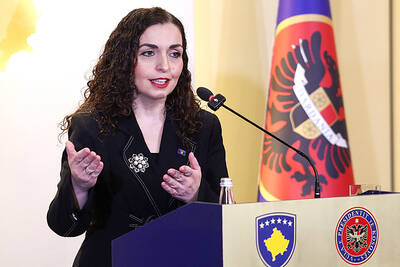
Kosovar President Vjosa Osmani on Friday after dissolving the Kosovar parliament said a snap election should be held as soon as possible to avoid another prolonged political crisis in the Balkan country at a time of global turmoil. Osmani said it is important for Kosovo to wrap up the upcoming election process and form functional institutions for political stability as the war rages in the Middle East. “Precisely because the geopolitical situation is that complex, it is important to finish this electoral process which is coming up,” she said. “It is very hard now to imagine what will happen next.” Kosovo, which declared

MORE BANS: Australia last year required sites to remove accounts held by under-16s, with a few countries pushing for similar action at an EU level and India considering its own ban Indonesia on Friday said it would ban social media access for children under 16, citing threats from online pornography, cyberbullying, online fraud and Internet addiction. “Accounts belonging to children under 16 on high-risk platforms will start to be deactivated, beginning with YouTube, TikTok, Facebook, Instagram, Threads, X, Bigo Live and Roblox,” Indonesian Minister of Communications and Digital Meutya Hafid said. “The government is stepping in so that parents no longer have to fight alone against the giants of the algorithm. Implementation will begin on March 28, 2026,” she said. The social media ban would be introduced in stages “until all platforms fulfill their


 RSS
RSS