


A US warship captured six suspected pirates on Saturday after a battle off the Horn of Africa — the Navy’s third direct encounter with seafaring bandits in less than two weeks.
The Navy has taken at least 21 suspected pirates since March 31 in the violence-plagued waters off Somalia and nearby regions, where US warships are part of an international anti-piracy flotilla.
A statement by the US Navy said the suspected pirates began shooting at the amphibious dock landing ship USS Ashland just before dawn about 610km off Djibouti, a small nation facing Yemen across the mouth of the Red Sea.
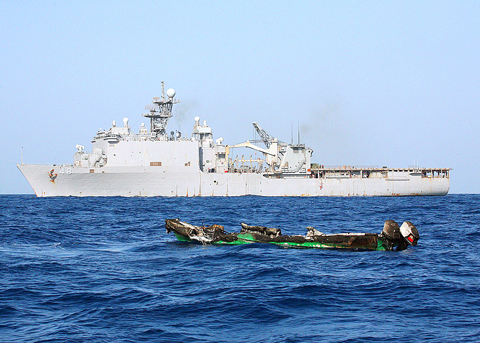
PHOTO: EPA
The Navy said the Ashland returned fire and the suspected pirate skiff was destroyed. All six people on board were rescued and taken aboard the Ashland.
The Ashland suffered no injuries or damage in the second recent attack on a US warship by suspected pirates.
On March 31, the frigate USS Nicholas exchanged fire with a suspected pirate vessel west of the Seychelles, sinking their skiff and confiscating a mother ship. Five suspected pirates were captured.
On Monday, the destroyer USS McFaul responded to the distress call from a merchant vessel and captured 10 other suspected pirates.
The Navy said it was reviewing “multiple options” on the suspects’ fates.
Some suspected pirates have been turned over to Kenya for trial, but there has been some reluctance by African countries to become a center for prosecutions. In December, the Dutch government released 13 suspected Somali pirates after the EU failed to find a country willing to prosecute them.
One of the suspected pirates accused of attacking the US-flagged merchant ship Maersk Alabama last year is facing trial in the US.
At the UN, Russia has introduced a draft resolution to the UN Security Council that calls for strengthening the international legal system to ensure captured Somali pirates do not escape punishment.
In Turkey, a news agency reported on Saturday that Somali pirates have abandoned a commandeered Turkish ship.
The Dogan agency quoted Fatih Kabal, an official of Bergen Shipping based in Istanbul, as saying the pirates left the MV Yasin C, which was seized on Wednesday 400km off the Kenyan coast.
Kabal said the crew had locked themselves in the engine room and realized that the pirates had left the ship on Friday.
He said crew members, who were unharmed, took the damaged ship to the Kenyan port of Mombasa.
Somali pirates have been known to give up on ships they believe have no ransom value, such as vessels owned or hired by Somali traders.
Meanwhile, the owner of a hijacked supertanker has begun negotiations for the ship’s release, a South Korean Foreign Ministry official said on condition of anonymity, citing the sensitivity of the talks. Repeated calls to the vessel operator, South Korea-based Samho Shipping, seeking comment went unanswered on Saturday night.
The vessel is owned by a Singaporean company.
A South Korean naval destroyer that had been monitoring the ship began sailing away from the pirates on Saturday and heading back toward the Gulf of Aden after the pirates warned the sailors not to come any closer.
Authorities say Somali pirates hijacked the 300,000-tonne Samho Dream in the Indian Ocean on April 4.
The ship was transporting about US$160 million of crude oil from Iraq to the US with a crew of 24 South Koreans and Filipinos.
More than a dozen ships and their crew are believed to be currently held by pirates off the lawless coast of Somalia.

SPEAKING OUT: After Siranudh Scott’s allegations surfaced, celebrities and public figures took to social media to share their own experiences of sexual misconduct and abuse A high-profile alleged sexual abuse case within a wealthy Thai beer brewing family has prompted a wave of painful accounts from survivors of unconnected abuse in the conservative nation. Siranudh Scott, a member of the billionaire Thai family that founded the ubiquitous Singha beer brand, posted an emotional video this month accusing his elder brother Sunit of repeatedly abusing him when he was a teenager. Sunit, who is in his 30s, later denied the allegations in a video posted online, but Singha parent Boonrawd dismissed him from his executive role with the company on Tuesday last week. “I felt I needed to speak

SEEKING ORDER: Rodrigo Paz said that ‘anyone who wants to destroy the nation will have to deal with this president and the full force of the constitution’ Bolivian President Rodrigo Paz on Wednesday said that the nation was at a “breaking point” after nearly a month of protests that have caused shortages of food, fuel and medicine. Paz, who took office six months ago amid the worst economic crisis there in four decades, is battling a groundswell of fury over his policies. The political capital, La Paz, has been besieged by low-income workers and members of the indigenous majority calling for his resignation. “The country needs order and is reaching breaking point,” the 58-year-old said at a public event in La Paz, renewing his appeal for dialogue. On Tuesday, the Bolivian

COMMUNITY CONFLICT: Concerns about disease spread from corpses has run up against friends and families’ desire to bury their dead as infection spreads in the area Angry residents of a town at the epicenter of the Ebola outbreak in the Democratic Republic of the Congo (DR Congo) attacked and burned a tent that was part of a health center where people are being treated for the virus, the staff there said Saturday. It was the second such attack in the region in a week. No one was hurt in the attack, according to reports but as patients ran out to escape the fire, 18 people with suspected Ebola infections fled the facility and are unaccounted for, a hospital director said. Angry residents arrived at the clinic in the

Forecasters in Europe yesterday warned of exceptional heat as record temperatures driven by a “heat dome” push temperatures well above seasonal norms across the continent. The surge follows a record-breaking Monday, with France logging its hottest day in the month of May on record, its weather agency said, and the UK also posting unprecedented highs. A so-called “heat dome” of warm air from northern Africa trapped under a high-pressure system over western Europe is behind the high temperatures not usually seen until high summer. Restrictions on outdoor work were imposed in parts of Italy, beaches in southwest France filled earlier than usual and


 RSS
RSS