


While a populist street movement paints Bangkok red, the army has been quietly acting its own role and will be pivotal to determining how the crisis plays out, analysts say.
Experts differ on who will win the political battle pitting Oxford-educated Thai Prime Minister Abhisit Vejjajiva against the “Red Shirts” loyal to his ousted billionaire predecessor, Thaksin Shinawatra.
But they agree that some of the real power play is taking place behind closed doors.
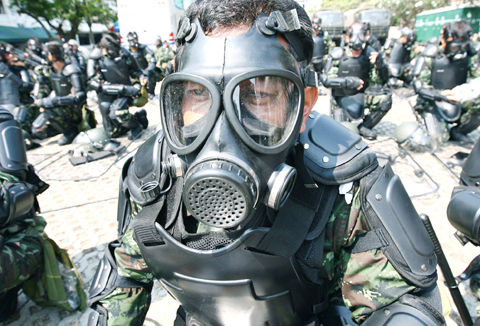
PHOTO: EPA
The army, responsible for no fewer than 18 coups or attempted coups since 1932, overthrew Thaksin in September 2006 and appointed a general to head an interim government, which created a new constitution during its year in power.
Thaksin’s allies took office in 2007 elections, but were hounded by a series of lawsuits and a vocal protest movement. They were toppled by court rulings in 2008 that saw Abhisit come to power through a parliamentary vote.
The coup still looms large over the political stage, said Thongchai Winichakul, a Thai analyst at the University of Wisconsin-Madison in the US.
“The 2006 coup has let the genie out of the bottle,” said Thongchai, arguing that the country’s establishment had asked the army to step in and restore order. “Of course they didn’t turn down the invitation to power.”
The Red Shirts have argued that former prime minister Prem Tinsulanonda, who is now the chief adviser to Thailand’s revered King Bhumibol Adulyadej, masterminded the putsch.
The monarch has been a stabilizing force during six politically turbulent decades on the throne, but he has kept out of the current crisis.
Observers now say Abhisit and his fragile coalition government survive only with the support of the army and its chief, General Anupong Paojinda.
The current army leadership “and [Abhisit’s] Democrats are both adamantly anti-Thaksin,” said Paul Chambers, a Thailand expert at Germany’s Heidelberg University.
“The former currently dominates the armed forces, the latter the ruling coalition. It is thus in their mutual interests to remain together,” he said.
The military was widely seen as being behind Abhisit’s sudden decision on Sunday to agree to televised talks with the Red Shirts, after previously refusing all negotiation until they left the streets.
And many believe the army must have agreed to Abhisit’s offer — rejected by the Red Shirts — to call elections a year early, at the end of this year.
If the polls were held even earlier it might upset a transition of power in the army, with Anupong due to retire in October.
He is pushing his No. 2, General Prayuth Chan-ocha, to succeed him but — despite the army’s clout — the appointment must be signed off by the government.
So it would have been “extremely unusual” if an election date was discussed for before the Oct. 1 military reshuffle, said Chris Baker, a Bangkok-based Thailand expert and biographer of Thaksin.
In recent months, Thai media have pored over signs of splits within army ranks and ruminated over persistent rumors of a fresh coup being plotted in the background.
But Chambers said the military was likely to keep up the pressure in private rather than stage another coup, allowing the country to maintain a “veneer of electoral democracy.”
“It is more convenient to allow an elected prime minister to face potential public scorn while the armed forces reap the rewards of enhanced prerogatives behind the scenes,” Chambers said.
Analyst Thongchai believes it is now up to Thai society to reject the army’s pre-eminent role in politics. Otherwise the military genies look likely to remain.
Only when “society no longer seeks a quick but false fix of political problems, but lets the democratic process and rule of law run its course, will they return to the bottle,” he said.
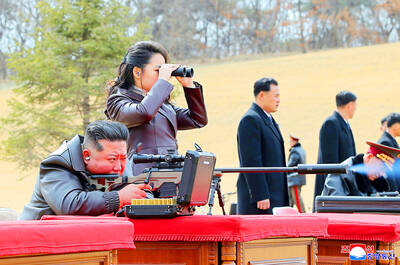
LIKE FATHER, LIKE DAUGHTER: By showing Ju-ae’s ability to handle a weapon, the photos ‘suggest she is indeed receiving training as a successor,’ an academic said North Korea on Saturday released a rare image of leader Kim Jong-un’s teenage daughter firing a rifle at a shooting range, adding to speculation that she is being groomed as his successor. Kim’s daughter, Ju-ae, has long been seen as the next in line to rule the secretive, nuclear-armed state, and took part in a string of recent high-profile outings, including last week’s military parade marking the closing stages of North Korea’s key party congress. Pyongyang’s official Korean Central News Agency (KCNA) released a photo of Ju-ae shooting a rifle at an outdoor shooting range, peering through a rifle scope
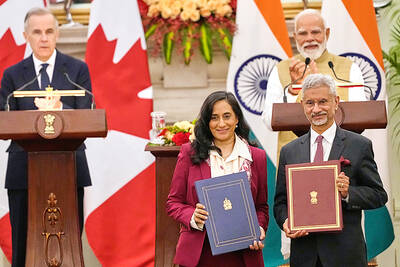
India and Canada yesterday reached a string of agreements, including on critical mineral cooperation and a “landmark” uranium supply deal for nuclear power, the countries’ leaders said in New Delhi. The pacts, which also covered technology and promoting the use of renewable energy, were announced after Indian Prime Minister Narendra Modi and Canadian Prime Minister Mark Carney hailed a fresh start in the relationship between their nations. “Our ties have seen a new energy, mutual trust and positivity,” Modi said. Carney’s visit is a key step forward in ties that effectively collapsed in 2023 after Ottawa accused New Delhi

Gaza is rapidly running out of its limited fuel supply and stocks of food staples might become tight, officials said, after Israel blocked the entry of fuel and goods into the war-shattered territory, citing fighting with Iran. The Israeli military closed all Gaza border crossings on Saturday after announcing airstrikes on Iran carried out jointly with the US. Israeli authorities late on Monday night said that they would reopen the Kerem Shalom crossing from Israel to Gaza yesterday, for “gradual entry of humanitarian aid” into the strip, without saying how much. Israeli authorities previously said the crossings could not be operated safely during
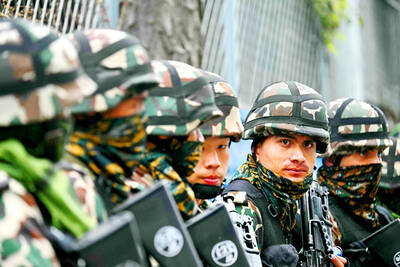
Counting was under way in Nepal yesterday, after a high-stakes parliamentary election to reshape the country’s leadership following protests last year that toppled the government. Key figures vying for power include former Nepalese prime minister K. P. Sharma Oli, rapper-turned-mayor Balendra Shah, who is bidding for the youth vote, and newly elected Nepali Congress party leader Gagan Thapa. In Kathmandu’s tea shops and city squares, people were glued to their phones, checking results as early trends flashed up — suggesting Shah’s centrist Rastriya Swatantra Party (RSP) was ahead. Nepalese Election Commission spokesman Prakash Nyupane said the counting was ongoing “in a peaceful manner”


 RSS
RSS