


Erod holds onto the bars of his cot and smiles, oblivious to his own amazing survival story 10 weeks after being left to die in a mound of stinking garbage following Haiti’s earthquake.
Found in a chronically malnourished state, the 18-month-old boy was taken to a hospital in the Port-au-Prince slum of Cite Soleil where Doctors Without Borders (MSF) returned to run things after the Jan. 12 quake.
Weeks of intensive care meant the determined 18-month old clung to life against the odds in the nation with the highest infant mortality rate in the Western Hemisphere.
“At the moment, we are looking for a place for him so he can leave the hospital, but we don’t know where,” said Emmanuel Massart, a 28-year-old nurse from Belgium.
In a staggeringly poor country where an astonishing 40 percent of the population is under 14 and almost one in 10 children die before they are five, the future of the little survivor is very uncertain.
Like Erod, who has half a finger missing on his right hand and a blotchy hairless scalp because of the months of starvation that nearly killed him, many babies are abandoned by families who can’t cope with an extra mouth to feed.
Erod grasped the nurse’s thumb and then uncurled it with his tiny hand, smiling with bright eyes that suddenly let loose a stream of tears the moment he was placed back in his cot, alone.
Leaving soon for a public refuge to hopefully be adopted, Erod is not the main concern of doctor Manuel Dewez, whose ward is full of suspected cases of meningitis, malaria and gastroenteritis.
“Here is a little baby,” Dewez said, his understatement only clear when he pulled back the curtain.
A tiny, tiny face peered out from a bundle of swaddling cloths, eyes blinking, the hint of a smile.
This was the newest addition to the ward, Bechina, a boy born two or three months prematurely and weighing an astonishing 1kg.
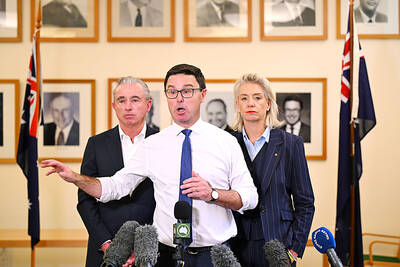
BACKLASH: The National Party quit its decades-long partnership with the Liberal Party after their election loss to center-left Labor, which won a historic third term Australia’s National Party has split from its conservative coalition partner of more than 60 years, the Liberal Party, citing policy differences over renewable energy and after a resounding loss at a national election this month. “Its time to have a break,” Nationals leader David Littleproud told reporters yesterday. The split shows the pressure on Australia’s conservative parties after Prime Minister Anthony Albanese’s center-left Labor party won a historic second term in the May 3 election, powered by a voter backlash against US President Donald Trump’s policies. Under the long-standing partnership in state and federal politics, the Liberal and National coalition had shared power
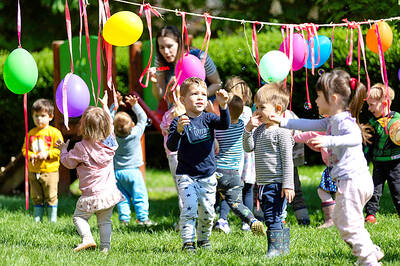
A Croatian town has come up with a novel solution to solve the issue of working parents when there are no public childcare spaces available: pay grandparents to do it. Samobor, near the capital, Zagreb, has become the first in the country to run a “Grandmother-Grandfather Service,” which pays 360 euros (US$400) a month per child. The scheme allows grandparents to top up their pension, but the authorities also hope it will boost family ties and tackle social isolation as the population ages. “The benefits are multiple,” Samobor Mayor Petra Skrobot told reporters. “Pensions are rather low and for parents it is sometimes

CONTROVERSY: During the performance of Israel’s entrant Yuval Raphael’s song ‘New Day Will Rise,’ loud whistles were heard and two people tried to get on stage Austria’s JJ yesterday won the Eurovision Song Contest, with his operatic song Wasted Love triumphing at the world’s biggest live music television event. After votes from national juries around Europe and viewers from across the continent and beyond, JJ gave Austria its first victory since bearded drag performer Conchita Wurst’s 2014 triumph. After the nail-biting drama as the votes were revealed running into yesterday morning, Austria finished with 436 points, ahead of Israel — whose participation drew protests — on 357 and Estonia on 356. “Thank you to you, Europe, for making my dreams come true,” 24-year-old countertenor JJ, whose
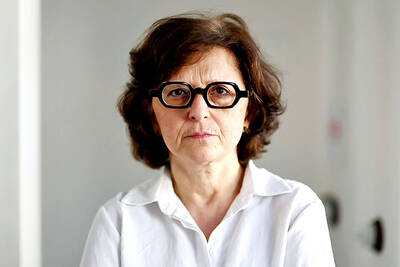
A documentary whose main subject, 25-year-old photojournalist Fatima Hassouna, was killed in an Israeli airstrike in Gaza weeks before it premiered at Cannes stunned viewers into silence at the festival on Thursday. As the cinema lights came back on, filmmaker Sepideh Farsi held up an image of the young Palestinian woman killed with younger siblings on April 16, and encouraged the audience to stand up and clap to pay tribute. “To kill a child, to kill a photographer is unacceptable,” Farsi said. “There are still children to save. It must be done fast,” the exiled Iranian filmmaker added. With Israel


 RSS
RSS