


The arrests of an opposition politician and the owner of a television network for statements critical of the government of President Hugo Chavez have rekindled debate over freedom of speech and democracy in Venezuela.
Chavez supporters deny that the president’s critics are being persecuted, but others see the latest developments as a concerted attempt to silence opposition voices.
“Having an opinion in Venezuela is a crime punished with the loss of freedom. We reject everything that restricts freedom of expression in the country, and the witch hunts against those who assume dissident positions,” said Juan Jose Molina, an opposition member of the National Assembly.
On Monday, authorities arrested Oswaldo Alvarez Paz, a former opposition governor and presidential candidate who claimed on television that Venezuela has become a center of operations facilitating drug trafficking.
On Thursday, the president of Globovision, Guillermo Zuloaga, was arrested for statements he made in the Dutch island of Aruba. He was charged with the crime of spreading false information.
“These are not isolated events. It’s all intended to foster self-censorship, intimidation and the fear to freely express oneself,” several former governors said in a statement published in the press.
In both arrests, the request for investigations emanated from the National Assembly, which is dominated by pro-Chavez parties and faces September elections.
“The freedom of the legislative branch is non-existent and the National Assembly is being used by the executive to legitimize anti-democratic actions,” said Molina.
“It is the arm for carrying out the persecution of citizens. We are dismayed because the democratic rationale has been lost,” he added.
Nevertheless, the head of the assembly’s science, technology and communications committee, Manuel Villalba, said the owner of a media outlet does not have carte blanche to say anything he wants.
“This is a government that fully guarantees freedom of expression,” he said. “You can express your opinion but you also have to be aware that these opinions carry responsibilities.”
Defending herself against accusations of political persecution, Attorney General Luisa Ortega said that in Venezuela people are tried “for the crimes they allegedly committed without any distinction being made for political militancy.”
Various Venezuelan opposition leaders believe that the arrests are a reflection of the government’s weakness as it approaches legislative elections on Sept. 26.
According to reliable polls, Chavez’ popularity has fallen several points since January.
The government “knows that the citizens hold the president responsible for power outages, insecurity, cuts in water, and that’s why they think that with these acts of intimidation they will succeed in silencing the democratic leadership,” opposition Copei party leader Luis Ignacio Planas said.
“What these actions ... show is that they know they are in the minority and they attack democrats to generate a climate of hopelessness so that citizens won’t turn out to vote,” the opposition party Un Nuevo Tiempo said in a statement.
Outside Venezuela, the arrests were greeted with unease.
In a statement, the Inter-American Commission on Human Rights expressed concern over “the lack of independence of the judicial branch” in Venezuela and “the use of the criminal justice system to punish critical expressions.”
The US State Department on Wednesday said it was “seriously concerned” about Alvarez Paz’s arrest, calling it “the latest example of [the Chavez administration’s] continuing assault on freedom of expression.”
The Venezuelan government responded Thursday night with a diplomatic note protesting US “interference.” Venezuelan Foreign Minister Nicolas Maduro on Friday also rejected the criticism of the Inter-American Commission on Human Rights.
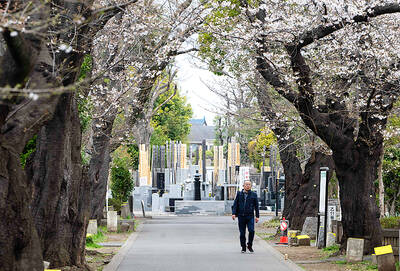
ROCKY RELATIONS: The figures on residents come as Chinese tourist numbers drop following Beijing’s warnings to avoid traveling to Japan The number of Chinese residents in Japan has continued to rise, even as ties between the two countries have become increasingly fractious, data released on Friday showed. As of the end of December last year, the number of Chinese residents had increased by 6.5 percent from the previous year to 930,428. Chinese people accounted for 22.6 percent of all foreign residents in Japan, making them by far the largest group, Japanese Ministry of Justice data showed. Beijing has criticized Tokyo in increasingly strident terms since Japanese Prime Minister Sanae Takaichi last year suggested that a military conflict around Taiwan could

A retired US colonel behind a privately financed rocket launch site in the Dominican Republic sees the project as a response to China’s dominance of the space race in Latin America. Florida-based Launch on Demand is slated to begin building a US$600 million facility in a remote region near the border with Haiti late this year. The project is designed to meet surging demand for the heavy-lift rockets needed to put clusters of satellites into orbit. It is also an answer to China’s growing presence in the region, said CEO Burton Catledge, a former commander of the US Air Force’s 45th Operations

Germany is considering Australia’s Ghost Bat robot fighter as it looks to select a combat drone to modernize its air force, German Minister of Defense Boris Pistorius said yesterday. Germany has said it wants to field hundreds of uncrewed fighter jets by 2029, and would make a decision soon as it considers a range of German, European and US projects developing so-called “collaborative combat aircraft.” Australia has said it will integrate the Ghost Bat, jointly developed by Boeing Australia and the Royal Australian Air Force, into its military after a successful weapons test last year. After inspecting the Ghost Bat in Queensland yesterday,
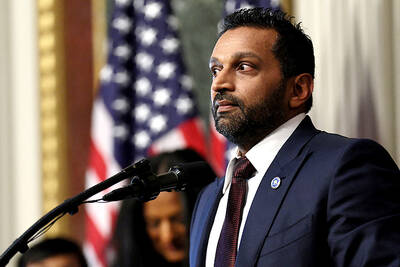
A pro-Iran hacking group claimed to breach FBI Director Kash Patel’s personal e-mail inbox and posted some of the contents online. The e-mails provided by the hacking group include travel details, correspondence with leasing agents in Washington and global entry, and loyalty account numbers. The e-mail address the hackers claim to have compromised has been previously tied to Patel’s personal details, and the leaked e-mails contain photos of Patel and others, in addition to correspondence with family members and colleagues. “The FBI is aware of malicious actors targeting Director Patel’s personal email information,” the agency said in a statement on


 RSS
RSS