


Democratic leaders appeared confident they had the votes needed to pass the landmark legislation yesterday, a day after US President Barack Obama called on them to make history by bringing health insurance to millions of struggling families.
On Saturday, Democratic leaders frenetically hunted for votes inside the Capitol as angry protesters gathered outside with some hurling racial insults at black members of Congress.
Obama can rely only on Democrats to gain passage of his top domestic priority in a make-or-break vote for his presidency. He faces unanimous opposition from Republicans, who say the plan amounts to a government takeover of health care that will lead to higher deficits and taxes. Some moderate House Democrats are also wary about the plan’s costs and abortion provisions.
“I know this is a tough vote,” the president told House Democrats at a meeting on Capitol Hill, adding that he also believed “it will end up being the smart thing to do politically.”
“It is in your hands,” Obama said, bringing lawmakers to their feet. “It is time to pass health care reform for America and I am confident that you are going to do it tomorrow.”
The US is alone among developed nations in not offering its citizens comprehensive health care, with nearly 50 million Americans uninsured.
Although the bill before Congress does not provide universal health care, it should expand coverage to about 95 percent of Americans. It would require most Americans to carry insurance with subsidies for those who can’t afford it, expand the government-run Medicaid program for the poor and create new places to buy health care.
Even so, the reform is likely to be judged alongside the boldest acts of presidents and Congress in domestic affairs. While national health care has long been a goal of politicians and presidents stretching back decades, it has proved elusive, in part because self-reliance and suspicion of a strong central government remain strong in the US.
It may still elude Obama, too. A series of last-minute flare-ups threatened to slow the Democrats’ march to passage after more than a year of grueling effort and a turbulent debate that has left the country deeply divided.
The most intense focus was on a small group of Democrats concerned that abortion funding restrictions in the legislation did not go far enough. Determined to avoid votes on such a charged issue, Democratic leaders raised the possibility of an executive order from Obama that reaffirms existing federal law barring taxpayer-funded abortions except in cases of rape, incest or to save the life of the mother.
House Democratic leaders abandoned a much-challenged procedure for passing the legislation after an outcry from Republicans and protest from some of their members. According to the new plan, the House will vote separately on the health care bill passed by the Senate on Christmas Eve as well as a package of changes.
The Senate bill would then go to Obama for his signature, the companion fix-it measure to the Senate, which hopes to pass it within the week under a procedure called reconciliation that requires only 50 votes in the 100-member body.
The parliamentary maneuvers became necessary after January’s special election in Massachusetts when a Republican won the seat held for decades by the late senator Edward Kennedy, a champion of health care reform. That deprived the Democrats of their 60-vote Senate supermajority required to block Republican legislative delaying maneuvers.
The 10-year, US$940 billion measure represents the biggest expansion of the social safety net since Medicare and Medicaid were enacted in the 1960s to provide government-funded health care coverage to the elderly and poor.
The sweeping legislation, affecting virtually every American and impacting one-sixth of the US economy, provides health coverage to 32 million people now uninsured, bars insurance companies from denying coverage to those in poor health and sets up new marketplaces where self-employed people and small businesses can pool together to buy coverage.

SPEAKING OUT: After Siranudh Scott’s allegations surfaced, celebrities and public figures took to social media to share their own experiences of sexual misconduct and abuse A high-profile alleged sexual abuse case within a wealthy Thai beer brewing family has prompted a wave of painful accounts from survivors of unconnected abuse in the conservative nation. Siranudh Scott, a member of the billionaire Thai family that founded the ubiquitous Singha beer brand, posted an emotional video this month accusing his elder brother Sunit of repeatedly abusing him when he was a teenager. Sunit, who is in his 30s, later denied the allegations in a video posted online, but Singha parent Boonrawd dismissed him from his executive role with the company on Tuesday last week. “I felt I needed to speak

SEEKING ORDER: Rodrigo Paz said that ‘anyone who wants to destroy the nation will have to deal with this president and the full force of the constitution’ Bolivian President Rodrigo Paz on Wednesday said that the nation was at a “breaking point” after nearly a month of protests that have caused shortages of food, fuel and medicine. Paz, who took office six months ago amid the worst economic crisis there in four decades, is battling a groundswell of fury over his policies. The political capital, La Paz, has been besieged by low-income workers and members of the indigenous majority calling for his resignation. “The country needs order and is reaching breaking point,” the 58-year-old said at a public event in La Paz, renewing his appeal for dialogue. On Tuesday, the Bolivian

A Hong Kong astronaut is to join a Chinese space mission for the first time as part of a three-person crew launching today, as Beijing edges closer to its goal of landing people on the moon. The Tiangong space station — crewed by teams of three astronauts that are typically rotated every six months — is the crown jewel of China’s space program, boosted by billions in state investment in a bid to catch up with the US and Russia. The Shenzhou-23 mission is to blast off at 11:08pm from the Jiuquan Satellite Launch Center in northwestern China, carrying three astronauts to
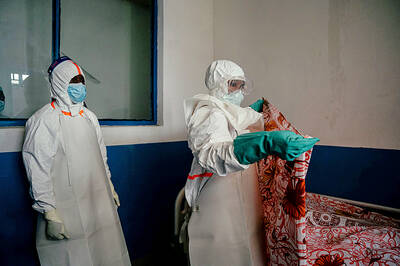
UPGRADED ALERT: The risk inside DR Congo is now considered ‘very high,’ while neighboring countries face a ‘high’ threat as the outbreak continues, the WHO said Ebola is spreading faster than responders can track it in eastern Congo, where health workers managed to follow up with barely one in five identified contacts in a single day. Authorities in the Democratic Republic of the Congo (DR Congo) reported 83 confirmed infections, 746 suspected cases and 1,603 identified contacts as of Thursday, but health workers were able to follow up on only 342 contacts that day — about 21 percent of the total under monitoring — data released by the DR Congo Ministry of Public Health on Friday showed. The figures suggest the response is falling behind the outbreak itself,


 RSS
RSS