


Thailand was mired in political deadlock yesterday as demonstrators used their own blood to create a giant piece of protest art after refusing talks with the government.
Buoyed by a huge parade a day earlier, the defiant “Red Shirts” painted and wrote poems on white canvas with the remains of the blood donated by supporters and splattered on the prime minister’s house and offices in the past week.
“People of the next generation will know that the older generation would sacrifice everything, including their blood,” Red Shirt poet Visa Kantab told the cheering crowd from the main rally stage in Bangkok’s old quarter.
“After we are victorious, we will frame it as evidence of history,” he said before the artwork was displayed to protesters, who are calling for parliament’s dissolution and immediate elections.
The Red Shirts back ousted Thai prime minister Thaksin Shinawatra and say the current government is illegitimate, as it came to power with army backing via a December 2008 parliamentary vote after a controversial court ruling removed his allies.
In what they have increasingly dubbed a “class war,” the mainly poor and rural Reds say they are fighting Thailand’s elite in bureaucratic, military and palace circles, whom they accuse of ousting elected governments.
Saturday’s carnival-like protests, that swelled to 65,000 people, aimed to recruit urban support and revive their waning rally demanding the dissolution of parliament and immediate elections.
A few hours after the peaceful parade, two small explosions hit Bangkok and a nearby province, targeting a new National Counter Corruption Commission office and a road near the defense ministry.
It was not clear who was behind the late-night attacks, in which one person suffered minor wounds, police said.
Thaksin, who lives in exile to avoid a jail term for corruption, spoke to supporters via a video link on Saturday night, thanking those who took part in the parade.
“I’m really proud of you. I almost cried,” he said.
“Today I want to invite everyone to join us to call for democracy. You don’t have to wear red, but just have one ideology — democracy,” said Thaksin, who was deposed in a coup in 2006.
Earlier, Thai Prime Minister Abhisit Vejjajiva said the demonstrators had agreed to send two senior Red Shirts to meet one of his ministers and a government official, but after their colorful convoy returned to the main rally site, the Red Shirts stuck to their demands for a snap poll.
Abhisit, who has spent most of the rally holed up in an army barracks, said he would not meet protesters immediately.
“They can talk to me, but before reaching that step, they must meet representatives to talk about the outline of talks,” he said on his weekly television program. “If [the Red Shirts] come it means they are interested in democracy. If not, they are following what Thaksin wants them to do.”
A 50,000-strong security force has been in place in Bangkok and surrounding areas during the protests under a strict security law, which is in place until tomorrow, but may be extended until a later date if the rally goes on, Abhisit said.

Australians were downloading virtual private networks (VPNs) in droves, while one of the world’s largest porn distributors said it was blocking users from its platforms as the country yesterday rolled out sweeping online age restriction. Australia in December became the first country to impose a nationwide ban on teenagers using social media. A separate law now requires artificial intelligence (AI)-powered chatbot services to keep certain content — including pornography, extreme violence and self-harm and eating disorder material — from minors or face fines of up to A$49.5 million (US$34.6 million). The country also joined Britain, France and dozens of US states requiring
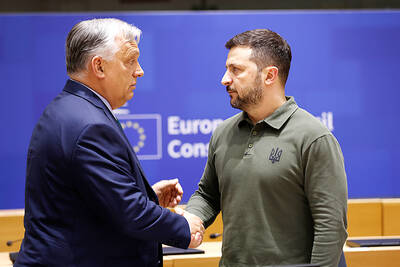
Hungarian authorities temporarily detained seven Ukrainian citizens and seized two armored cars carrying tens of millions of euros in cash across Hungary on suspicion of money laundering, officials said on Friday. The Ukrainians were released on Friday, following their detention on Thursday, but Hungarian officials held onto the cash, prompting Ukraine to accuse Hungary’s Russia-friendly government of illegally seizing the money. “We will not tolerate this state banditism,” Ukrainian Minister of Foreign Affairs Andrii Sybiha said. The seven detained Ukrainians were employees of the Ukrainian state-owned Oschadbank, who were traveling in the two armored cars that were carrying the money between Austria and
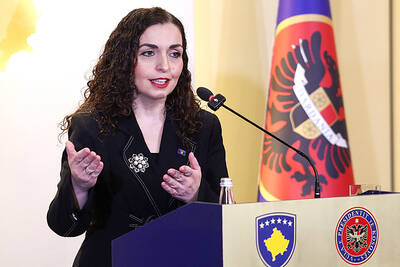
Kosovar President Vjosa Osmani on Friday after dissolving the Kosovar parliament said a snap election should be held as soon as possible to avoid another prolonged political crisis in the Balkan country at a time of global turmoil. Osmani said it is important for Kosovo to wrap up the upcoming election process and form functional institutions for political stability as the war rages in the Middle East. “Precisely because the geopolitical situation is that complex, it is important to finish this electoral process which is coming up,” she said. “It is very hard now to imagine what will happen next.” Kosovo, which declared

MORE BANS: Australia last year required sites to remove accounts held by under-16s, with a few countries pushing for similar action at an EU level and India considering its own ban Indonesia on Friday said it would ban social media access for children under 16, citing threats from online pornography, cyberbullying, online fraud and Internet addiction. “Accounts belonging to children under 16 on high-risk platforms will start to be deactivated, beginning with YouTube, TikTok, Facebook, Instagram, Threads, X, Bigo Live and Roblox,” Indonesian Minister of Communications and Digital Meutya Hafid said. “The government is stepping in so that parents no longer have to fight alone against the giants of the algorithm. Implementation will begin on March 28, 2026,” she said. The social media ban would be introduced in stages “until all platforms fulfill their


 RSS
RSS