


A federal judge on Friday rejected a legal settlement that would have given at least US$575 million to people sickened by ash and dust from the World Trade Center, saying the deal shortchanged 10,000 ground zero workers whom he called heroes.
“In my judgment, this settlement is not enough,” said US District Judge Alvin Hellerstein, who delivered his pronouncement to a stunned gallery at a federal courthouse in Manhattan.
Rising from his chair, the 76-year-old jurist said he feared police officers, firefighters and other laborers who cleared rubble after the Sept. 11, 2001, terror attacks were being pushed into signing a deal few of them understood.
Under the terms of the settlement, workers had been given just 90 days to say yes or no to a deal that would have assigned them payments based on a point system that Hellerstein said was complicated enough to make a Talmudic scholar’s head spin.
“I will not preside over a settlement that is based on fear or ignorance,” he said.
Of the proposed settlement of US$575 million to US$657 million, workers stood to get amounts ranging from a few thousand dollars to more than US$1 million.
LEGAL FEES
Hellerstein said the deal should be richer. Too much of it would be eaten up by legal fees, he said.
A third or more of the money set aside for the workers was expected to go to their lawyers. Some plaintiffs had agreed at the start of the case to give as much as 40 percent of any judgment to cover fees and expenses. That might have meant US$200 million or more going to attorneys.
Hellerstein, who presides over all federal court litigation related to the terror attacks, ripped into the agreement after hearing several ground zero responders speak tearfully of their illnesses and after receiving letters and phone calls from others expressing confusion about the deal. He said he was speaking “from the heart” out of great compassion for the thousands of men and women who spent time at ground zero.
It wasn’t immediately clear whether the judge’s actions would kill the settlement entirely.
The deal had taken years to negotiate and was announced on March 11, with about two months to go until the first trials.
A spokeswoman for the law partnership that negotiated the settlement on behalf of the workers said she had no comment on the judge’s remarks.
Christine LaSala, president of the WTC Captive Insurance Co, a special insurance entity created by Congress to represent the city in the lawsuit, said the judge “has now made it more difficult, if not impossible, for the people bringing these claims to obtain compensation and a settlement.”
She said the lawyers would confer with city officials and “try to find a way forward.”
New York City’s chief lawyer, Michael Cardozo, said: “We have great respect for Judge Hellerstein and will consider his comments, but his reaction to the settlement will make it extremely difficult to resolve these cases.”
PROPOSALS
Hellerstein laid out a number of proposed fixes for what he saw as deficiencies in the settlement and told the two sides to resume negotiations.
He rejected the idea that a third or more of the money should go to the plaintiffs’ lawyers and said the legal fees should be paid by the WTC Captive, not the workers.
Hellerstein said workers should have ample opportunities to ask questions and get answers about the settlement, and he offered to go on a mini-speaking tour to get information to the plaintiffs.
“I will make myself available in union halls, fire department houses, police precincts and schools,” Hellerstein said.
He said more money should be set aside for people who later develop cancer that may be linked to ground zero toxins. He said he wanted to retain ultimate control over which workers were entitled to have claims paid.
Hellerstein acknowledged that he felt a personal connection to the case, calling it “the greatest burden in my life,” but insisted that his unusual intervention was legally and morally necessary, given the importance of the Sept. 11 attacks to the country.
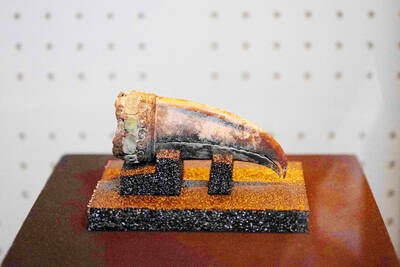
Archeologists in Peru on Thursday said they found the 5,000-year-old remains of a noblewoman at the sacred city of Caral, revealing the important role played by women in the oldest center of civilization in the Americas. “What has been discovered corresponds to a woman who apparently had elevated status, an elite woman,” archeologist David Palomino said. The mummy was found in Aspero, a sacred site within the city of Caral that was a garbage dump for more than 30 years until becoming an archeological site in the 1990s. Palomino said the carefully preserved remains, dating to 3,000BC, contained skin, part of the

TRUMP EFFECT: The win capped one of the most dramatic turnarounds in Canadian political history after the Conservatives had led the Liberals by more than 20 points Canadian Prime Minister Mark Carney yesterday pledged to win US President Donald Trump’s trade war after winning Canada’s election and leading his Liberal Party to another term in power. Following a campaign dominated by Trump’s tariffs and annexation threats, Carney promised to chart “a new path forward” in a world “fundamentally changed” by a US that is newly hostile to free trade. “We are over the shock of the American betrayal, but we should never forget the lessons,” said Carney, who led the central banks of Canada and the UK before entering politics earlier this year. “We will win this trade war and
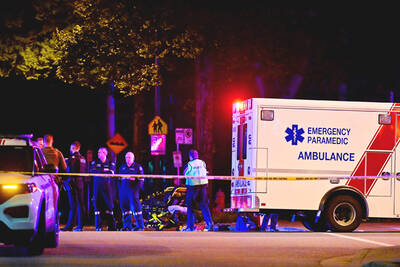
‘BODIES EVERYWHERE’: The incident occurred at a Filipino festival celebrating an anti-colonial leader, with the driver described as a ‘lone suspect’ known to police Canadian police arrested a man on Saturday after a car plowed into a street party in the western Canadian city of Vancouver, killing a number of people. Authorities said the incident happened shortly after 8pm in Vancouver’s Sunset on Fraser neighborhood as members of the Filipino community gathered to celebrate Lapu Lapu Day. The festival, which commemorates a Filipino anti-colonial leader from the 16th century, falls this year on the weekend before Canada’s election. A 30-year-old local man was arrested at the scene, Vancouver police wrote on X. The driver was a “lone suspect” known to police, a police spokesperson told journalists at the
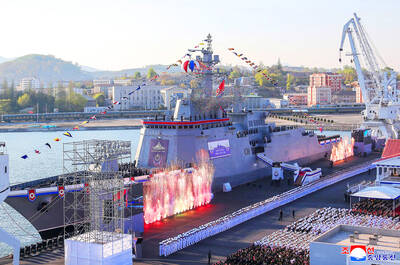
North Korean leader Kim Jong-un has unveiled a new naval destroyer, claiming it as a significant advancement toward his goal of expanding the operational range and preemptive strike capabilities of his nuclear-armed military, state media said yesterday. North Korea’s state-run Korean Central News Agency (KCNA) said Kim attended the launching ceremony for the 5,000-tonne warship on Friday at the western port of Nampo. Kim framed the arms buildup as a response to perceived threats from the US and its allies in Asia, who have been expanding joint military exercises amid rising tensions over the North’s nuclear program. He added that the acquisition


 RSS
RSS