


The administration of US President Barack Obama said it was near an agreement with other nations to cancel the US$447 million that Haiti owes to the Inter-American Development Bank (IADB).
US Treasury Department officials said on Thursday that a deal would likely be struck this weekend to cancel Haiti’s debt to the bank, which serves as a major source of development loans for Latin America and the Caribbean.
Two senior Treasury officials briefed reporters in advance of the annual meetings of the bank, which was to begin yesterday in Cancun, Mexico. They spoke on condition of anonymity because the meetings had yet to occur.
Following the devastating earthquake that struck Haiti in January, US Treasury Secretary Timothy Geithner said the administration would seek an agreement for the cancellation of all debts owed by Haiti to international lending institutions including the IADB, the IMF and the World Bank.
Geithner won support for that drive at meetings of finance officials of the G7 major industrial countries last month in Canada.
One of the Treasury officials who briefed reporters on Thursday said that the administration was working for an agreement at the IADB meetings that would not only cancel Haiti’s IADB debt, but would also lead to Haiti receiving grants from the bank that would not have to be repaid.
The Cancun conference will be attended by representatives from Latin American and Caribbean nations as well as the US and China, two major donor countries to the Washington-based lending institution.
The US Treasury Department will be represented at the meetings by Marisa Lago, Treasury’s assistant secretary for international markets and development.
In addition to discussing debt relief for Haiti, the Cancun meetings are expected to lead to an agreement on boosting the IADB’s capital reserves, which stand now at about US$100 billion.
An advisory panel last year recommended that the IADB’s reserves be increased by up to US$178 billion to sustain annual lending of US$18 billion, but the Treasury officials would not provide a specific figure that the US was supporting.
One Treasury official said that the administration would support a “substantial” increase that would provide the resources so that the bank would be able to double the amount in loans made before the financial crisis hit in 2008.
The bank loaned an average of about US$6 billion a year before the economic meltdown and spiked to a level of US$15 billion in loan commitments last year in response to the financial crisis.
“There is a clear case for an increase that would allow the bank to effectively double its loan volume in relation to the pre-crisis loan levels,” the Treasury official said.
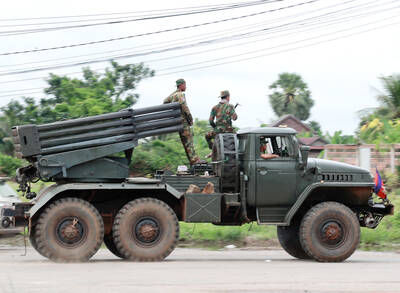
POLITICAL PATRIARCHS: Recent clashes between Thailand and Cambodia are driven by an escalating feud between rival political families, analysts say The dispute over Thailand and Cambodia’s contested border, which dates back more than a century to disagreements over colonial-era maps, has broken into conflict before. However, the most recent clashes, which erupted on Thursday, have been fueled by another factor: a bitter feud between two powerful political patriarchs. Cambodian Senate President and former prime minister Hun Sen, 72, and former Thai prime minister Thaksin Shinawatra, 76, were once such close friends that they reportedly called one another brothers. Hun Sen has, over the years, supported Thaksin’s family during their long-running power struggle with Thailand’s military. Thaksin and his sister Yingluck stayed
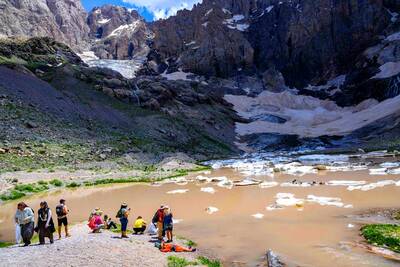
Kemal Ozdemir looked up at the bare peaks of Mount Cilo in Turkey’s Kurdish majority southeast. “There were glaciers 10 years ago,” he recalled under a cloudless sky. A mountain guide for 15 years, Ozdemir then turned toward the torrent carrying dozens of blocks of ice below a slope covered with grass and rocks — a sign of glacier loss being exacerbated by global warming. “You can see that there are quite a few pieces of glacier in the water right now ... the reason why the waterfalls flow lushly actually shows us how fast the ice is melting,” he said.

FOREST SITE: A rescue helicopter spotted the burning fuselage of the plane in a forested area, with rescue personnel saying they saw no evidence of survivors A passenger plane carrying nearly 50 people crashed yesterday in a remote spot in Russia’s far eastern region of Amur, with no immediate signs of survivors, authorities said. The aircraft, a twin-propeller Antonov-24 operated by Angara Airlines, was headed to the town of Tynda from the city of Blagoveshchensk when it disappeared from radar at about 1pm. A rescue helicopter later spotted the burning fuselage of the plane on a forested mountain slope about 16km from Tynda. Videos published by Russian investigators showed what appeared to be columns of smoke billowing from the wreckage of the plane in a dense, forested area. Rescuers in
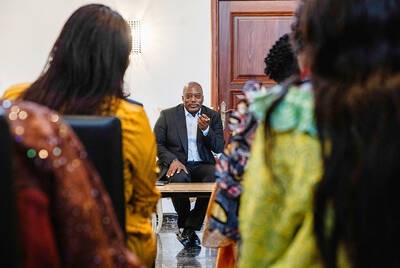
‘ARBITRARY’ CASE: Former DR Congo president Joseph Kabila has maintained his innocence and called the country’s courts an instrument of oppression Former Democratic Republic of the Congo (DR Congo) president Joseph Kabila went on trial in absentia on Friday on charges including treason over alleged support for Rwanda-backed militants, an AFP reporter at the court said. Kabila, who has lived outside the DR Congo for two years, stands accused at a military court of plotting to overthrow the government of Congolese President Felix Tshisekedi — a charge that could yield a death sentence. He also faces charges including homicide, torture and rape linked to the anti-government force M23, the charge sheet said. Other charges include “taking part in an insurrection movement,” “crime against the


 RSS
RSS