

Beijing needs to take US concerns about the value of the Chinese currency seriously, but bilateral disputes should not impede cooperation on global issues such as climate change and Iran’s nuclear program, the US ambassador to Beijing said yesterday.
Washington and other trading partners are pressing China to ease currency controls that have kept its yuan steady against the dollar for 18 months to help their companies compete amid weak global demand.
A group of US lawmakers wrote to US President Barack Obama this week urging him to press Beijing to loosen controls. The US Treasury has the option of declaring Beijing a currency manipulator in a report due out next month, which could set the stage for a complaint to the WTO and possible sanctions on Chinese goods.
“This is a real concern for people in my country,” Ambassador Jon Huntsman told students at Beijing’s elite Tsinghua University, citing high US unemployment that critics say is exacerbated by an undervalued yuan.
“Many see the trading relationship with China as a little bit out of balance, partially because of the currency issue,” he said.
Huntsman said China would be wrong to view the currency issue as merely a US complaint, with the EU and other trading partners — and even the head of the IMF — sharing such concerns.
He indicated US officials would press China hard on allowing the yuan to appreciate in upcoming trade talks, and hoped to see “more flexibility on the exchange rate.”
China denies that its currency is undervalued, although many analysts expect the government will gradually raise the yuan’s value this year while maintaining exchange rate controls.
The sharpening trade disputes come amid lingering Chinese anger over US arms sales to Taiwan and a recent meeting between Obama and Tibet’s exiled spiritual leader, the Dalai Lama.
Hard-liners in the Chinese military have argued for punishing the US by withholding cooperation on issues such as Iran and climate change.
However, Huntsman said such differences “cannot, must not, prevent the two countries from working together to create jobs, address climate change and prevent Iran from developing a nuclear weapons capability.”
“To put our relationship on a more stable and mature footing, we have to delink our differences on bilateral issues from our cooperation on global issues, including nonproliferation,” he said.
China, which relies on Iran for much of its energy needs, has so far refused to agree to new sanctions on Iran to pressure it to suspend its uranium enrichment program.
Huntsman said China has much at stake in the debate over Iran, having imported more oil from Saudi Arabia last year to fuel its booming economy than the US did.
“Tensions in the Middle East have an impact on the price of oil internationally and can adversely affect China’s development strategies,” Huntsman said.
China also needs to work with the US on establishing verifiable targets for reductions in greenhouse gas emissions ahead of the next major climate conference in Mexico in late November, he said.
“As the world’s two largest emitters of greenhouse gases, we have a responsibility to lead the way,” Huntsman said.
China has resisted setting verifiable targets for emissions reductions and was blamed by some for the failure to reach a binding agreement at last year’s Copenhagen climate change conference.
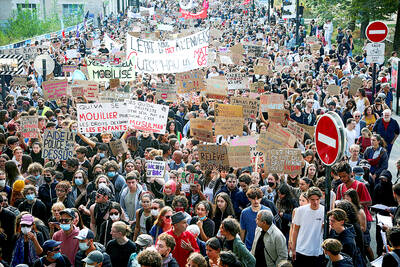
VIOLENT STANDOFFS: The government said 215 students have been injured since the start of the movement last month, including a teenager who lost a hand on Monday Thousands of demonstrators yesterday massed under heavy police surveillance in Paris and cities across France, as unions and teachers joined high-school students who for days have been demanding better conditions in protests punctuated by violent clashes. Students have blocked the entrances to hundreds of high schools for 15-to-17-year-olds since late last month, complaining of missing teachers, overloaded schedules, dilapidated classrooms and buildings that cannot cope with rising temperatures. In the Paris suburb of Creteil, where the protests started last month, students piled barriers outside the Saint-Exupery high school. “We are here to make our voice heard, all too often forgotten,” student Abderrahmane Abdelkader

As shark attack survivor Mel Ismail fought the predator that severed his leg, he noticed something odd. “I saw its eye ... a big black eye,” Ismail said. “But it was winking back at me — I was trying to get my fingers in its eye and just pushing its eye as I was being dragged.” When the shark swam off, he managed to struggle back to shore, the surfer and professional firefighter said in an Australian Broadcasting Corp interview broadcast on Thursday. He was surfing at Glenfield Beach near Geraldton on Australia’s west coast when he was attacked on Sept. 14. He
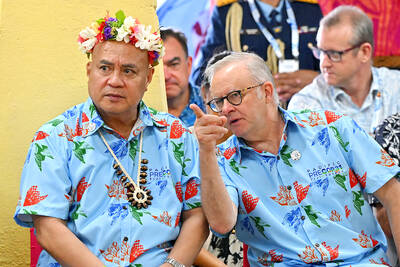
A Tuvalu government adviser yesterday said it felt like Australia had “taken over” the tiny country’s sovereignty during a visit by leaders to the Pacific island. The official — a senior government adviser who asked to remain anonymous because they were not authorized to speak to the media — said they were disappointed in Australia’s handling of the visit. The comments came during a visit by Australian Prime Minister Anthony Albanese and other leaders to Tuvalu, which has become a symbol of the existential threat posed by rising seas and is a key partner in Canberra’s Pacific strategy. “Just because we signed the

Halfway around the world from Russia, in a Caribbean tourism hot spot, men young and old are being lured by Moscow with tantalizing job offers, only to find themselves en route to the front lines in Ukraine. Moscow and Kyiv have recruited thousands of foreign nationals into their armies since Russia launched its invasion of Ukraine in 2022. Moscow is accused, in some cases, of using fake job ads to hoodwink men from deprived backgrounds in Africa, Asia and Latin America into traveling to Russia and then forcing them to fight on arrival. From countries such as India, Kenya, Equatorial Guinea, Colombia and


 RSS
RSS