

A row has erupted in South Africa after it emerged taxpayers are spending more than 15.5 million rand (US$2.1 million) a year to support South African President Jacob Zuma’s three wives and some of his 20 children.
The figure, almost double the presidential spousal budget a year ago, was condemned as “exorbitant” by the opposition leader, Western Cape Premier Helen Zille, who said the size of Zuma’s family “makes corruption almost inevitable.”
This prompted a sharp riposte from the governing African National Congress (ANC), which accused Zille, who is white, of “cultural intolerance.” Zuma is a member of the Zulu tribe, in which polygamy is a traditional practice.
In a written answer to a parliamentary question on Tuesday, Collins Chabane, a minister charged with monitoring government performance, said the state had a 15.5 million rand budget for Zuma’s family this year. This compares with the spousal support office budget of 4.5 million rand in 2005-2006 and 8 million rand in 2008-2009.
The spousal office paid for personal support staff, such as secretaries and researchers, as well as domestic and international air travel and accommodation, Chabane said.
Cell phones for spouses and their secretaries, laptops and printers and a special daily allowance for “incidental” expenses were also covered.
“The state provides all reasonable administrative, logistical and other support to the spouses to enable them to meet these responsibilities in a manner that permits them actively to pursue their own careers and interests if they so desire,” he said.
Thobeka Zuma was engaged in community work related to health, Sizakele Zuma was dealing with agriculture and food security, while Nompumelelo Zuma was working with orphans and vulnerable children, he added.
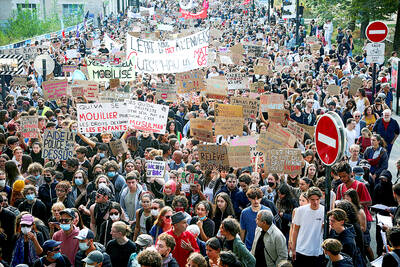
VIOLENT STANDOFFS: The government said 215 students have been injured since the start of the movement last month, including a teenager who lost a hand on Monday Thousands of demonstrators yesterday massed under heavy police surveillance in Paris and cities across France, as unions and teachers joined high-school students who for days have been demanding better conditions in protests punctuated by violent clashes. Students have blocked the entrances to hundreds of high schools for 15-to-17-year-olds since late last month, complaining of missing teachers, overloaded schedules, dilapidated classrooms and buildings that cannot cope with rising temperatures. In the Paris suburb of Creteil, where the protests started last month, students piled barriers outside the Saint-Exupery high school. “We are here to make our voice heard, all too often forgotten,” student Abderrahmane Abdelkader

As shark attack survivor Mel Ismail fought the predator that severed his leg, he noticed something odd. “I saw its eye ... a big black eye,” Ismail said. “But it was winking back at me — I was trying to get my fingers in its eye and just pushing its eye as I was being dragged.” When the shark swam off, he managed to struggle back to shore, the surfer and professional firefighter said in an Australian Broadcasting Corp interview broadcast on Thursday. He was surfing at Glenfield Beach near Geraldton on Australia’s west coast when he was attacked on Sept. 14. He
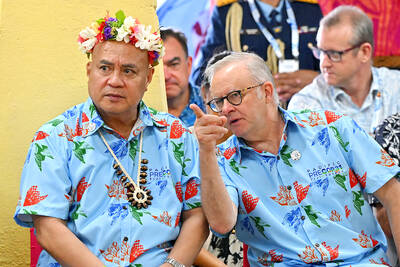
A Tuvalu government adviser yesterday said it felt like Australia had “taken over” the tiny country’s sovereignty during a visit by leaders to the Pacific island. The official — a senior government adviser who asked to remain anonymous because they were not authorized to speak to the media — said they were disappointed in Australia’s handling of the visit. The comments came during a visit by Australian Prime Minister Anthony Albanese and other leaders to Tuvalu, which has become a symbol of the existential threat posed by rising seas and is a key partner in Canberra’s Pacific strategy. “Just because we signed the
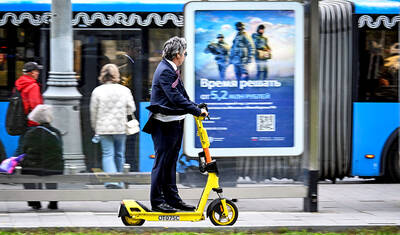
Halfway around the world from Russia, in a Caribbean tourism hot spot, men young and old are being lured by Moscow with tantalizing job offers, only to find themselves en route to the front lines in Ukraine. Moscow and Kyiv have recruited thousands of foreign nationals into their armies since Russia launched its invasion of Ukraine in 2022. Moscow is accused, in some cases, of using fake job ads to hoodwink men from deprived backgrounds in Africa, Asia and Latin America into traveling to Russia and then forcing them to fight on arrival. From countries such as India, Kenya, Equatorial Guinea, Colombia and


 RSS
RSS