


Atlantic bluefin tuna is in crisis and meets the criteria for a total ban on international trade, the head of the UN wildlife trade organization said on Saturday in opening a 13-day meeting.
The 175-nation Convention on International Trade in Endangered Species (CITES), convening for the first time in the Middle East, is the only UN body with the power to outlaw commerce in endangered wild animals and plants.
Besides the sharply disputed proposal on bluefin, the convention was to debate the status of African elephants, polar bears and tigers.
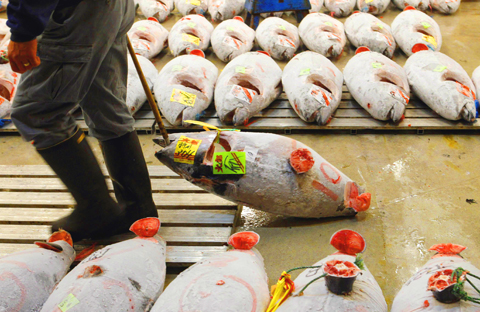
PHOTO: REUTERS
Delegates from the nearly 150 nations in attendance will also vote on less stringent protection for several types of shark and their lookalikes.
Up to 73 million of the open-water predators are killed every year for their fins, a prestige food eaten mainly in China and Chinese communities around the world.
Boosting the CITES budget — at less than US$5 million the smallest of the major UN conventions — is the first item on the agenda.
“In the absence of necessary funding, CITES will not be able to fully exploit its great potential,” CITES Secretary-General Willem Wijnstekers said.
Until now, the forum was best known for measures restricting commerce in charismatic species, including big cats, great apes and elephants.
But for the first time a marine species — bluefin tuna — has taken center stage.
Despite self-imposed quotas, high-tech fisheries have drained tuna stocks in the Mediterranean and Western Atlantic by as much as 80 percent since 1970.
“The secretariat believes the species [Thunnus thynnus] meets the criteria for Appendix I” of the convention, Wijnstekers said.
This conclusion, he said, “has been confirmed by the Food and Agriculture Organization and the scientific committee of the ICCAT [The International Commission for the Conservation of Atlantic Tunas],” the inter-governmental fishery group that manages tuna stocks in the Atlantic Ocean and adjacent seas.
The EU and the US back a move to list the US$100,000-a-head fish on CITES’ Appendix I, which bans international trade.
Japan is fiercely opposed to the measure, and is sure to mount a vigorous campaign to block the two-thirds vote of those attending the conference needed for the top tier of protection, experts said.
On elephants, a proposal by Tanzania and Zambia would reopen trade in ivory, currently under a nine-year moratorium that started in 2008.
Most other African nations oppose the move, backing a competing measure that would extend the ban by another decade.
Polar bears are also being considered for the top level of protection.
Attended by environmentalists, animal rights advocates, big business and governments, CITES seeks a sustainable balance between protection and commercial exploitation.
Terrestrial flora and fauna have fallen victim to shrinking habitats, hunting and over-harvesting.
Many ocean species have simply been eaten to the brink of viability.
“We have nearly 34,000 species placed under our protection. You need scientific studies, legislation, enforcement, training for customs police, capacity building,” Juan Carlos Vasquez of CITES said in pleading for a 16 percent budget boost.

‘IN A DIFFERENT PLACE’: The envoy first visited Shanghai, where he attended a Chinese basketball playoff match, and is to meet top officials in Beijing tomorrow US Secretary of State Antony Blinken yesterday arrived in China on his second visit in a year as the US ramps up pressure on its rival over its support for Russia while also seeking to manage tensions with Beijing. The US diplomat tomorrow is to meet China’s top brass in Beijing, where he is also expected to plead for restraint as Taiwan inaugurates president-elect William Lai (賴清德), and to raise US concerns on Chinese trade practices. However, Blinken is also seeking to stabilize ties, with tensions between the world’s two largest economies easing since his previous visit in June last year. At the
Nearly half of China’s major cities are suffering “moderate to severe” levels of subsidence, putting millions of people at risk of flooding, especially as sea levels rise, according to a study of nationwide satellite data released yesterday. The authors of the paper, published by the journal Science, found that 45 percent of China’s urban land was sinking faster than 3mm per year, with 16 percent at more than 10mm per year, driven not only by declining water tables, but also the sheer weight of the built environment. With China’s urban population already in excess of 900 million people, “even a small portion

UNSETTLING IMAGES: The scene took place in front of TV crews covering the Trump trial, with a CNN anchor calling it an ‘emotional and unbelievably disturbing moment’ A man who doused himself in an accelerant and set himself on fire outside the courthouse where former US president Donald Trump is on trial has died, police said yesterday. The New York City Police Department (NYPD) said the man was declared dead by staff at an area hospital. The man was in Collect Pond Park at about 1:30pm on Friday when he took out pamphlets espousing conspiracy theories, tossed them around, then doused himself in an accelerant and set himself on fire, officials and witnesses said. A large number of police officers were nearby when it happened. Some officers and bystanders rushed

Beijing is continuing to commit genocide and crimes against humanity against Uyghurs and other Muslim minorities in its western Xinjiang province, U.S. Secretary of State Antony Blinken said in a report published on Monday, ahead of his planned visit to China this week. The State Department’s annual human rights report, which documents abuses recorded all over the world during the previous calendar year, repeated language from previous years on the treatment of Muslims in Xinjiang, but the publication raises the issue ahead of delicate talks, including on the war in Ukraine and global trade, between the top U.S. diplomat and Chinese


 RSS
RSS