


Outlandish tales of shady drug bosses and glamorous women assassins are the staple of Colombian primetime TV. But the latest “narco-soaps” about the country’s drug gangs have sparked a debate about just how much of that dark reality should be broadcast into living rooms night after night.
The latest narco-show to air is Rosario Tijeras, a TV adaptation of a novel by the same name about a sexy hitwoman at the service of the drug mafia.
The show’s initial slogan, “It’s harder to love than to kill,” sparked such protests in the city of Medellin, where the story is set, that advertising posters were taken down.
The main Medellin newspaper El Colombiano said the show was a “gulp of absurdity, vulgarity, bad manners and a big dose of narco-culture.”
Medellin, Colombia’s second-largest city is best known for the cartel of the same name led in the 1980s and 1990s by Pablo Escobar.
Murder, betrayal, fast money and beautiful, buxom women may be vulgar, but fans of the show said it makes for riveting television and Rosario has been among the country’s top-rated programs since it began last month.
Rosario is the latest of the narco-soaps to raise a fracas. Over the past two years Colombians have seen The Cartel, about the powerful Norte del Valle Cartel and The Capo, which paints a wily drug boss as a sensitive anti-hero. There was also the smash hit Without Tits there is no Paradise that portrayed the lives of the women who surround the drug lords, as did Mafia Dolls, which ended last week.
The main complaint is that such series glamorize the life of criminals and incite young people to emulate that lifestyle. The argument over the narco-soaps has even reached neighboring Panama, where Panamian President Ricardo Martinelli complained about the Colombian shows that air on local television there.
“They exalt drug trafficking, theft, muggings,” he said, adding that the shows do “damage to our country” and corrupt “moral values.”
Others think that the central messages of such shows can be positive. In an editorial on Thursday, El Espectador newspaper said rather than being “apologists” for the narco lifestyle, the soaps may be seen as cautionary tales. The smalltown girl who thought heaven could only be reached with large breasts ended up dying a lonely alcoholic, drug bosses wind up in tiny jail cells in a foreign country, and Rosario dies the way she lived: by the gun.
German Yances, a media expert at Bogota’s Javeriana University, said some Colombians “don’t like to see their problems reflected on fictional TV because the daily drama of the country is on every night on the news.”
The high ratings, however, suggest that many viewers either see their lives reflected in or are fascinated by the shows, Yances said.
Despite the ratings, a powerful group of companies in Medellin has reportedly decided it would not advertise on the show and at least one cable operator is considering blocking it.
“If we don’t like the programs, then we should debate that, but we should not try to censor them,” Yances said. “What is painful is the reality they reflect and that’s what we should think about.”
Angela Camacho, an optometrist’s assistant in Bogota, has no connection to the narco culture but she doesn’t miss an episode of the narco-novelas: “I watched The Cartel and then Mafia Dolls and now Rosario Tijeras. It is violent some times and they exaggerate but I like it.”
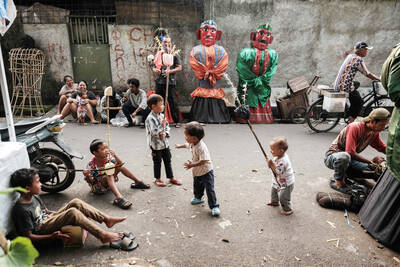
In the sweltering streets of Jakarta, buskers carry towering, hollow puppets and pass around a bucket for donations. Now, they fear becoming outlaws. City authorities said they would crack down on use of the sacred ondel-ondel puppets, which can stand as tall as a truck, and they are drafting legislation to remove what they view as a street nuisance. Performances featuring the puppets — originally used by Jakarta’s Betawi people to ward off evil spirits — would be allowed only at set events. The ban could leave many ondel-ondel buskers in Jakarta jobless. “I am confused and anxious. I fear getting raided or even

POLITICAL PATRIARCHS: Recent clashes between Thailand and Cambodia are driven by an escalating feud between rival political families, analysts say The dispute over Thailand and Cambodia’s contested border, which dates back more than a century to disagreements over colonial-era maps, has broken into conflict before. However, the most recent clashes, which erupted on Thursday, have been fueled by another factor: a bitter feud between two powerful political patriarchs. Cambodian Senate President and former prime minister Hun Sen, 72, and former Thai prime minister Thaksin Shinawatra, 76, were once such close friends that they reportedly called one another brothers. Hun Sen has, over the years, supported Thaksin’s family during their long-running power struggle with Thailand’s military. Thaksin and his sister Yingluck stayed
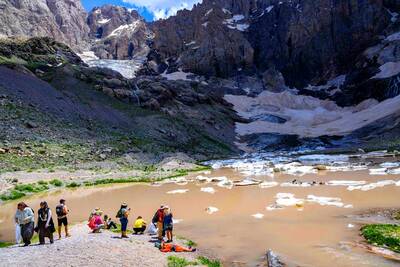
Kemal Ozdemir looked up at the bare peaks of Mount Cilo in Turkey’s Kurdish majority southeast. “There were glaciers 10 years ago,” he recalled under a cloudless sky. A mountain guide for 15 years, Ozdemir then turned toward the torrent carrying dozens of blocks of ice below a slope covered with grass and rocks — a sign of glacier loss being exacerbated by global warming. “You can see that there are quite a few pieces of glacier in the water right now ... the reason why the waterfalls flow lushly actually shows us how fast the ice is melting,” he said.

RESTRUCTURE: Myanmar’s military has ended emergency rule and announced plans for elections in December, but critics said the move aims to entrench junta control Myanmar’s military government announced on Thursday that it was ending the state of emergency declared after it seized power in 2021 and would restructure administrative bodies to prepare for the new election at the end of the year. However, the polls planned for an unspecified date in December face serious obstacles, including a civil war raging over most of the country and pledges by opponents of the military rule to derail the election because they believe it can be neither free nor fair. Under the restructuring, Myanmar’s junta chief Min Aung Hlaing is giving up two posts, but would stay at the


 RSS
RSS