


French President Nicolas Sarkozy faces an embarrassing setback at the polls over the next week as France votes in elections that look likely to hand a significant victory to the opposition Socialist party.
Although not officially on the ballot for the regional elections, whose first of two rounds will be held today, the embattled leader is expected to be punished indirectly as voters shun his right-wing UMP party in favor of left-wing and green alternatives.
With opinion polls showing the Socialists — who won control of 20 of the 22 mainland regions at the last vote in 2004 — will consolidate their “pink tide” or even increase it, commentators say the predicted defeat will reflect voters’ dissatisfaction with Sarkozy.
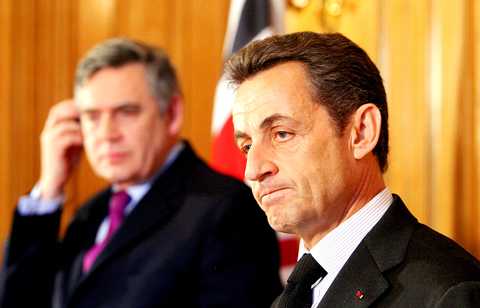
PHOTO: EPA
Yesterday, Sarkozy tried to distance himself from the impending rout, saying local elections had little to do with national politics.
He told Le Figaro Magazine: “The vote ... is a regional vote: Its consequences will therefore be regional.”
However, because the significance of the poll — which elects regional presidents and assemblies — is limited, many are predicting it will be seen as an unofficial referendum on Sarkozy’s leadership. The president is more than halfway through his five-year term, and this is the last major electoral exercise France will see before his mandate expires in 2012.
Opposition parties have urged voters to use the election as a means of expressing their dislike of the president, whose approval ratings, according to a CSA poll this week, are at 36 percent — the lowest since he came to power in 2007.
The Socialist leader, Martine Aubry, said at a campaign rally: “The left must win in all regions to beat the UMP and force Sarkozy to backtrack on all his projects.”
Amid rising unemployment and concerns about how the country will recover from the recession, frustrations with the ruling center-right party have been mounting among both its opponents and its traditional supporters.
According to pollsters, the UMP looks likely to fall victim to the changing dynamics of French politics. While the first round is expected to be close, it is unlikely to fend off the combined force of the Socialists and the Europe Ecologie (EE) party in the second round on March 21.
For Sarkozy and UMP chiefs, the worst-case scenario would be to then see Corsica and Alsace fall to the PS and Aubry’s dreams of a “grand slam” in all 22 mainland regions come true. That, however, would involve a victory for Aubry’s bitter rival, Segolene Royal, in her region of Poitou Charentes.
Daniel Cohn-Bendit, the head of France’s burgeoning green movement, believes his allies have succeeded in making his party the third political power in France. After an unexpectedly strong showing in last year’s European elections, the EE are now the kingmakers, he claimed at a triumphant party rally this week.
“Without us, the Socialists won’t win any region,” he said.
The impact of other parties on the result is expected to be limited.
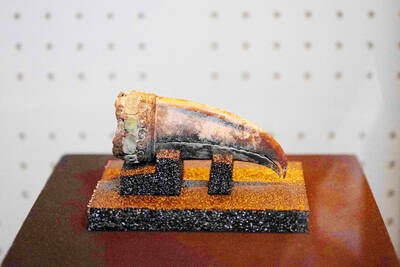
Archeologists in Peru on Thursday said they found the 5,000-year-old remains of a noblewoman at the sacred city of Caral, revealing the important role played by women in the oldest center of civilization in the Americas. “What has been discovered corresponds to a woman who apparently had elevated status, an elite woman,” archeologist David Palomino said. The mummy was found in Aspero, a sacred site within the city of Caral that was a garbage dump for more than 30 years until becoming an archeological site in the 1990s. Palomino said the carefully preserved remains, dating to 3,000BC, contained skin, part of the
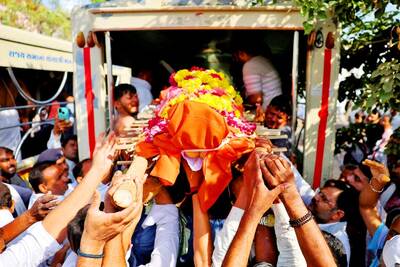
‘WATER WARFARE’: A Pakistani official called India’s suspension of a 65-year-old treaty on the sharing of waters from the Indus River ‘a cowardly, illegal move’ Pakistan yesterday canceled visas for Indian nationals, closed its airspace for all Indian-owned or operated airlines, and suspended all trade with India, including to and from any third country. The retaliatory measures follow India’s decision to suspend visas for Pakistani nationals in the aftermath of a deadly attack by shooters in Kashmir that killed 26 people, mostly tourists. The rare attack on civilians shocked and outraged India and prompted calls for action against their country’s archenemy, Pakistan. New Delhi did not publicly produce evidence connecting the attack to its neighbor, but said it had “cross-border” links to Pakistan. Pakistan denied any connection to

TRUMP EFFECT: The win capped one of the most dramatic turnarounds in Canadian political history after the Conservatives had led the Liberals by more than 20 points Canadian Prime Minister Mark Carney yesterday pledged to win US President Donald Trump’s trade war after winning Canada’s election and leading his Liberal Party to another term in power. Following a campaign dominated by Trump’s tariffs and annexation threats, Carney promised to chart “a new path forward” in a world “fundamentally changed” by a US that is newly hostile to free trade. “We are over the shock of the American betrayal, but we should never forget the lessons,” said Carney, who led the central banks of Canada and the UK before entering politics earlier this year. “We will win this trade war and
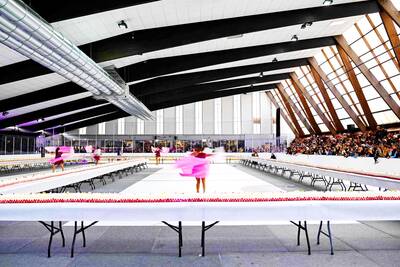
Armed with 4,000 eggs and a truckload of sugar and cream, French pastry chefs on Wednesday completed a 121.8m-long strawberry cake that they have claimed is the world’s longest ever made. Youssef El Gatou brought together 20 chefs to make the 1.2 tonne masterpiece that took a week to complete and was set out on tables in an ice rink in the Paris suburb town of Argenteuil for residents to inspect. The effort overtook a 100.48m-long strawberry cake made in the Italian town of San Mauro Torinese in 2019. El Gatou’s cake also used 350kg of strawberries, 150kg of sugar and 415kg of


 RSS
RSS