


So this is how you get through China’s biggest political event of the year: “Sit still, stare toward the front, pretend like you’re looking but you’re really not, pretend like you’re listening but you’re really not ... make your brain blank.”
As delegates to the National People’s Congress (NPC) dip into the world of Twitter-like microblogging, the Chinese public is getting a rare glimpse inside the workings — and nonworkings — of power.
For the first time, some of the almost 3,000 delegates are posting brief online messages from behind the scenes as they shuttle between vast, largely immobile meetings and their hotels, sealed off from the public with police tape.
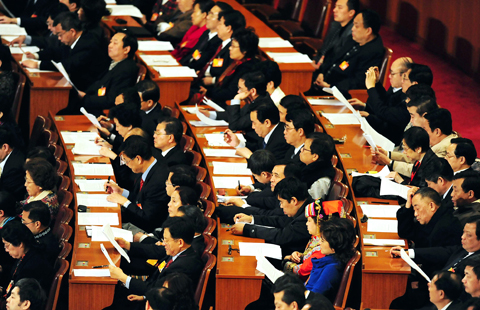
PHOTO: AFP
China’s political workings are so controlled and opaque that some Chinese don’t know who their delegates are. But some representatives are now being scrutinized, sucked into chats with netizens and even breaking news on the social network, where anyone can post notes of up to 140 characters and choose which people to “follow” or get updates from.
Beauty Fashion magazine publisher Zhang Xiaomei (張曉梅) is a member of the NPC’s sister session, the Chinese People’s Political Consultative Conference. People digging into her microblog posts before the session started discovered her advice, above, on surviving meetings.
“When people in the meeting talk on and on, you can take the chance to make your mind and body more healthy,” she wrote. “The longer the meeting is, the more you benefit.”
But Zhang also posted a tidbit that Chinese state media picked up and shot through the online world.
“When delegates show up, they get a laptop computer. What’s different this year is that they don’t have to be returned when we’re done,” she wrote.
The offhand comment quickly turned into an investigation. Media and netizens estimated that free laptops for Zhang and her more than 2,000 colleagues would cost Chinese taxpayers about 10 million yuan (US$1.5 million).
Angry editorials and blog posts about the need for clean government soon followed.
The microblogging experiment is the latest hesitant step for China, where the government wants to stay on top of new technology but guide the message as well.
Twitter is blocked in China, and two popular China-based clones this month said they had shut down for good.
The delegates are using a service by Internet portal operator Sina Corp, with the apparent blessing of the government.
“Microblogs meet the practicable needs of the masses and are in tune with the times of opposing cliches and nonsense,” the Chinese Communist Party Web site said last week.
Now the delegates just need to learn how to use them.
Ye Qing (葉青), deputy director of the statistics bureau in Hubei Province, has seemed a bit rattled. When he mentioned his delegation would take photos with central government leaders, more than 50 responses blasted him, saying he was being paid to do more than that.
“These criticisms are reasonable,” Ye said.
Other comments pointed out he had more than 24,000 followers but was following just two people.
“I only know what ‘following’ is after seeing these comments,” Ye said. “I’m inexperienced. Sorry!”
Some have used the tool to push, 140 characters at a time, for reform.
Wang Dewei, a professor and a delegate, microblogged about his proposal that government officials disclose their personal assets.
More than 50 other delegates signed the proposal, he said — a grouping almost certain to draw attention in China, where officials suspect anything that might be seen as a collective challenge.
Some of the signatories were scared, saying: “If I speak too much for ordinary people, they might not make me a delegate again,” Wang wrote.

‘CROSSING THE LINE’: China’s embassy in Seoul criticized US Forces Korea Commander General Xavier Brunson, asking if his ‘hostile’ remarks were authorized by Washington South Korea and the US are in talks over recent public remarks by the commander of US Forces Korea, Seoul’s presidential office said yesterday, after the comments drew sharp criticism from China. In a recent podcast interview, US Forces Korea Commander General Xavier Brunson described South Korea as “the dagger in the heart of Asia” from China’s east coast, prompting the Chinese embassy in Seoul to say that he had “truly crossed the line.” The interview came amid growing speculation that Washington might seek to expand the role of US Forces Korea in countering the growing regional influence of China, a key

Through the noise of rushing papers and whirring belts at a print factory in Kyoto, two creators watch their photo essay come to life in broadsheet form — part of an effort to win new audiences in the age of artificial intelligence (AI). Despite the decline of the publishing industry, self-publication and handmade “zine” magazines are growing in popularity in Japan, reflecting the nation’s enduring love of paper in the digital era. While speaking to Agence France-Presse at the plant, his hands black with ink, one of the creators, Kazuma Obara, said: “I think [paper] is a medium that engages all five

Australian researchers have trained lab-grown brain cells on a silicon computer chip to play the 1990s shooter game Doom and said they are just scratching the surface of what the neurons could be capable of doing. It is the science-fiction work of biotech boffins at Cortical Labs, who researched and developed the technology that harnesses the workings of the brain’s networking system. Each so-called “biological computer” contains about 200,000 living human brain cells, grown from stem cells that were harvested from blood donations. Having mastered the simple computer game Pong, where a paddle is moved up and down to send a ball

France experienced its hottest spring on record, the French weather service said on Tuesday, after an exceptional early heat wave that also broke highs for the season in England and Wales. Meteo-France said the average nationwide temperature over March to May was 13.8°C — about 1.7°C above the norm, and surpassing records set in 2011 and 2020. “The warmest spring since records began in 1900,” it said in a bulletin. All three months were warmer than average, but the onset of an “unprecedented heatwave” late last month pushed the mercury to highs typically seen at the height of the summer. “Our country had never


 RSS
RSS