


US President Barack Obama dispatched his vice president to the Middle East yesterday to try to build support for reviving Israeli-Palestinian peace talks despite deep skepticism on both sides.
US Vice President Joe Biden will meet Israeli, Palestinian, Egyptian and Jordanian leaders starting today, but a main component of his trip will be public diplomacy — reassuring anxious Israelis about Obama’s commitment to their security while explaining why they should be willing to make concessions for peacemaking.
Biden, who will be the most senior US official to visit Israel since Obama came to office in January last year, faces a tough sell, Israeli officials and analysts say.
Obama may enjoy superstar status in other parts of the world, but not in Israel.
Many Israelis are distrustful of the president’s outreach to the Muslim world, a priority he highlighted with high-profile visits to Egypt and Saudi Arabia, and, later this month, to Indonesia.
“If Israel is supposed to make sacrifices for a peace deal, the Israeli public has to be convinced it is receiving sufficient support from the US,” an Israeli official said, calling Biden’s visit the beginning of that process.
US-Israeli tensions flared over Obama’s early push for a complete Jewish settlement freeze, although his administration has at least temporarily backed off, embracing a more limited moratorium on new building. Other differences remain over next steps and the scope of renewed talks with the Palestinians.
Iran is another sore point for many Israelis, who see Obama’s focus on diplomacy and targeted sanctions to curb Iran’s nuclear program as wishful thinking.
Before Biden’s visit, US Secretary of Defense Robert Gates and Admiral Mike Mullen, chairman of the Joint Chiefs of Staff, made the case to Israel against taking military action against Iran, a message the vice president is likely to echo.
“A strike [by Israel] could be as destabilizing as Iran getting a nuclear weapon,” one US official said, adding Israeli leaders “are very aware of our concerns.”
An Israeli official said the Americans had made clear Israel “doesn’t have a military option without US clearance and we don’t have clearance at this time.”
US and Israeli officials said the main source of discord on Iran for the time being was over the scope of future sanctions, rather than the pros and cons of military action.
The Israeli official said Israeli Prime Minister Benjamin Netanyahu, who will meet Biden during his visit, was “disappointed” by the sanctions proposed thus far by the US. “This is not what we’ve been promised,” he said.
Asked if that meant Netanyahu would seek a US green light for striking Iran, another senior Israeli official said: “We’re not there yet … This is the time to act on sanctions and it is premature to discuss anything else.”
Israel has called for imposing “crippling” sanctions. Washington wants them to be targeted against hard-liners and is wary of broad-based penalties that could destabilize the Iranian economy as a whole and alienate its people.
Biden is not expected to take part in indirect Israeli-Palestinian talks that would be spearheaded by Obama’s special envoy, George Mitchell, and could be announced during his visit, although he will be briefed on them.
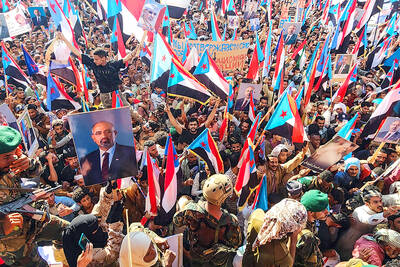
Yemen’s separatist leader has vowed to keep working for an independent state in the country’s south, in his first social media post since he disappeared earlier this month after his group briefly seized swathes of territory. Aidarous al-Zubaidi’s United Arab Emirates (UAE)-backed Southern Transitional Council (STC) forces last month captured two Yemeni provinces in an offensive that was rolled back by Saudi strikes and Riyadh’s allied forces on the ground. Al-Zubaidi then disappeared after he failed to board a flight to Riyadh for talks earlier this month, with Saudi Arabia accusing him of fleeing to Abu Dhabi, while supporters insisted he was

The Chinese Embassy in Manila yesterday said it has filed a diplomatic protest against a Philippine Coast Guard spokesman over a social media post that included cartoonish images of Chinese President Xi Jinping (習近平). Philippine Coast Guard spokesman Jay Tarriela and an embassy official had been trading barbs since last week over issues concerning the disputed South China Sea. The crucial waterway, which Beijing claims historic rights to despite an international ruling that its assertion has no legal basis, has been the site of repeated clashes between Chinese and Philippine vessels. Tarriela’s Facebook post on Wednesday included a photo of him giving a

‘MOBILIZED’: While protesters countered ICE agents, Minnesota Governor Tim Walz activated the state’s National Guard to ‘support the rights of Minnesotans’ to assemble Hundreds of counterprotesters drowned out a far-right activist’s attempt to hold a small rally in support of US President Donald Trump’s latest immigration crackdown in Minneapolis, Minnesota, on Saturday, as the governor’s office announced that National Guard troops were mobilized and ready to assist law enforcement, although not yet deployed to city streets. There have been protests every day since the US Department of Homeland Security (DHS) ramped up immigration enforcement in the Twin Cities of Minneapolis and Saint Paul by bringing in more than 2,000 federal officers. Conservative influencer Jake Lang organized an anti-Islam, anti-Somali and pro-US Immigration and Customs Enforcement
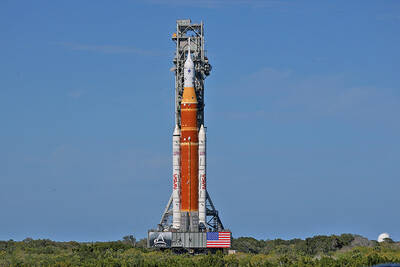
NASA on Saturday rolled out its towering Space Launch System (SLS) rocket and Orion spacecraft as it began preparations for its first crewed mission to the Moon in more than 50 years. The maneuver, which takes up to 12 hours, would allow the US space agency to begin a string of tests for the Artemis 2 mission, which could blast off as early as Feb. 6. The immense orange and white SLS rocket, and the Orion vessel were slowly wheeled out of the Vehicle Assembly Building at the Kennedy Space Center in Florida, and painstakingly moved 6.5km to Launch Pad 39B. If the


 RSS
RSS