

For Tibetans living near the birthplace of the Dalai Lama, one question is very much on their minds these days — who will succeed the aging exiled spiritual leader once he dies?
The possibility that scares most of them, and is seen as the most likely to happen, is that the atheist Chinese Communist Party government in Beijing will simply appoint its own replacement, with a veneer of tradition and religion thrown in.
One of the few certainties about the political future of Tibet is that the death of the current Dalai Lama will cause major disturbances in Tibet and overseas.
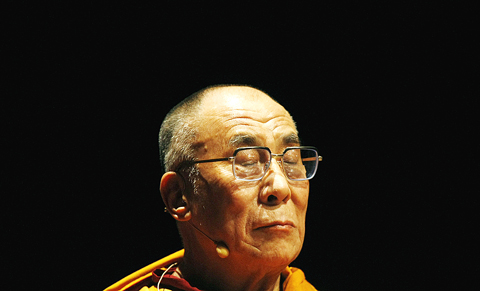
PHOTO: REUTERS
Some Tibetans fear a violent backlash in what is now called the Tibet Autonomous Region and surrounding provinces with large Tibetan populations, like Qinghai, Gansu and Sichuan, if Beijing were to unilaterally appoint the next Dalai Lama.
There is precedent for that happening.
China chose a rival incarnation to succeed the late 10th Panchen Lama, Tibetan Buddhism’s second-holiest position, shortly after the Dalai Lama announced his choice in 1995.
“We think China will try to appoint its own Dalai Lama, as it did with the Panchen Lama,” said Jigme, a monk in the Tibetan region of Tongren in the arid northwestern province of Qinghai.
“If that happens, we will protest,” he added, punching his fists into the freezing air. “The people will be very unhappy. This is a religious decision. There should be no politics.”
The worry of violence is very real.
Anti-Chinese protests erupted in March 2008, in which at least 19 people were killed in riots in Lhasa. Pro-Tibet groups say hundreds died in a subsequent crackdown across the region.
The Beijing-anointed Panchen Lama is spurned by most Tibetans as a fake. The whereabouts of the Dalai Lama-recognized Panchen Lama is one of China’s most tightly guarded secrets. China has in the past insisted he is safe, healthy and wants his privacy.
“We will not believe in a Dalai Lama chosen by the government,” said another Qinghai Tibetan, who gave his name as Jokhar. “Look what happened when they appointed their own Panchen Lama. We don’t believe in that one, and never will.”
Born in 1935 into a farming family in Qinghai, known to Tibetans as Amdo, Lhamo Thondup was discovered at the age of two to be the 14th reincarnation of the Dalai Lama. He fled to India in 1959 after a failed uprising against Communist Chinese rule.
The Dalai Lama, or Ocean of Wisdom, has earned adulation from supporters in the West, including Hollywood celebrities, who see him as one of the world’s most enduring symbols of peace after Mahatma Gandhi and Martin Luther King Jr.
China’s Communist rulers view him as a political headache and hypocrite with “a human face and the heart of a beast.” They say he foments violence and is a separatist. He denies both charges, pointing out that he wants more meaningful autonomy for Tibet.
For China, who becomes the next Dalai Lama is a heavily politicized issue.
Beijing appears determined not to cede any kind of authority to a candidate beyond their control.
Last year, a top official warned that the central government must approve the Dalai Lama’s reincarnation and would not recognize any candidate that it had not endorsed.
“In terms of what has been flagged by China ... no other option has emerged, no other even vague likelihood has emerged, except for China promoting its own candidate,” said Robbie Barnett, a Tibet expert at Columbia University in New York.
The Dalai Lama’s succession has become a prickly issue, as the Nobel Prize winner’s health declines, as witnessed by his recent hospital visits for trapped nerves, abdominal discomfort and gallstone surgery.
He has suggested that his incarnation might be found outside of Chinese-controlled territory, or even that Tibetans themselves could order a vote on whether to continue an institution that once gave one monk both spiritual and temporal sway over Tibet.
“There definitely will be two,” Khedroob Thondup, a member of the exiled Tibetan parliament, said when asked how he thought the succession would play out.
“It will depend on who’s in power in Beijing. If it’s the present regime, they will go out of their way to choose their own,” said Khedroob Thondup, a nephew of the Dalai Lama.
Chinese officials have prevaricated when directly asked recently about how the succession could be handled.
“Chinese people have a custom of not asking when an aged person is going to pass away,” Zhu Weiqun, a Communist Party vice-minister responsible for co-opting Tibetans and other ethnic minorities, told a news conference last month. “The Dalai Lama once met Chairman Mao. We hope he lives a long life and we hope he can resolve the question of his succession while he is still with us.”
Yet there is a level of worry in official circles about the potential for instability when the Dalai Lama passes away.
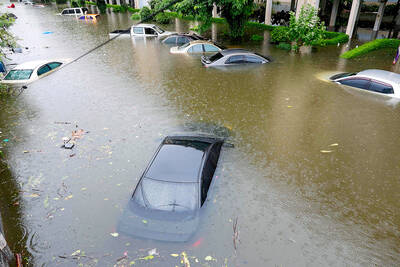
Several areas of Thailand’s capital city Bangkok were inundated by continuous rain from Thursday afternoon to yesterday morning that has disrupted traffic and forced some residents to evacuate. Major canals in Bangkok filled with accumulated rainfall exceeding 20cm, officials said yesterday. Floodwaters spread across the city, particularly in the central and eastern parts, blocking roads and stopping traffic. The Thai Meteorological Department warned that the heavy rain would continue in most parts of the country through today, citing a strong low-pressure system over the central region and strengthening southwest monsoon conditions. More than 84,000 people in 21 provinces nationwide were
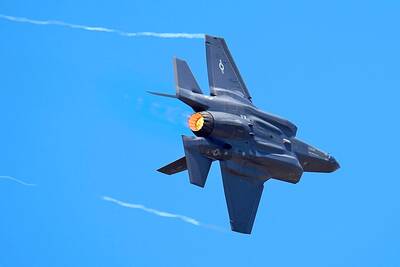
BAD TIMING: The disclosure of the incident, which is under investigation by at least two congressional committees, comes as Xi was to meet with Trump The Pentagon is investigating how parts of the US’ most advanced fighter jet ended up in Hong Kong, with a news outlet on Wednesday reporting that China has obtained the F-35 equipment. The F-35 Joint Program Office said in a statement that it and the US Department of Defense are aware of “a shipment issue” with F-35 components. “We are actively working with US authorities and industry partners to retrieve these components, investigate the incident and place safeguards to avoid a future occurrence,” the office said. UPS was shipping a cockpit canopy and weapons-bay door from an Australian military F-35 that was being

Yemen’s Saudi-led coalition early yesterday said it had intercepted two ballistic missiles and two drones launched by the Iran-backed Houthis toward the kingdom. The coalition said in posts on social media that the missiles were headed towards Khamis Mushait and the drones toward the capital, Riyadh, adding that it was monitoring the missile threat and drones launched at the kingdom, without providing further details. The Saudi Civil Defense had sent alerts overnight for Khamis Mushait and Abha, but not for Riyadh. The Houthis, who control the most populous parts of Yemen and much of the north, have been launching attacks

IN DEFENSE: Australia said it takes the protection of classified and export-controlled tech extremely seriously amid concerns over reverse engineering A US House of Representatives committee that oversees defense policy is investigating the diversion of potentially sensitive F-35 jet components this year from Australia to Hong Kong, a spokesperson said. “The committee is aware of this issue and we’ve received multiple briefings on it,” House Committee on Armed Services spokesperson Heather Vaughan said, adding that the group is “continuing to look into the incident and conduct oversight.” The Pentagon’s F-35 program office said in a statement that “we are aware of a shipment issue of unserviceable F-35 components and we are actively working with US authorities and industry partners to retrieve these


 RSS
RSS