


US President Barack Obama began a final push for healthcare reform on Wednesday, urging Congress to vote on the plan in the next few weeks even if it means passing the measure with a narrow Democratic majority and no Republican support.
Although much uncertainty remains on the path to passage of the legislation, Obama opposed Republican calls to throw out broad bills passed by the House of Representatives and Senate last year and begin again with a more step-by-step approach.
“For us to start over now could simply lead to delay that could last for another decade or even more,” Obama said.
Americans are waiting for the administration to lead, Obama said in remarks at the White House backing a muscle tactic known as “reconciliation” as a way of overcoming rock-solid Republican opposition.
Republicans dismissed Obama’s comments and said Democrats risked paying a price in mid-term congressional elections in November.
“Every election in America this fall will be a referendum on this issue,” Senate Republican leader Mitch McConnell said.
Wall Street shrugged off Obama’s statement.
“It doesn’t really seem like there’s any change here. Basically, what it was was a call to action,” said Steve Shubitz, a healthcare analyst at Edward Jones. “There really wasn’t much new in there, meaning nothing incrementally more damaging to the health insurance companies.”
“My opinion is it’s still just political maneuvering on healthcare ... I’d be surprised if anything does get done,” said Wayne Schmidt of Minnesota-based Gradient Investments.
The Morgan Stanley Healthcare Payor index of health insurer stocks was up about 1 percent on Wednesday.
“Now is the time to make a decision about how to finally reform health care so that it works, not just for the insurance companies, but for America’s families and businesses,” Obama said in his speech.
He said his plan included ideas from both his fellow Democrats and rival Republicans, who staunchly oppose the idea of a large-scale overhaul of the US$2.5 trillion healthcare industry, which accounts for one-sixth of the US economy. Republicans say such a plan is too expensive for a government running huge budget deficits.
Obama renewed his effort to win Republican backing with a healthcare summit last week and a letter on Tuesday outlining some of their ideas he was willing to adopt. Obama said he was open to Republican ideas such as probing healthcare providers who get federal money and offering more grants to study alternatives to medical malpractice suits.
With those efforts, he can say he gave bipartisanship another chance, even as Democrats seek to bypass Republicans.
“Given these honest and substantial differences between the parties ... I do not see how another year of negotiations would help,” Obama said.
White House spokesman Robert Gibbs said Obama will push hard.
“Whatever it takes to get healthcare done,” he said.
Obama is due to travel to Philadelphia and St Louis next week to make his case for the overhaul.
Democrats have been preparing to pass a final measure in the Senate without opposition support through reconciliation, which requires only simple majority approval instead of the usual 60 votes that are needed in the 100-member chamber to overcome procedural hurdles. The Democrats lost their “supermajority” with the loss of a Senate seat in a special election in January.
Obama did not use the word reconciliation, a term not understood by many Americans, but made clear he supported that process with comments urging an up or down vote in Congress.
“No matter which approach you favor, I believe the United States Congress owes the American people a final vote on healthcare reform,” he said.
The political stakes are enormous. Obama’s approval ratings have dropped during the healthcare fight amid public worries about an unemployment rate hovering around 10 percent.
With polls providing a mixed picture of their attitudes, the president made clear he was willing to let voters decide in November whether healthcare should be approved or not. With more than one third of the Senate and all seats in the House up for grabs, his fellow Democrats want to move past healthcare to focus on job creation and the economy.
It is unclear whether Speaker Nancy Pelosi will be able to muster a bare majority of 216 Democrats to pass the plan in the House, with moderates fearing a rebellion from voters more concerned about jobs.
The House approved its version in November with only three votes to spare, and will take up a Senate version that includes several provisions House Democrats do not like. Those include a tax on high-cost “Cadillac” insurance plans and lower federal subsidies to make insurance more affordable.
Australians were downloading virtual private networks (VPNs) in droves, while one of the world’s largest porn distributors said it was blocking users from its platforms as the country yesterday rolled out sweeping online age restriction. Australia in December became the first country to impose a nationwide ban on teenagers using social media. A separate law now requires artificial intelligence (AI)-powered chatbot services to keep certain content — including pornography, extreme violence and self-harm and eating disorder material — from minors or face fines of up to A$49.5 million (US$34.6 million). The country also joined Britain, France and dozens of US states requiring

Hungarian authorities temporarily detained seven Ukrainian citizens and seized two armored cars carrying tens of millions of euros in cash across Hungary on suspicion of money laundering, officials said on Friday. The Ukrainians were released on Friday, following their detention on Thursday, but Hungarian officials held onto the cash, prompting Ukraine to accuse Hungary’s Russia-friendly government of illegally seizing the money. “We will not tolerate this state banditism,” Ukrainian Minister of Foreign Affairs Andrii Sybiha said. The seven detained Ukrainians were employees of the Ukrainian state-owned Oschadbank, who were traveling in the two armored cars that were carrying the money between Austria and
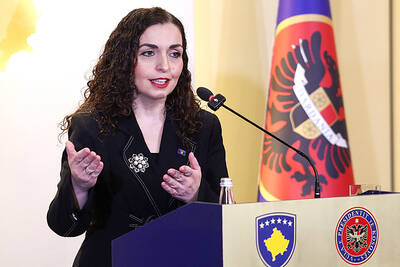
Kosovar President Vjosa Osmani on Friday after dissolving the Kosovar parliament said a snap election should be held as soon as possible to avoid another prolonged political crisis in the Balkan country at a time of global turmoil. Osmani said it is important for Kosovo to wrap up the upcoming election process and form functional institutions for political stability as the war rages in the Middle East. “Precisely because the geopolitical situation is that complex, it is important to finish this electoral process which is coming up,” she said. “It is very hard now to imagine what will happen next.” Kosovo, which declared

ACTIONABLE ADVICE: The majority of chatbots tested provided guidance on weapons, tactics and target selections, with Perplexity and Meta AI deemed to be the least safe From school shootings to synagogue bombings, leading artificial intelligence (AI) chatbots helped researchers plot violent attacks, according to a study published on Wednesday that highlighted the technology’s potential for real-world harm. Researchers from the nonprofit watchdog Center for Countering Digital Hate and CNN posed as 13-year-old boys in the US and Ireland to test 10 chatbots, including ChatGPT, Google Gemini, Perplexity, Deepseek and Meta AI. Eight of the chatbots assisted the make-believe attackers in more than half the responses, providing advice on “locations to target” and “weapons to use” in an attack, the study said. The chatbots had become a “powerful accelerant for


 RSS
RSS