


Syrian President Bashar Assad on Thursday defied US calls to loosen ties with Iran, saying his long-standing alliance with Tehran remains strong despite overtures from Washington intended to shift his loyalties.
The US has reached out to Syria in recent months by nominating the first US ambassador to Damascus since 2005 and sending top diplomats to meet with Syrian President Bashar Assad. Washington is hoping to draw Syria away from Iran, Hezbollah and Hamas.
But with Iranian President Mahmoud Ahmadinejad by his side in Damascus, Assad said on Thursday that the US should not dictate relationships in the Middle East.
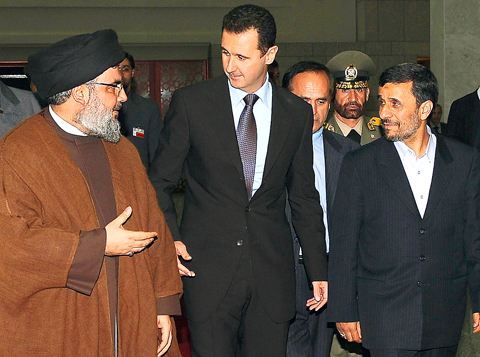
PHOTO: AFP
“I find it strange how they talk about Middle East stability and at the same time talk about dividing two countries,” Assad told reporters when asked about US Secretary of State Hillary Rodham Clinton’s call on Wednesday for Syria to move away from Iran.
Assad took a swipe at Clinton for making such a suggestion, saying he and Ahmadinejad “misunderstood, maybe because of translation error or limited understanding.”
In a show of unity, the two signed an agreement canceling the need for travel visas between the their countries.
US State Department spokesman PJ Crowley, speaking to reporters in Washington on Thursday, said Assad “need only look around the region and recognize that Syria is increasingly an outlier.”
“We want to see Syria play a more constructive role in the region and one step would be to make clear what Iran needs to do differently. And unfortunately, there was no evidence of that today,” he said.
Assad’s strong words indicate that US does not have the kind of leverage it thought over Syria, said Joshua Landis, a Syria expert who runs a popular blog called Syria Comment.
“America overplayed its hand,” Landis said. “The rest of the world is engaged with Syria — France is doing business, Turkey is doing business. Syria can survive. But it can’t survive cutting ties with Iran.”
Still, there are signs Assad could be open to a breakthrough with the US. He has begun to dismantle his father’s socialist legacy since he rose to office in 2000. He has loosened the reins on banking, sought to attract foreign investment, and encouraged tourism and private education.
He also is hoping for US help in boosting the Syrian economy and US mediation in direct peace talks with Israel. However, Clinton said on Wednesday that the recent decision to send an ambassador to Syria did not mean concerns about the country have been addressed.
She told lawmakers in Washington that the nomination of career diplomat Robert Ford signaled a “slight opening” with Syria. But she said Washington remained troubled by suspected Syrian support for militant groups in Iraq and elsewhere, interference in Lebanon and Syria’s close relationship with Iran.
Ahmadinejad, meanwhile, said Syria and Iran are partners with a long history.
“There is nothing that could harm these brotherly relations,” he said. “With each passing day, these relations will improve and deepen.”
In related news, the head of Lebanon’s Hezbollah movement traveled to Damascus for talks with allies Syria and Iran, the SANA news agency said yesterday.
Hassan Nasrallah attended a dinner banquet that Assad hosted for Ahmadinejad on Thursday, the agency said.
Hezbollah’s Al-Manar TV in Lebanon reported that Nasrallah and Ahmadinejad met to discuss “the latest developments in the region.”
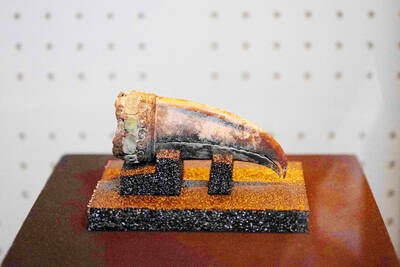
Archeologists in Peru on Thursday said they found the 5,000-year-old remains of a noblewoman at the sacred city of Caral, revealing the important role played by women in the oldest center of civilization in the Americas. “What has been discovered corresponds to a woman who apparently had elevated status, an elite woman,” archeologist David Palomino said. The mummy was found in Aspero, a sacred site within the city of Caral that was a garbage dump for more than 30 years until becoming an archeological site in the 1990s. Palomino said the carefully preserved remains, dating to 3,000BC, contained skin, part of the
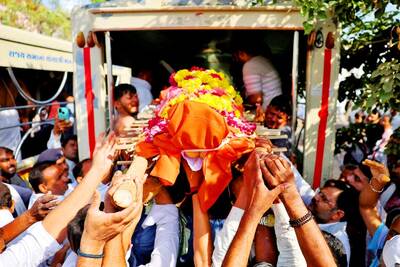
‘WATER WARFARE’: A Pakistani official called India’s suspension of a 65-year-old treaty on the sharing of waters from the Indus River ‘a cowardly, illegal move’ Pakistan yesterday canceled visas for Indian nationals, closed its airspace for all Indian-owned or operated airlines, and suspended all trade with India, including to and from any third country. The retaliatory measures follow India’s decision to suspend visas for Pakistani nationals in the aftermath of a deadly attack by shooters in Kashmir that killed 26 people, mostly tourists. The rare attack on civilians shocked and outraged India and prompted calls for action against their country’s archenemy, Pakistan. New Delhi did not publicly produce evidence connecting the attack to its neighbor, but said it had “cross-border” links to Pakistan. Pakistan denied any connection to

TRUMP EFFECT: The win capped one of the most dramatic turnarounds in Canadian political history after the Conservatives had led the Liberals by more than 20 points Canadian Prime Minister Mark Carney yesterday pledged to win US President Donald Trump’s trade war after winning Canada’s election and leading his Liberal Party to another term in power. Following a campaign dominated by Trump’s tariffs and annexation threats, Carney promised to chart “a new path forward” in a world “fundamentally changed” by a US that is newly hostile to free trade. “We are over the shock of the American betrayal, but we should never forget the lessons,” said Carney, who led the central banks of Canada and the UK before entering politics earlier this year. “We will win this trade war and
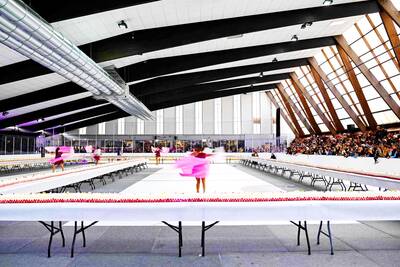
Armed with 4,000 eggs and a truckload of sugar and cream, French pastry chefs on Wednesday completed a 121.8m-long strawberry cake that they have claimed is the world’s longest ever made. Youssef El Gatou brought together 20 chefs to make the 1.2 tonne masterpiece that took a week to complete and was set out on tables in an ice rink in the Paris suburb town of Argenteuil for residents to inspect. The effort overtook a 100.48m-long strawberry cake made in the Italian town of San Mauro Torinese in 2019. El Gatou’s cake also used 350kg of strawberries, 150kg of sugar and 415kg of


 RSS
RSS