


Leading Cuban political prisoner Orlando Zapata died in hospital on Tuesday, 85 days into a hunger strike, medical officials said, as “indignant” dissidents blamed the government for his death.
A spokesman for Havana’s Hermanos Ameijeiras hospital, where the 42-year-old political prisoner was transferred late on Monday from a smaller clinic near his prison in the eastern province of Camaguey, said Zapata died at 1pm.
Jailed since 2003 and deemed a prisoner of conscience by Amnesty International, Zapata had been on a hunger strike to protest prison conditions that he blamed for his deteriorating health.
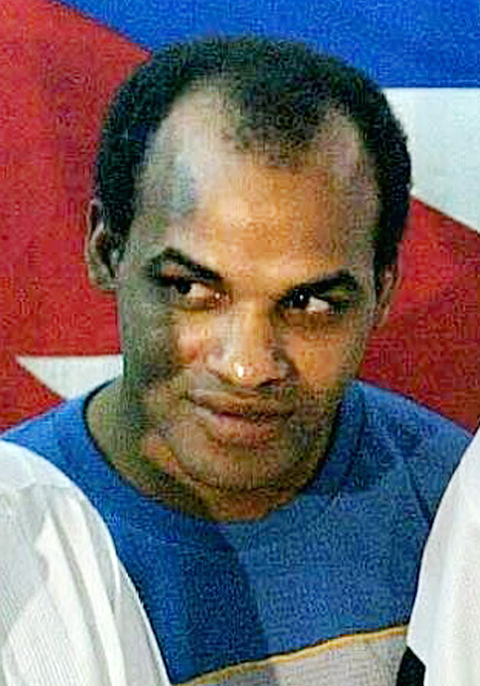
PHOTO: AFP
The movement “is not seeking martyrs,” said Oswaldo Paya, leader of the Christian Liberation Movement dissident group. Zapata died “defending the freedom, rights and dignity of all Cubans,” he said.
In Camaguey, authorities had placed the dissident in a provincial hospital before he was transferred by ambulance to Hermanos Ameijeiras, one of the biggest in the capital and outfitted with more care and surgical options.
Hours before Zapata’s death, the banned Cuban Committee for Human Rights and National Reconciliation (CCDHRN) had said his condition was “very serious.”
Early this month, Cuban police harassed, beat and briefly jailed some 35 dissidents marching in Camaguey protesting the “cruel and inhuman treatment” of Zapata, CCDHRN said.
The group’s director, Elizardo Sanchez, said it was the first time in nearly 40 years that a Cuban opposition figure has died while on a hunger strike.
Zapata’s demise is “bad news for the human rights movement and for the government as well,” Sanchez said.
In Miami, a Cuban exile group quoted his mother as saying authorities essentially killed her son in Havana.
“They have done him in. My son’s death was a premeditated murder,” Reina Tamayo said in a statement released by the Cuban Democratic Directorate.
Hector Palacios, one of 75 political prisoners convicted in 2003 and who met Zapata in prison, said that “people are indignant” and that a national mourning and fasting period was being considered.
“I’m crushed,” said Palacios, who has been released for health reasons. Zapata “had no alternative but to decide on the hunger strike. The authorities took no pity on him, they just let him die,” he said.
Zapata was convicted in 2003 for political activities anathema to the only one-party communist regime in the Americas. He received a similar sentence to the other 75 dissidents, but while jailed his sentence was boosted to 25 years in subsequent trials.
The Cuban government denies holding any political prisoners, instead calling those imprisoned “mercenaries” in the pay of US opponents of the regime. Dissident sources however put the number of political prisoners at 200 in a country of more than 11 million.
Palacios said the timing was terrible for Havana. Just as Latin American leaders wrapped up a Rio Group regional summit in Mexico, “the world learns that in Cuba at this moment a man has just died from lack of attention,” he said. “It’s a political crime.”
Zapata’s death could also cast a shadow over a visit to the island by Brazilian President Luiz Inacio da Silva, who arrived late on Tuesday.
Cuban dissidents had written a letter to da Silva urging him to intercede to try to help Zapata or secure his release.

TRUMP EFFECT: The win capped one of the most dramatic turnarounds in Canadian political history after the Conservatives had led the Liberals by more than 20 points Canadian Prime Minister Mark Carney yesterday pledged to win US President Donald Trump’s trade war after winning Canada’s election and leading his Liberal Party to another term in power. Following a campaign dominated by Trump’s tariffs and annexation threats, Carney promised to chart “a new path forward” in a world “fundamentally changed” by a US that is newly hostile to free trade. “We are over the shock of the American betrayal, but we should never forget the lessons,” said Carney, who led the central banks of Canada and the UK before entering politics earlier this year. “We will win this trade war and

‘BODIES EVERYWHERE’: The incident occurred at a Filipino festival celebrating an anti-colonial leader, with the driver described as a ‘lone suspect’ known to police Canadian police arrested a man on Saturday after a car plowed into a street party in the western Canadian city of Vancouver, killing a number of people. Authorities said the incident happened shortly after 8pm in Vancouver’s Sunset on Fraser neighborhood as members of the Filipino community gathered to celebrate Lapu Lapu Day. The festival, which commemorates a Filipino anti-colonial leader from the 16th century, falls this year on the weekend before Canada’s election. A 30-year-old local man was arrested at the scene, Vancouver police wrote on X. The driver was a “lone suspect” known to police, a police spokesperson told journalists at the

North Korean leader Kim Jong-un has unveiled a new naval destroyer, claiming it as a significant advancement toward his goal of expanding the operational range and preemptive strike capabilities of his nuclear-armed military, state media said yesterday. North Korea’s state-run Korean Central News Agency (KCNA) said Kim attended the launching ceremony for the 5,000-tonne warship on Friday at the western port of Nampo. Kim framed the arms buildup as a response to perceived threats from the US and its allies in Asia, who have been expanding joint military exercises amid rising tensions over the North’s nuclear program. He added that the acquisition
An American man identified as the son of a deputy director of the CIA was killed in eastern Ukraine last year while fighting under contract for the Russian military, an investigation by independent Russian media said. Michael Alexander Gloss, 21, died on April 4 last year in “Eastern Europe,” an obituary published by his family said. He was the son of Juliane Gallina, who was appointed the deputy director for digital innovation at the CIA in February last year. The story of how the son of a top-ranking US spy died fighting for Russian President Vladimir Putin’s full-scale invasion of


 RSS
RSS