


A young, brash militant who gained notoriety after posing for cameras with three Red Cross hostages became the latest casualty of US-backed Philippine military assaults that have slowly eliminated the nation’s most wanted terror suspects.
Albader Parad is best remembered as head of a faction of the al-Qaeda-linked Abu Sayyaf group who demanded a ransom last year for the release of the Red Cross workers — a Swiss, an Italian and a Filipino. All three were freed after months in jungle captivity despite threats to behead them.
A special operations platoon on Sunday crawled within 30m of a forest hut on southern Jolo and opened fire after receiving intelligence that Parad and senior leader Umbra Jumdail were meeting, military officials said.
At the end of the hourlong gunfight, Parad and five other militants, including Jumdail’s brother, lay dead. Parad’s body was later identified by four civilians, regional military commander Lieutenant General Benjamin Dolorfino said. A marine was also killed.
“This will be a big blow to the Abu Sayyaf,” Dolorfino said. “He was the most visible among the leaders. The fear of the people for the Abu Sayyaf is represented by the face of Albader, which always comes out in newspapers.”
The Abu Sayyaf is blamed for the country’s worst bomb attacks, kidnapping sprees and for beheading some of its hostages during the last two decades.
The Abu Sayyaf, which means “Father of the Swordsman” in Arabic, was founded in 1991 in Basilan province with suspected funds from Asian and Middle Eastern radical groups, including al-Qaeda. It came to the US attention in 2001, when it kidnapped three Americans, two of whom were later killed, and dozens of Filipinos.
The violence prompted Washington to deploy hundreds of troops to train Philippine forces and share intelligence, driving military operations that have neutralized the most prominent leaders one by one.
Out of the 24 original leaders and militants, about half a dozen remain at large. The rest are dead or in jail. Abu Sayyaf’s oldest, ailing commander, one-armed Radulan Sahiron, has not been seen since a 2008 clash.
Only two other influential leaders remain — Jumdail, an ideologue also known as Dr Abu Pula and Isnilon Hapilon, who carries a US reward of US$5 million for his capture. However, Hapilon might have suffered a stroke, Dolorfino said.
“There are no young leaders emerging,” he said.
Parad, who appeared to be in his 20s, began as an errand boy in militant jungle camps and in 2000 took part in a mass kidnapping from the Sipadan resort in nearby Malaysia that netted 10 Europeans and 11 other people, a military dossier said.
He was described as coming from a poor family where most relatives had links to the Abu Sayyaf. He had reportedly amassed more than US$400,000 from a string of earlier abductions, some of which was invested by relatives in passenger transport and coconut farmlands.
Philippine National Red Cross chairman Richard Gordon, who talked to Parad by telephone until he persuaded him to release the Red Cross hostages, blamed poverty and lack of government support and job opportunities for driving people like Parad to join militants.
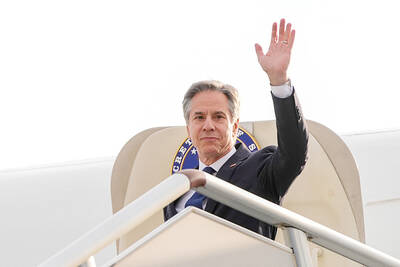
‘IN A DIFFERENT PLACE’: The envoy first visited Shanghai, where he attended a Chinese basketball playoff match, and is to meet top officials in Beijing tomorrow US Secretary of State Antony Blinken yesterday arrived in China on his second visit in a year as the US ramps up pressure on its rival over its support for Russia while also seeking to manage tensions with Beijing. The US diplomat tomorrow is to meet China’s top brass in Beijing, where he is also expected to plead for restraint as Taiwan inaugurates president-elect William Lai (賴清德), and to raise US concerns on Chinese trade practices. However, Blinken is also seeking to stabilize ties, with tensions between the world’s two largest economies easing since his previous visit in June last year. At the
Nearly half of China’s major cities are suffering “moderate to severe” levels of subsidence, putting millions of people at risk of flooding, especially as sea levels rise, according to a study of nationwide satellite data released yesterday. The authors of the paper, published by the journal Science, found that 45 percent of China’s urban land was sinking faster than 3mm per year, with 16 percent at more than 10mm per year, driven not only by declining water tables, but also the sheer weight of the built environment. With China’s urban population already in excess of 900 million people, “even a small portion

UNSETTLING IMAGES: The scene took place in front of TV crews covering the Trump trial, with a CNN anchor calling it an ‘emotional and unbelievably disturbing moment’ A man who doused himself in an accelerant and set himself on fire outside the courthouse where former US president Donald Trump is on trial has died, police said yesterday. The New York City Police Department (NYPD) said the man was declared dead by staff at an area hospital. The man was in Collect Pond Park at about 1:30pm on Friday when he took out pamphlets espousing conspiracy theories, tossed them around, then doused himself in an accelerant and set himself on fire, officials and witnesses said. A large number of police officers were nearby when it happened. Some officers and bystanders rushed

Beijing is continuing to commit genocide and crimes against humanity against Uyghurs and other Muslim minorities in its western Xinjiang province, U.S. Secretary of State Antony Blinken said in a report published on Monday, ahead of his planned visit to China this week. The State Department’s annual human rights report, which documents abuses recorded all over the world during the previous calendar year, repeated language from previous years on the treatment of Muslims in Xinjiang, but the publication raises the issue ahead of delicate talks, including on the war in Ukraine and global trade, between the top U.S. diplomat and Chinese


 RSS
RSS