


Old tobacco smoke does more than simply make a room smell stale — it can leave cancer-causing toxins behind, US researchers reported on Monday.
They found cancer-causing agents called tobacco-specific nitrosamines (TSNAs) stick to a variety of surfaces, where they can get into dust or be picked up on the fingers. Children and infants are the most likely to pick them up, the team at Lawrence Berkeley National Laboratory in California reported.
“These findings raise concerns about exposures to the tobacco smoke residue that has been recently dubbed ‘third-hand smoke,’” the researchers wrote in the Proceedings of the National Academy of Sciences.
They suggested a good clean up could help remove these potentially harmful chemicals and said their findings suggest other airborne toxins may also be found on surfaces. “TSNAs are among the most broadly acting and potent carcinogens present in unburned tobacco and tobacco smoke,” Berkeley chemist Hugo Destaillats, who worked on the study, said in a statement. “The burning of tobacco releases nicotine in the form of a vapor that adsorbs strongly onto indoor surfaces, such as walls, floors, carpeting, drapes and furniture. Nicotine can persist on those materials for days, weeks and even months.”
The nicotine combines with another common compound called nitrous acid to form TSNAs, Destaillats and colleagues found.
Unvented gas appliances are the main source of nitrous acid indoors, and vehicle engines emit it as well.
The researchers did laboratory tests with cigarette smoke, and also tested a 45-year-old pickup truck driven by a heavy smoker. The TSNA compound formed quickly if nitrous acids were around — notably in the truck compartment but also in rooms where cigarette smoke wafted.
It would be easy to ingest this new compound, they said, calling it “an unappreciated health hazard.”
“Because of their frequent contact with surfaces and dust, infants and children are particularly at risk,” they wrote.
“Nicotine, the addictive substance in tobacco smoke, has until now been considered to be non-toxic in the strictest sense of the term,” Kamlesh Asotra of the University of California’s Tobacco-Related Disease Research Program, which paid for the study, said in a statement to the press.
“What we see in this study is that the reactions of residual nicotine with nitrous acid at surface interfaces are a potential cancer hazard, and these results may be just the tip of the iceberg,” Asotra said.
James Pankow, who also worked on the study, said it may raise questions about the safety of electronic cigarettes, or “e-cigarettes,” which produce a nicotine vapor but not smoke.
The researchers said regulators who have cracked down on second-hand smoke with smoking bans may decide to consider policies on third-hand smoke.

SPEAKING OUT: After Siranudh Scott’s allegations surfaced, celebrities and public figures took to social media to share their own experiences of sexual misconduct and abuse A high-profile alleged sexual abuse case within a wealthy Thai beer brewing family has prompted a wave of painful accounts from survivors of unconnected abuse in the conservative nation. Siranudh Scott, a member of the billionaire Thai family that founded the ubiquitous Singha beer brand, posted an emotional video this month accusing his elder brother Sunit of repeatedly abusing him when he was a teenager. Sunit, who is in his 30s, later denied the allegations in a video posted online, but Singha parent Boonrawd dismissed him from his executive role with the company on Tuesday last week. “I felt I needed to speak

SEEKING ORDER: Rodrigo Paz said that ‘anyone who wants to destroy the nation will have to deal with this president and the full force of the constitution’ Bolivian President Rodrigo Paz on Wednesday said that the nation was at a “breaking point” after nearly a month of protests that have caused shortages of food, fuel and medicine. Paz, who took office six months ago amid the worst economic crisis there in four decades, is battling a groundswell of fury over his policies. The political capital, La Paz, has been besieged by low-income workers and members of the indigenous majority calling for his resignation. “The country needs order and is reaching breaking point,” the 58-year-old said at a public event in La Paz, renewing his appeal for dialogue. On Tuesday, the Bolivian

A Hong Kong astronaut is to join a Chinese space mission for the first time as part of a three-person crew launching today, as Beijing edges closer to its goal of landing people on the moon. The Tiangong space station — crewed by teams of three astronauts that are typically rotated every six months — is the crown jewel of China’s space program, boosted by billions in state investment in a bid to catch up with the US and Russia. The Shenzhou-23 mission is to blast off at 11:08pm from the Jiuquan Satellite Launch Center in northwestern China, carrying three astronauts to
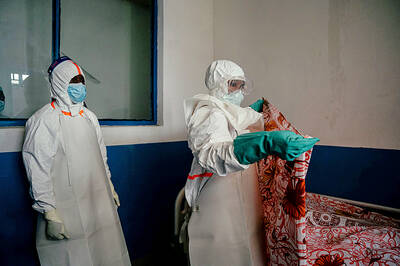
UPGRADED ALERT: The risk inside DR Congo is now considered ‘very high,’ while neighboring countries face a ‘high’ threat as the outbreak continues, the WHO said Ebola is spreading faster than responders can track it in eastern Congo, where health workers managed to follow up with barely one in five identified contacts in a single day. Authorities in the Democratic Republic of the Congo (DR Congo) reported 83 confirmed infections, 746 suspected cases and 1,603 identified contacts as of Thursday, but health workers were able to follow up on only 342 contacts that day — about 21 percent of the total under monitoring — data released by the DR Congo Ministry of Public Health on Friday showed. The figures suggest the response is falling behind the outbreak itself,


 RSS
RSS