


State and federal officials are scrambling to determine what caused the deaths of three children in this central California farming town of about 1,500 that shares a ZIP code with the largest hazardous waste treatment site west of the Mississippi.
Over a 15-month period in 2007 and 2008, six children of mothers from Kettleman City were born with serious birth defects, including cleft palates, deformities and brain damage. Three of those infants subsequently died.
And while health authorities have not placed any blame, the apparent cluster of defects has given new ammunition to environmentalists and local residents who have long been wary of the town’s proximity to the Kettleman Hills waste facility, a 647-hectare landfill that lies in an unincorporated area less than 6.4km west of here.
“We’ve always been saying, `The sky is falling, the sky is falling,”’ said Maricela Mares-Alatorre, a Kettleman City resident and longtime critic of the facility. “Well, for those mothers, the sky fell.”
Last week, officials from the US Environmental Protection Agency toured the landfill and visited with families of the children with birth defects. That action came less than a week after California Governor Arnold Schwarzenegger ordered the State Department of Public Health and California’s Environmental Protection Agency to look into what he called “an abnormal percentage of birth defects” occurring here.
The first report from the state is expected to be delivered tomorrow to the Kings County Board of Supervisors, which recently approved an expansion of the waste facility, owned by Waste Management, the largest recycler and waste-handling company in North America. The company operates hundreds of other landfills nationwide.
The company says it welcomes the investigation and the visit from the EPA’s regional administrator, Jared Blumenfeld.
“We were proud to showcase our sophisticated, state-of-the-art facility,” Bob Henry, the senior district manager of the Kettleman Hills facility, said in a statement, “and provide him an opportunity to see, firsthand, why we set the standard for safely managing hazardous waste.”
For Mares-Alatorre, the government scrutiny is long overdue. Her parents moved to Kettleman City from Los Angeles, about 257km south of here, in the late 1970s.
“They wanted a safe place to raise a family,” said Mares-Alatorre, 37, who teaches farm workers. “It’s got that Mayberry feeling, with a Latino twist.”
The waste facility opened in 1980. Late in that decade and in the early 1990s, the town became an environmental battleground when Waste Management, based in Houston, proposed opening a chemical-waste incinerator, a plan that was later abandoned.
That battle contributed to what Kit Cole, a spokeswoman for the company, called “a legacy of tension between Waste Management and selected members of the Kettleman City community that we struggle with even today.”
Cole said that the Kettleman Hills facility was safe and that a vast majority of the waste handled was run-of-the-mill garbage from municipalities. Only 24 hectares was devoted to the most dangerous material, she said, including hazardous chemicals and byproducts from manufacturing and agriculture, which are stabilized in cement blocks before they are buried.
And while Cole said the company made mistakes in “not reaching out to the community as much as we could have,” she also said she believed that environmentalists from other parts of California were using the situation in Kettleman City as “a gigantic fundraising effort.”
Bradley Angel, a persistent critic of the facility, said that that accusation was groundless, adding that Waste Management had “a lot of nerve resorting to bogus claims in a desperate attempt to divert attention from the fact that babies are being born with birth defects and dying in Kettleman City.”
Environmental concerns, including air and water quality, have long been a reality in the Central Valley of California, one of the most productive agricultural regions in the world. Kettleman City, a town of mostly low-income Latino residents, is no exception.
County health officials said they had been cautious about suggesting any connection between the facility and the birth defects, while also trying to manage the fear and pain of victims and their families.
Michael MacLean, the public health officer for Kings County, said that drawing conclusions from such a small sample was a challenge.
“I understand why people are concerned about it,” MacLean said, adding, however: “If I had to bet the farm on it, I think that this is just a statistical anomaly.”
State officials, meanwhile, have promised a wide-ranging investigation including a look at the overall rates of birth defects in the community and the region, as well as those for cancer and asthma.

Crowds in Bangladesh are flocking to snap photographs with an unlikely social media star — an albino buffalo with flowing blond hair nicknamed “Donald Trump” that is due to be sacrificed within days. Owner Zia Uddin Mridha, 38, said his brother named the 700kg bull over its flowing helmet of hair resembling the signature look of the US president. “My younger brother picked this name because of the buffalo’s extraordinary hair,” he said at his farm in Narayanganj, just outside the capital, Dhaka. Mridha said that a constant stream of curious visitors — social media fans, onlookers and children — have come throughout

The Bolivian government on Friday struck a deal with protesting miners, but was still grappling with blockades and demonstrations by other workers across La Paz. Other groups are still blocking access roads into the city, which is also the seat of the government. Police on Thursday prevented the miners from entering the main square by using tear gas, while the demonstrators hurled stones and explosives with slingshots. Protests against the policies of Bolivian President Rodrigo Paz have convulsed the Andean nation since early this month, and roadblocks were choking routes into La Paz throughout Friday, the national road authority said. Miners demanded that Paz

The Philippines said it has asked the country’s Supreme Court to allow it to arrest former Philippine president Rodrigo Duterte’s chief drug war enforcer to stand trial in an international tribunal. The International Criminal Court (ICC) last week unsealed an arrest warrant against Philippine Senator Ronald dela Rosa, accusing him along with Duterte and other “coperpetrators” of the “crime against humanity of murder.” Dela Rosa briefly sought refuge in the Philippine Senate last week while asking the Philippine Supreme Court to stop an ongoing attempt by government agents to arrest him. “By his own conduct, he has placed himself outside the protection of
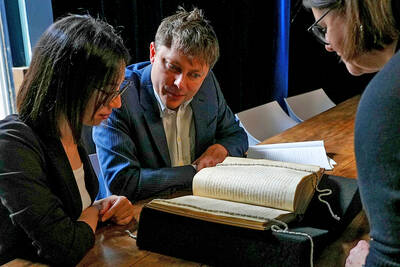
The researchers in Ireland looked at their computer screen, marveling at a medieval book tracked down in a Roman library. They flipped through its digitized pages and found their sought-after treasure: the oldest surviving English poem. “We were extremely surprised. We were speechless. We couldn’t believe our eyes when we first saw that,” said Elisabetta Magnanti, a visiting research fellow at Trinity College Dublin’s school of English. The poem was also within the main body of Latin text, she said, calling it “extraordinary.” Composed in Old English by a Northumbrian agricultural worker in the 7th century, Caedmon’s Hymn appears within some copies of


 RSS
RSS