


Government officials have labeled environmental campaigners extremists and listed them alongside dissident Irish republican groups and terrorists inspired by al-Qaeda in internal documents seen by the Guardian.
The guidance on extremism, produced by the Ministry of Justice, says: “The United Kingdom like many other countries faces a continuing threat from extremists who believe they can advance their aims by committing acts of terrorism.”
It was sent to probation staff who were writing court reports or supervising a range of activists, including environmental protesters.
The advice lists “environmental extremists” alongside far-right activists, dissident Irish republicans, loyalist paramilitaries and al-Qaeda-inspired extremists as among groups “currently categorized as extremist [that] may include those who have committed serious crime in pursuit of an ideology or cause.”
The government has been criticized for tarring environmental protesters as “domestic extremists,” a term invented by the police, who say it can cover activists suspected of minor public order offenses, such as peaceful direct action and civil disobedience. The internal guidance from the Ministry of Justice’s National Offender Management Service defines domestic extremism as any “unlawful action that is part of a protest or campaign.”
“It is often associated with a ‘single issue’ protest, such as animal rights, far-right and far-left political extremism, anti-war and environmentalist extremism. The activity of Domestic Extremist Offenders is more criminal in its nature than that of an activist — but falls short of terrorism,” the document says.
Environmentalists rejected the extremist label, saying their protests are peaceful and non-violent.
Harry Fletcher, assistant general secretary of the probation service union, NAPO, said its members were unhappy with government attempts to lump environmental campaigners with terrorist suspects.
He said the guidance appeared to be part of a wider attempt by some government officials to interfere for political reasons in the work of criminal justice staff.
Ben Stewart, of Greenpeace, said: “The climate movement has never once sought to further its political aims by using violence, which is something that Jack Straw, foreign secretary during the invasion of Iraq, can most certainly not claim. His Ministry of Justice would be better occupied reminding itself that peaceful direct action has a long and noble history in this country.”
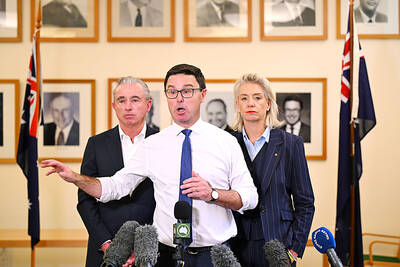
BACKLASH: The National Party quit its decades-long partnership with the Liberal Party after their election loss to center-left Labor, which won a historic third term Australia’s National Party has split from its conservative coalition partner of more than 60 years, the Liberal Party, citing policy differences over renewable energy and after a resounding loss at a national election this month. “Its time to have a break,” Nationals leader David Littleproud told reporters yesterday. The split shows the pressure on Australia’s conservative parties after Prime Minister Anthony Albanese’s center-left Labor party won a historic second term in the May 3 election, powered by a voter backlash against US President Donald Trump’s policies. Under the long-standing partnership in state and federal politics, the Liberal and National coalition had shared power

CONTROVERSY: During the performance of Israel’s entrant Yuval Raphael’s song ‘New Day Will Rise,’ loud whistles were heard and two people tried to get on stage Austria’s JJ yesterday won the Eurovision Song Contest, with his operatic song Wasted Love triumphing at the world’s biggest live music television event. After votes from national juries around Europe and viewers from across the continent and beyond, JJ gave Austria its first victory since bearded drag performer Conchita Wurst’s 2014 triumph. After the nail-biting drama as the votes were revealed running into yesterday morning, Austria finished with 436 points, ahead of Israel — whose participation drew protests — on 357 and Estonia on 356. “Thank you to you, Europe, for making my dreams come true,” 24-year-old countertenor JJ, whose

A documentary whose main subject, 25-year-old photojournalist Fatima Hassouna, was killed in an Israeli airstrike in Gaza weeks before it premiered at Cannes stunned viewers into silence at the festival on Thursday. As the cinema lights came back on, filmmaker Sepideh Farsi held up an image of the young Palestinian woman killed with younger siblings on April 16, and encouraged the audience to stand up and clap to pay tribute. “To kill a child, to kill a photographer is unacceptable,” Farsi said. “There are still children to save. It must be done fast,” the exiled Iranian filmmaker added. With Israel

Africa has established the continent’s first space agency to boost Earth observation and data sharing at a time when a more hostile global context is limiting the availability of climate and weather information. The African Space Agency opened its doors last month under the umbrella of the African Union and is headquartered in Cairo. The new organization, which is still being set up and hiring people in key positions, is to coordinate existing national space programs. It aims to improve the continent’s space infrastructure by launching satellites, setting up weather stations and making sure data can be shared across


 RSS
RSS