


Britain should be vigilant in shielding its tradition of free speech from erosion by anxieties over security, a leading European Muslim critic of the Iraq War says, referring to a furore over Islamists on UK campuses.
A report that a Nigerian who allegedly tried to down a US airliner joined al-Qaeda as a student in Britain has triggered charges from some media commentators that militant Islamists are establishing a dangerous presence at British universities.
Yemen has said the Nigerian, Umar Farouk Abdulmutallab, joined al-Qaeda in Britain before moving to the Arabian country, his home until shortly before Dec. 25. Britain says he was not seen as someone engaged in extremism during his 2005 to 2008 stay.
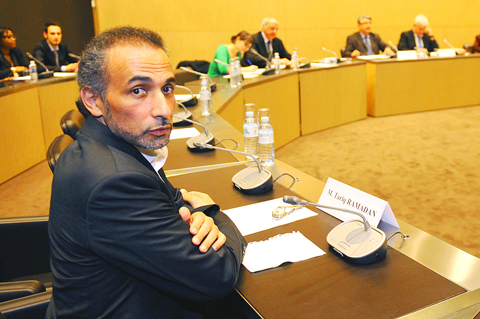
PHOTO: REUTERS
Tariq Ramadan, professor of contemporary Islamic studies at Oxford University, said the US experience under the administration of former US president George W. Bush had shown security fears could result in pressure on academic freedoms, a danger he said the administration of US President Barack Obama was now addressing.
“I think that in times of psychological pressure and fears, anything is possible,” he said. “I think we have to be very vigilant in Britain. It’s a very old tradition of free speech. What President Obama is saying today is, if we want to defeat violent extremist Muslims, we should understand that Muslims that are the mainstream trends are our allies, not our enemies. This is something we have to keep in mind in the UK.”
The US administration said on Wednesday it had lifted a ban on a planned visit by Ramadan, who was barred from the US for several years because of alleged terrorism ties which he denies. Rights groups hailed the move as a victory for civil liberties.
The US State Department said of the move that the government hoped to encourage more interaction with the Muslim world.
Ramadan said: “We should be able to protect the expression of disagreement, of dissent. If not we are all in danger.”
University College London, where Abdulmutallab studied, has set up an independent review of his time at the university. A university lobby group, Universities UK, is examining how all universities can protect academic freedom, while taking “appropriate action” to prevent violent extremism.
The American Civil Liberties Union had championed the case of Ramadan as part of a pattern of academics being excluded because of unwarranted or unspecified US national security grounds.
“You had Sept. 11 and you had an administration for eight years which was able to put such a psychological pressure on the continent it was very difficult to have free speech,” Ramadan said, referring to the attacks on US targets in 2001.
Ramadan said controversial headlines about security issues obscured what he called the positive dimension of Muslims’ presence and achievements in Britain.
Ramadan said he was telling Muslims critical of Western policies that they should be “constructively critical.”
“This is what I call the critical loyalty. So a loyal citizen is not a blind citizen,” he said.
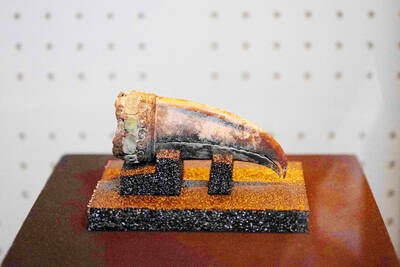
Archeologists in Peru on Thursday said they found the 5,000-year-old remains of a noblewoman at the sacred city of Caral, revealing the important role played by women in the oldest center of civilization in the Americas. “What has been discovered corresponds to a woman who apparently had elevated status, an elite woman,” archeologist David Palomino said. The mummy was found in Aspero, a sacred site within the city of Caral that was a garbage dump for more than 30 years until becoming an archeological site in the 1990s. Palomino said the carefully preserved remains, dating to 3,000BC, contained skin, part of the
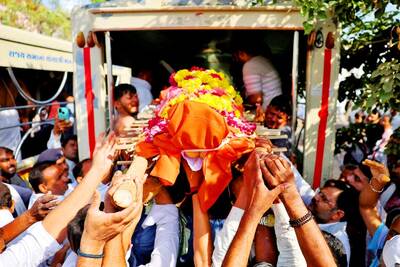
‘WATER WARFARE’: A Pakistani official called India’s suspension of a 65-year-old treaty on the sharing of waters from the Indus River ‘a cowardly, illegal move’ Pakistan yesterday canceled visas for Indian nationals, closed its airspace for all Indian-owned or operated airlines, and suspended all trade with India, including to and from any third country. The retaliatory measures follow India’s decision to suspend visas for Pakistani nationals in the aftermath of a deadly attack by shooters in Kashmir that killed 26 people, mostly tourists. The rare attack on civilians shocked and outraged India and prompted calls for action against their country’s archenemy, Pakistan. New Delhi did not publicly produce evidence connecting the attack to its neighbor, but said it had “cross-border” links to Pakistan. Pakistan denied any connection to

TRUMP EFFECT: The win capped one of the most dramatic turnarounds in Canadian political history after the Conservatives had led the Liberals by more than 20 points Canadian Prime Minister Mark Carney yesterday pledged to win US President Donald Trump’s trade war after winning Canada’s election and leading his Liberal Party to another term in power. Following a campaign dominated by Trump’s tariffs and annexation threats, Carney promised to chart “a new path forward” in a world “fundamentally changed” by a US that is newly hostile to free trade. “We are over the shock of the American betrayal, but we should never forget the lessons,” said Carney, who led the central banks of Canada and the UK before entering politics earlier this year. “We will win this trade war and

Armed with 4,000 eggs and a truckload of sugar and cream, French pastry chefs on Wednesday completed a 121.8m-long strawberry cake that they have claimed is the world’s longest ever made. Youssef El Gatou brought together 20 chefs to make the 1.2 tonne masterpiece that took a week to complete and was set out on tables in an ice rink in the Paris suburb town of Argenteuil for residents to inspect. The effort overtook a 100.48m-long strawberry cake made in the Italian town of San Mauro Torinese in 2019. El Gatou’s cake also used 350kg of strawberries, 150kg of sugar and 415kg of


 RSS
RSS