


Ukraine has paid too high a price for the democratic reforms ushered in by the 2004 Orange Revolution, says the pro-Russian front-runner in the country’s presidential race, who pledges to bring back the “rule of law” if elected next month.
Viktor Yanukovych, whose Kremlin-backed election victory in 2004 was overturned by the Supreme Court amid allegations of fraud, says the pro-Western revolution that brought his rivals to power has led to political chaos, corruption and a dismal economy.
“So what did this Orange Revolution give us?” Yanukovych asked in an interview on Monday. “Freedom of speech? That’s very good. But what price did the Ukrainian people pay for this? For the development of this democratic principle in our country, the price was too great.”
Democracy is “above all the rule of law,” which the Orange Revolution has failed to bring, he said.
Since taking power in 2005 on a wave of hope and excitement, the revolution’s leaders have disappointed many Ukrainians, fostering nostalgia among some for the stable, if autocratic, rule of an earlier era.
The Orange Revolution took Ukraine out of Russia’s orbit, as the pro-Western leadership sought membership in the EU and NATO. It also deepened animosity between the pro-Russian east and the west of the country, where Ukrainian nationalism is strong.
Yanukovych said his first priority as president would be to revive the use of the Russian language in schools and in the workplace, a move that would reverse the “forced Ukrainization” of the millions of Russian-speaking Ukrainians who support him.
“This is the main question that we have to solve right now, the one that is very seriously worrying the people,” he said.
With elections less than three weeks away, Yanukovych, 59, is leading in the polls. The former electrician said he would put his weight behind Moscow on issues ranging from trade to security.
He repeated his pledge not to seek membership in NATO, Russia’s Cold War foe. But he said he would give his full support to Russia’s proposal for a joint European security regime, which has gotten an icy reception in most of Europe.
He also promised, if elected, to do everything in his power to speed Russia’s entry into the WTO.
Viktor Yushchenko, the current president and the leader of the Orange Revolution, is going into the vote with approval ratings in the single digits. He has been at loggerheads with his former ally, Prime Minister Yulia Tymoshenko, for most of his time in office, causing political gridlock that has deepened the country’s economic collapse and alienated voters.
Yanukovych, a barrel-chested hunting enthusiast, also denies that his 2004 presidential victory was fixed. His campaign has focused on shaming Tymoshenko, his only real competition, for her leadership of the Orange Revolution, which he blames for turning Ukraine’s government into one of the most corrupt in the world and its economy into one of the worst-performing.
“Democracy is above all rule of law ... we have seen how the laws have been systematically broken, how the principles of the law have been replaced by political expediency,” Yanukovych said.
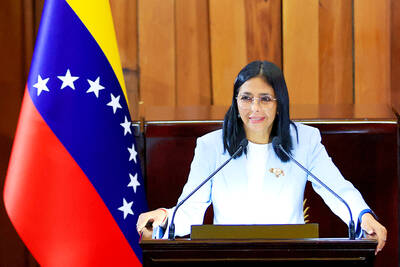
VAGUE: The criteria of the amnesty remain unclear, but it would cover political violence from 1999 to today, and those convicted of murder or drug trafficking would not qualify Venezuelan Acting President Delcy Rodriguez on Friday announced an amnesty bill that could lead to the release of hundreds of prisoners, including opposition leaders, journalists and human rights activists detained for political reasons. The measure had long been sought by the US-backed opposition. It is the latest concession Rodriguez has made since taking the reins of the country on Jan. 3 after the brazen seizure of then-Venezuelan president Nicolas Maduro. Rodriguez told a gathering of justices, magistrates, ministers, military brass and other government leaders that the ruling party-controlled Venezuelan National Assembly would take up the bill with urgency. Rodriguez also announced the shutdown
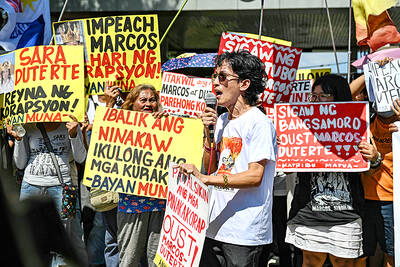
Civil society leaders and members of a left-wing coalition yesterday filed impeachment complaints against Philippine Vice President Sara Duterte, restarting a process sidelined by the Supreme Court last year. Both cases accuse Duterte of misusing public funds during her term as education secretary, while one revives allegations that she threatened to assassinate former ally Philippine President Ferdinand Marcos Jr. The filings come on the same day that a committee in the House of Representatives was to begin hearings into impeachment complaints against Marcos, accused of corruption tied to a spiraling scandal over bogus flood control projects. Under the constitution, an impeachment by the
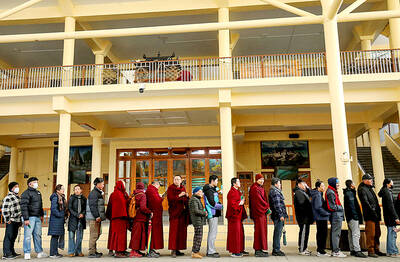
Exiled Tibetans began a unique global election yesterday for a government representing a homeland many have never seen, as part of a democratic exercise voters say carries great weight. From red-robed Buddhist monks in the snowy Himalayas, to political exiles in megacities across South Asia, to refugees in Australia, Europe and North America, voting takes place in 27 countries — but not China. “Elections ... show that the struggle for Tibet’s freedom and independence continues from generation to generation,” said candidate Gyaltsen Chokye, 33, who is based in the Indian hill-town of Dharamsala, headquarters of the government-in-exile, the Central Tibetan Administration (CTA). It
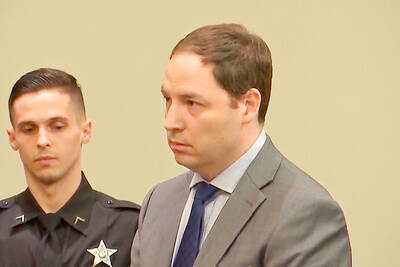
A Virginia man having an affair with the family’s Brazilian au pair on Monday was found guilty of murdering his wife and another man that prosecutors say was lured to the house as a fall guy. Brendan Banfield, a former Internal Revenue Service law enforcement officer, told police he came across Joseph Ryan attacking his wife, Christine Banfield, with a knife on the morning of Feb. 24, 2023. He shot Ryan and then Juliana Magalhaes, the au pair, shot him, too, but officials argued in court that the story was too good to be true, telling jurors that Brendan Banfield set


 RSS
RSS