


Supporters of Iran’s opposition have posted hundreds of photos online of men in women’s clothing to mock what they say was a government attempt to discredit a student leader by photographing him in a head scarf and woman’s robe.
Majid Tavakoli was arrested in last week’s large student-led protests after he gave a speech urging students to reject “tyranny,” a call greeted by chants of “Death to the dictator.”
Pro-government media said he put on women’s clothing in an attempt to escape authorities around his campus but was caught.
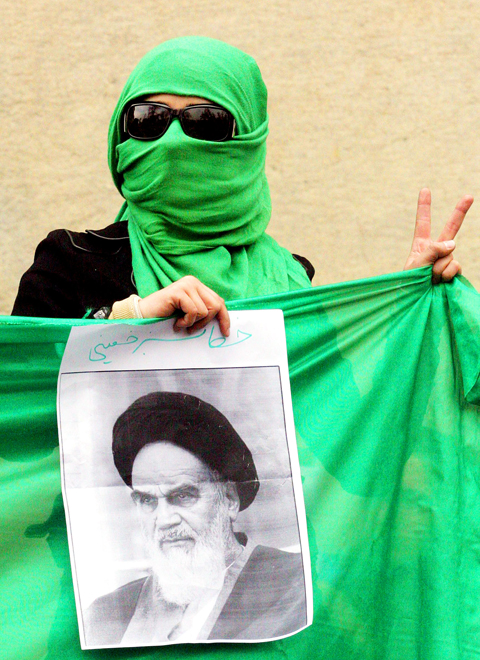
PHOTO: EPA
The Fars news agency, which is close to the elite Revolutionary Guard military force, published photos of Tavakoli wearing a black chador, the all-covering dress worn by devout Muslim women, and a blue head scarf around his unshaven, downcast face.
Iran’s opposition fired back over the past week by inundating Web sites such as Facebook with pictures of men wearing headscarves and chadors.
Tavakoli’s supporters accused authorities of forcing him into women’s clothing and photographing him in an attempt to humiliate the activist and discredit the opposition.
Tavakoli is a member of the largest student organization advocating greater social and political freedoms in Iran and is a student at Tehran’s Amir Kabir University, the site of one of the Dec. 7 protests the drew tens of thousands out on campuses and city squares around the country.
Students have been at the core of the pro-reform movement, which has accused authorities of rigging Iranian President Mahmoud Ahmadinejad’s June re-election.
In the Web campaigns calling for Tavakoli’s release, male supporters donned Islamic-style women’s dress in hundreds of whimsical self-portraits. Many of them were bearded and smirking. Others held up V-for-victory signs and wore the green color that has become the opposition’s emblem.
Some of the photos were clumsily altered to underscore opposition claims that the pictures of Tavakoli might have been digitally manipulated.
The Fars report quoted a pro-government student activist as saying that Tavakoli tried to flee in women’s clothing and that his actions were a “permanent stain on the illegal student movement.”
“He was always introduced as a brave guy, but this move proved his lack of power to resist and avoid paying the price for his own ideas,” the activist, Abbas Ensani, was quoted as saying.
Tavakoli has been arrested twice before. He was jailed for 15 months in 2007 and last year on a conviction of insulting Islam in a student newsletter.
He and two other students put on trial in that case told the court that the newsletter containing insults against an Islamic saint had been fabricated by hardline students and attributed to reformist students in effort to defame them.
Meanwhile, authorities have arrested several people accused of destroying photos of Khomeini and Supreme Leader Ayatollah Ali Khamenei at demonstrations on university campuses last week, state media reported yesterday.
Tehran’s prosecutor promised to show “no mercy” to those responsible, but the news reports carrying his remarks gave no details on those arrested.

‘CROSSING THE LINE’: China’s embassy in Seoul criticized US Forces Korea Commander General Xavier Brunson, asking if his ‘hostile’ remarks were authorized by Washington South Korea and the US are in talks over recent public remarks by the commander of US Forces Korea, Seoul’s presidential office said yesterday, after the comments drew sharp criticism from China. In a recent podcast interview, US Forces Korea Commander General Xavier Brunson described South Korea as “the dagger in the heart of Asia” from China’s east coast, prompting the Chinese embassy in Seoul to say that he had “truly crossed the line.” The interview came amid growing speculation that Washington might seek to expand the role of US Forces Korea in countering the growing regional influence of China, a key

SEEKING ORDER: Rodrigo Paz said that ‘anyone who wants to destroy the nation will have to deal with this president and the full force of the constitution’ Bolivian President Rodrigo Paz on Wednesday said that the nation was at a “breaking point” after nearly a month of protests that have caused shortages of food, fuel and medicine. Paz, who took office six months ago amid the worst economic crisis there in four decades, is battling a groundswell of fury over his policies. The political capital, La Paz, has been besieged by low-income workers and members of the indigenous majority calling for his resignation. “The country needs order and is reaching breaking point,” the 58-year-old said at a public event in La Paz, renewing his appeal for dialogue. On Tuesday, the Bolivian

Through the noise of rushing papers and whirring belts at a print factory in Kyoto, two creators watch their photo essay come to life in broadsheet form — part of an effort to win new audiences in the age of artificial intelligence (AI). Despite the decline of the publishing industry, self-publication and handmade “zine” magazines are growing in popularity in Japan, reflecting the nation’s enduring love of paper in the digital era. While speaking to Agence France-Presse at the plant, his hands black with ink, one of the creators, Kazuma Obara, said: “I think [paper] is a medium that engages all five

Australian researchers have trained lab-grown brain cells on a silicon computer chip to play the 1990s shooter game Doom and said they are just scratching the surface of what the neurons could be capable of doing. It is the science-fiction work of biotech boffins at Cortical Labs, who researched and developed the technology that harnesses the workings of the brain’s networking system. Each so-called “biological computer” contains about 200,000 living human brain cells, grown from stem cells that were harvested from blood donations. Having mastered the simple computer game Pong, where a paddle is moved up and down to send a ball


 RSS
RSS