


A court in China’s restive Xinjiang yesterday sentenced three more people to death for their roles in July ethnic violence, Xinhua news agency reported, raising the total reported condemned to 17.
On Thursday, the court handed out death sentences to five others.
The Intermediate People’s Court of Urumqi also sentenced one person to life in prison, while three defendants were given varying jail terms for the violence that left nearly 200 dead and over 1,600 injured, the agency said.
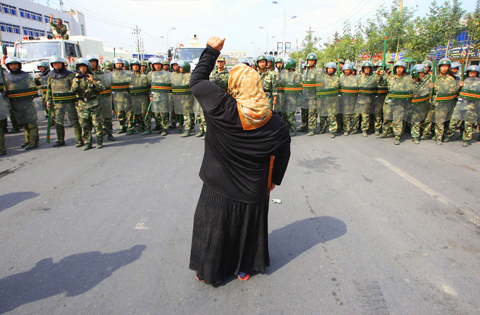
PHOTO: REUTERS
Last month nine people previously sentenced to death were executed for their roles in the violence, the worst strife in China in decades.
Violence erupted in the streets of Urumqi on July 5, when Uighurs — a Muslim minority that has long complained of Chinese repression — reportedly attacked members of China’s Han ethnic majority.
In subsequent days, mobs of Han roamed the city’s streets seeking revenge.
Xinhua identified those sentenced to death yesterday as Heyrinisa Sawut and Ruzikhari Niyaz — both apparently Uighurs judging from their names — and Li Longfei.
Sawut was convicted of beating one man to death and injuring three others by repeatedly bludgeoning them with a wooden club, Xinhua said, while Niyaz was convicted of killing a taxi driver.
Li Longfei was convicted over the beating deaths of at least two victims, whose names suggested they were Uighurs.
So far 41 people have been tried and sentenced in the unrest.
Of the five sentenced to death on Thursday, Memeteli Islam was accused of killing a police officer by smashing him in the back of the head with a brick.
Mamattursun Elmu and Memeteli Abburakm were accused of attacking a minibus and kicking a man and woman inside until they died. Mamattursun Elmu was also charged with setting fire to a grain distribution center, killing five people.
Helil Sadir was accused of killing a bystander with a beer bottle and kicks to the face, and Kushiman Kurban was found guilty of stabbing a bystander to death.
Rebiya Kadeer, leader of the Germany-based World Uyghur Congress, said in a statement e-mailed to journalists: “The Chinese government has brazenly ignored all standards of due process of law in a campaign to silence and intimidate the Uighur population through executions and mass detentions.”

An American scientist convicted of lying to US authorities about payments from China while he was at Harvard University has rebuilt his research lab in Shenzhen, China, to pursue technology the Chinese government has identified as a national priority: embedding electronics into the human brain. Charles Lieber, 67, is among the world’s leading researchers in brain-computer interfaces. The technology has shown promise in treating conditions such as amyotrophic lateral sclerosis and restoring movement in paralyzed people. It also has potential military applications: Scientists at the Chinese People’s Liberation Army have investigated brain interfaces as a way to engineer super soldiers by boosting

Indonesian police have arrested 13 people after shocking images of alleged abuse against small children at a daycare center went viral, sparking outrage across the nation, officials said on Monday. Police on Friday last week raided Little Aresha, a daycare center in Yogyakarta on Java island, following a report from a former employee. CCTV footage circulating on social media showed children, most younger than two, lying on the floor wearing only diapers, their hands and feet bound with rags. The police have confirmed that the footage is authentic. Police said they also found 20 children crammed into a room just 3m by 3m. “So

A highway bomb attack in a restive region of southwestern Colombia on Saturday killed 14 people and injured at least 38, the latest spate of violence ahead of next month’s presidential election. Authorities blamed the attack in the Cauca department — a conflict-ridden, coca-growing region — on dissidents of the now-disbanded FARC guerrilla army, who have been sowing violence across the country. “Those who carried out this attack ... are terrorists, fascists and drug traffickers,” Colombian President Gustavo Petro said on social media. “I want our very best soldiers to confront them,” he added. The leftist leader blamed the bombing
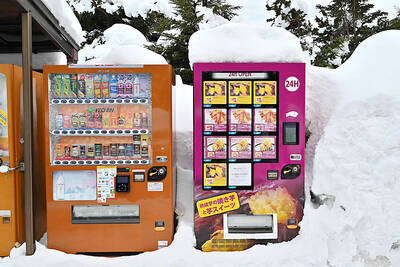
From post offices and parks to stations and even the summit of Mount Fuji, Japan’s vending machines are ubiquitous, but with the rapid pace of inflation cooling demand for their drinks, operators are being forced to rethink the business. Last month beverage giant DyDo Group Holdings announced it would remove about 20,000 vending machines — about 7 percent of their stock nationwide — by January next year, to “reconstruct a profitable network.” Pokka Sapporo Food & Beverage, based in Nagoya, also said last month it would sell its 40,000-machine operation to Osaka-based Lifedrink Co. “The strength of the vending machine


 RSS
RSS