


Peggy Pauly lives in a robin-egg blue, two-story house not far from hectares of onion fields that make the northern Nevada air smell sweet at harvest time, but she can look through the window from her kitchen table, just past her backyard and pet llama, and see an ominous sign on a neighboring fence: “Danger: Uranium Mine.”
For almost a decade, people who make their homes in this rural community in the Mason Valley 105km southeast of Reno have blamed that enormous abandoned mine for the high levels of uranium in their water wells.
They say they have been met by a stone wall from state regulators, local politicians and the huge oil company that inherited the toxic site — London-based BP PLC. Those interests have insisted uranium naturally occurs in the region’s soil and there’s no way to prove that a half-century of processing metals at the former Anaconda pit mine is responsible for the contamination.
That has changed. A new wave of testing by the US Environmental Protection Agency (EPA) has found that 79 percent of the wells tested north of the World War II-era copper mine have dangerous levels of uranium or arsenic, or both, that make the water unsafe to drink.
And, more importantly to the neighbors, that the source of the pollution is a groundwater plume that has slowly migrated from the 15.5km² mine site.
The new samples likely never would have been taken if not for a whistle-blower, a preacher’s wife, a tribal consultant and some stubborn government scientists who finally helped crack the toxic mystery that has plagued this rural mining and farming community for decades.
“They have completely ruined the groundwater out here,” said Pauly, the wife of a local pastor and mother of two girls who organized a community action group five years ago to seek the truth about the pollution.
“It almost sounds like we are happy the contamination has moved off the site, but what we are happy about is ... they have enough data to now answer our questions,” she said.
“Prior to this, we didn’t really have an understanding of where water was moving,” said Steve Acree, a highly regarded hydrogeologist for the EPA in Oklahoma, who was brought in to examine the test results. “My interpretation at this stage of the process is yes, you now have evidence of mine-impacted groundwater.”
The tests found levels of uranium more than 10 times the legal drinking water standard in one monitoring well about 1km north of the mine. Though the health effects of specific levels are not well understood, the EPA says long-term exposure to high levels of uranium in drinking water may cause cancer and damage kidneys.
At the mine itself, wells tested as high as 3.4 milligrams per liter — more than 100 times the standard. That’s in an area where ore was processed with sulfuric acid and other toxic chemicals in unlined ponds.
Moving north toward the mine’s boundary and beyond, readings begin to decline, but several wells still tested two to three times above health limits.
“The hot spots, the treatment areas on the site, are places you totally expect to see readings like that, but this shows you have a continuous plume with decreasing concentration as you move away from the site,” said Dietrick McGinnis, an environmental consultant for the neighboring Yerington Paiute Tribe.
The new findings are no surprise to Earle Dixon, the site’s former project manager for the US Bureau of Land Management (BLM), which owns about half of the property.
An administrative judge ruled last year that the BLM illegally fired Dixon in 2004 in retaliation for speaking out about the health and safety dangers at the mine.
“The new data depicts the story that I had tried to hypothesize as a possibility,” Dixon said.
“It was speculation, because I didn’t have the dramatic evidence they have now. You just had all the symptoms,” he said from New Mexico, where he is now a state geologist.
“The way the state has been telling the story and BP and Lyon County ... is this is mostly all natural. Well, no it’s not,” he said. “We now know for a fact that most of this uranium as far as 2 miles [3.2km] out from the mine comes from the mine. This site becomes a poster child for mining pollution.”
Officials for BP and its subsidiary, Atlantic Richfield, have insisted until now that the uranium could not be tied to the mine. They maintained the high concentrations were a naturally occurring phenomenon beneath Nevada’s mineral-laden mountains.
The new discovery has Pauly, McGinnis and others renewing a call for the EPA to declare the mine a Superfund site — something the state and county have opposed despite a new potential source of money to help cover clean-up costs that could reach hundreds of millions of dollars.
Jill Lufrano, spokeswoman for the Nevada Department of Environmental Protection, said an investigation into the source of contamination is continuing, but “the new finding does put scientific confirmation behind the theory that this would migrate off site.”
She said the new evidence doesn’t change the state’s opposition to Superfund listing. Nevada has a long tradition of supporting mining and now produces more gold than anywhere in the world except China, South Africa and Australia.
Copper was first discovered around Yerington in 1865. Anaconda bought the property in 1941 and — fueled by demand after World War II — produced nearly 800 million kilograms from 1952 to 1978.
A mineral firm launched a then-secret plan to produce yellowcake uranium from the mine’s waste piles in the 1970s. An engineer reported in 1976 that they weren’t finding as much uranium as anticipated in the processing ponds.
“Where could it be now?” he wrote. “Should we continue to look for it?”
Had they continued the search outside the processing area, Wyoming Mineral Corp likely would have detected the movement of the contamination, but the market for uranium dipped and the company scuttled the venture.
Pauly never suspected the mine was leaking contamination when she and her husband finished building their home in 1990. They drank water from their well until 2003 — and used it to mix formula for a baby from 1996 to 1998 — before becoming suspicious as rumors swirled about the contaminated mine.
“Everybody said it was fine,” she said. “Legally they didn’t have to disclose anything because technically there was nothing definitive then that showed the contamination was moving off the site.”
BP and Atlantic Richfield, which bought Anaconda Copper Co in 1978, have stopped claiming there is no evidence the mine caused any contamination, but they aren’t conceding anything about how much.
“We know the mine has had an impact, but to what extent is not really known at this time,” Tom Mueller, spokesman for BP America, said in a recent e-mail.
He said the sampling “remains inconclusive regarding relative impacts from the mine” compared with other potential sources.
Yerington Paiute Tribe chairman Elwood Emm said he hopes the new findings help expedite a cleanup.
“In the meantime, we continue to lose our water resource,” he said.
So who will pay for the cleanup?
“That is the million-dollar question,” Dixon said. “Every Superfund site needs an advocate or two or three, and in my view there are none for Yerington except for Peggy Pauly.”
Regardless of who pays, Acree said, it likely will take decades to clean up.

VAGUE: The criteria of the amnesty remain unclear, but it would cover political violence from 1999 to today, and those convicted of murder or drug trafficking would not qualify Venezuelan Acting President Delcy Rodriguez on Friday announced an amnesty bill that could lead to the release of hundreds of prisoners, including opposition leaders, journalists and human rights activists detained for political reasons. The measure had long been sought by the US-backed opposition. It is the latest concession Rodriguez has made since taking the reins of the country on Jan. 3 after the brazen seizure of then-Venezuelan president Nicolas Maduro. Rodriguez told a gathering of justices, magistrates, ministers, military brass and other government leaders that the ruling party-controlled Venezuelan National Assembly would take up the bill with urgency. Rodriguez also announced the shutdown
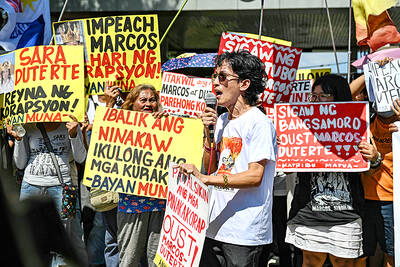
Civil society leaders and members of a left-wing coalition yesterday filed impeachment complaints against Philippine Vice President Sara Duterte, restarting a process sidelined by the Supreme Court last year. Both cases accuse Duterte of misusing public funds during her term as education secretary, while one revives allegations that she threatened to assassinate former ally Philippine President Ferdinand Marcos Jr. The filings come on the same day that a committee in the House of Representatives was to begin hearings into impeachment complaints against Marcos, accused of corruption tied to a spiraling scandal over bogus flood control projects. Under the constitution, an impeachment by the
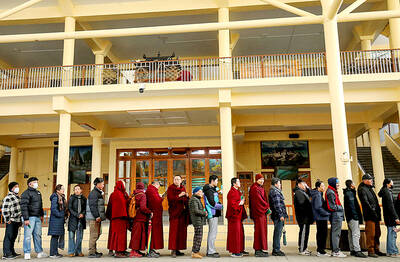
Exiled Tibetans began a unique global election yesterday for a government representing a homeland many have never seen, as part of a democratic exercise voters say carries great weight. From red-robed Buddhist monks in the snowy Himalayas, to political exiles in megacities across South Asia, to refugees in Australia, Europe and North America, voting takes place in 27 countries — but not China. “Elections ... show that the struggle for Tibet’s freedom and independence continues from generation to generation,” said candidate Gyaltsen Chokye, 33, who is based in the Indian hill-town of Dharamsala, headquarters of the government-in-exile, the Central Tibetan Administration (CTA). It

A Virginia man having an affair with the family’s Brazilian au pair on Monday was found guilty of murdering his wife and another man that prosecutors say was lured to the house as a fall guy. Brendan Banfield, a former Internal Revenue Service law enforcement officer, told police he came across Joseph Ryan attacking his wife, Christine Banfield, with a knife on the morning of Feb. 24, 2023. He shot Ryan and then Juliana Magalhaes, the au pair, shot him, too, but officials argued in court that the story was too good to be true, telling jurors that Brendan Banfield set


 RSS
RSS