


Valuing truth over the right to privacy, Argentina’s Congress has authorized the forced extraction of DNA from people who may have been born to political prisoners slain a quarter-century ago — even when they don’t want to know their birth parents.
Human rights activists hope the new law will help find about 400 people stolen as babies, many from women who were kidnapped and gave birth inside clandestine torture centers during the 1976 to 1983 dictatorship. Thousands of leftists disappeared in what became known as the “dirty war” against political dissent.
Others see the law as government intrusion, legalizing the violation of a person’s very identity. And as written, it could have much broader implications, enabling DNA to be sought from anyone whenever a judge determines the evidence to be “absolutely necessary.”
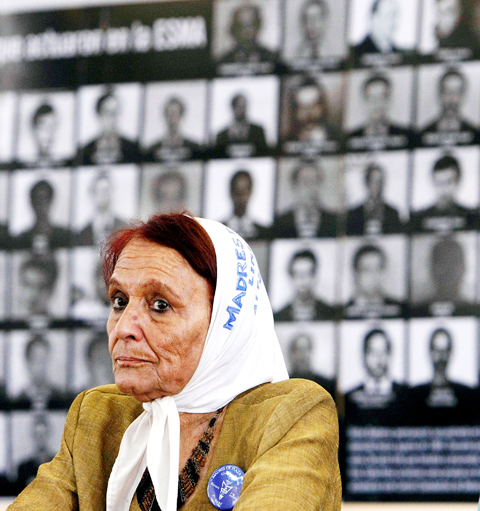
PHOTO: REUTERS
Children of the “disappeared” were often given to military or police families considered loyal to the military government. Some have grown up not even knowing they were adopted until activists or judges announced efforts to obtain their DNA.
The project of the Grandmothers of the Plaza de Mayo, close allies of Argentine President Cristina Fernandez, was approved by a 58-1 vote of the Senate on Wednesday. Since it has already passed in the lower house, it will become law once it is published in Argentina’s official bulletin.
Recovering their grandchildren has been a priority for the group since they first began demonstrating in front of the presidential palace in 1977, carrying pictures of their disappeared relatives.
DNA technology has helped them identify 98 of 500 children they believe were born in prison or kidnapped as infants.
Using survivors’ testimony, documents from birth families and adoption records, they have persuaded some judges to seek DNA from suspected victims of the “dirty war.” But courts have sometimes ruled that a child’s right to privacy outweighs a grandmother’s right to know.
The new law legalizes the extraction of “minimal amounts of blood, saliva, skin, hair or other biological samples” to determine identity. If a person refuses to provide a sample, a judge can issue a warrant for material from a hairbrush, toothbrush, clothing or other objects.
“It’s an absolute invasion of the right to biological privacy,” constitutional lawyer Gregorio Badeni told reporters. “No one has the right to know what I have inside my body. That belongs only to me. I can give it up voluntarily, but no one can obligate me to deliver it.”
Estela de Carlotto, the head of the grandmothers group, said that she disagrees.
By allowing officials to extract DNA from personal effects, the law “doesn’t violate in any way the body or the privacy,” she said.
The Argentine law may be unprecedented in requiring tests of people who aren’t suspected of crimes, said Marcy Darnovsky, associate executive director for the Center for Genetics and Society in Berkeley, California.
Large forensic DNA databases in Britain and the US have generated controversy because they include people who have been arrested but not convicted or, in some cases, even charged. Pilot projects in Britain, the US and France that used DNA tests to confirm family ties of asylum seekers also have raised ethical concerns.
“If an adult doesn’t want to know his origins, you have to respect it,” said Julio Strassera, a former prosecutor who put top military leaders on trial.
Some who have recovered their identities welcome the law, saying it helps people who suspect they might have been stolen at birth.
“The state cannot leave in the hands of a young person, raised by a member of the military, manipulated by guilt, the decision of whether or not to learn his true identity,” said Horacio Pietragalla, who learned in 2003 that he was taken as a baby from his biological mother, Liliana Corti.
Under the law, the state “tells you the truth. After that, you have to decide what you want to do with that truth,” he said.
In the past, DNA findings have sometimes been made public against an orphan’s wishes, either because a judge announced it or because the biological family released the information. The new law provides no guarantee of privacy either.
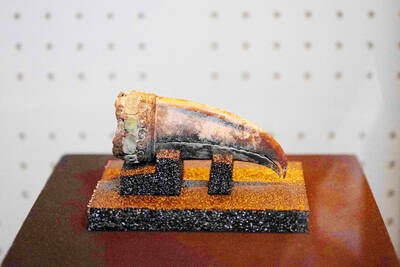
Archeologists in Peru on Thursday said they found the 5,000-year-old remains of a noblewoman at the sacred city of Caral, revealing the important role played by women in the oldest center of civilization in the Americas. “What has been discovered corresponds to a woman who apparently had elevated status, an elite woman,” archeologist David Palomino said. The mummy was found in Aspero, a sacred site within the city of Caral that was a garbage dump for more than 30 years until becoming an archeological site in the 1990s. Palomino said the carefully preserved remains, dating to 3,000BC, contained skin, part of the
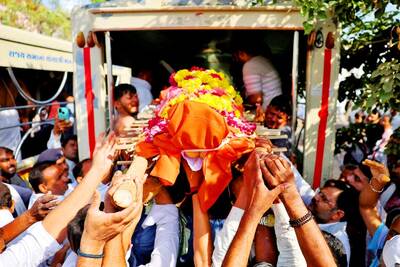
‘WATER WARFARE’: A Pakistani official called India’s suspension of a 65-year-old treaty on the sharing of waters from the Indus River ‘a cowardly, illegal move’ Pakistan yesterday canceled visas for Indian nationals, closed its airspace for all Indian-owned or operated airlines, and suspended all trade with India, including to and from any third country. The retaliatory measures follow India’s decision to suspend visas for Pakistani nationals in the aftermath of a deadly attack by shooters in Kashmir that killed 26 people, mostly tourists. The rare attack on civilians shocked and outraged India and prompted calls for action against their country’s archenemy, Pakistan. New Delhi did not publicly produce evidence connecting the attack to its neighbor, but said it had “cross-border” links to Pakistan. Pakistan denied any connection to

TRUMP EFFECT: The win capped one of the most dramatic turnarounds in Canadian political history after the Conservatives had led the Liberals by more than 20 points Canadian Prime Minister Mark Carney yesterday pledged to win US President Donald Trump’s trade war after winning Canada’s election and leading his Liberal Party to another term in power. Following a campaign dominated by Trump’s tariffs and annexation threats, Carney promised to chart “a new path forward” in a world “fundamentally changed” by a US that is newly hostile to free trade. “We are over the shock of the American betrayal, but we should never forget the lessons,” said Carney, who led the central banks of Canada and the UK before entering politics earlier this year. “We will win this trade war and

Armed with 4,000 eggs and a truckload of sugar and cream, French pastry chefs on Wednesday completed a 121.8m-long strawberry cake that they have claimed is the world’s longest ever made. Youssef El Gatou brought together 20 chefs to make the 1.2 tonne masterpiece that took a week to complete and was set out on tables in an ice rink in the Paris suburb town of Argenteuil for residents to inspect. The effort overtook a 100.48m-long strawberry cake made in the Italian town of San Mauro Torinese in 2019. El Gatou’s cake also used 350kg of strawberries, 150kg of sugar and 415kg of


 RSS
RSS