


In India, the rich just got richer. Despite one of the worst global recessions in history, the number of billionaires in the subcontinent has almost doubled since last year.
Figures show that there are now 52 billionaires in India, compared with 27 last year.
Over the course of the year, the stock market has gained more than 75 percent and the economy has grown at almost 7 percent, pouring billions of dollars into the bank accounts of India’s richest people.
But with 0.00001 percent of India’s population now accounting for around a quarter of its US$1 trillion GDP, fierce debate about the polarization of the country’s society has begun.
Mukesh Ambani, the chief of Reliance Industries, India’s biggest private company, remains its richest person with a net worth of about US$32 billion.
He is followed by London-based steel baron Lakshmi Mittal, with US$30 billion, with the net worth of both men rising by half.
Ambani’s estranged brother, Anil, was India’s third-wealthiest person, with a fortune of US$17.5 billion.
The combined wealth of India’s 100 richest people was put at US$276 billion — considerably more than China’s 100 wealthiest, who have US$170 billion.
These two Asian giants have been the bright spots in the global economy, and analysts expect India, Asia’s third-biggest economy, to expand by 6.4 percent next year — the fastest pace among the G20 nations after China.
By contrast, the rich in the US have gotten poorer. Microsoft founder Bill Gates lost US$7 billion, shrinking his personal wealth to US$50 billion. Investor Warren Buffet was down to his last US$40 billion, while almost 100 billionaires in the US were reduced to being worth millions last year.
In a sign of how wealthy Indian billionaires are, Mukesh Ambani, whose oil-to-supermarkets empire is ubiquitous in the country, is now almost three times richer than Microsoft CEO Steve Ballmer, a classmate at Stanford University.
There has been increasing concern about the emergence of the super-rich in India, a country in which 800 million people live on 20 rupees (US$0.50) a day.
Last month, India’s corporate affairs minister Salman Khurshid called for a cut in the “vulgar” salaries of top bosses in India, who have seen their pay rocket. Soon after his call for restraint, Reliance announced a 66 percent pay cut for Mukesh Ambani to “set a personal example of moderation.”
The elder Ambani will take home US$3.2 million in salary and a share of profits for the year.
However, Abhijet Sen, a leftwing academic who is also a member of the Planning Commission — India’s advisory panel on government spending — said: “I am certain that inequality is increasing and nothing is being done to curb grotesque amounts of wealth building up.”
He said the government was “sincere about doing something for the poor, but not about capping the rich.”
“I can see a major problem, because money is corrupting politics,” he said. “People are able to buy power in a way that is not healthy. You have to be a millionaire to contest even local elections. So there are problems with rising inequality.”
He said that, as a first step, India “should institute a death tax. In America, there are inheritance taxes. This would be a good first step to immediately reducing inequality.”
However, other experts say inequality, as measured by the government, has not risen. “This is just a few headlines, not a serious look about wealth distribution in the general population,” Surjit Bhalla of Oxus investments said. “Forbes’ billionaire list allows for leftwingers to talk up poverty. The [government] surveys show that, for 20 years, inequality has not risen.”

Hungarian authorities temporarily detained seven Ukrainian citizens and seized two armored cars carrying tens of millions of euros in cash across Hungary on suspicion of money laundering, officials said on Friday. The Ukrainians were released on Friday, following their detention on Thursday, but Hungarian officials held onto the cash, prompting Ukraine to accuse Hungary’s Russia-friendly government of illegally seizing the money. “We will not tolerate this state banditism,” Ukrainian Minister of Foreign Affairs Andrii Sybiha said. The seven detained Ukrainians were employees of the Ukrainian state-owned Oschadbank, who were traveling in the two armored cars that were carrying the money between Austria and
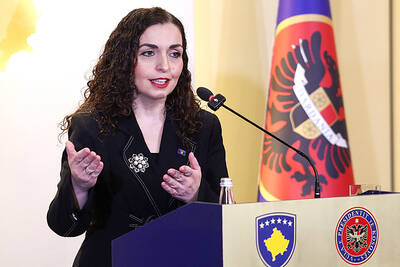
Kosovar President Vjosa Osmani on Friday after dissolving the Kosovar parliament said a snap election should be held as soon as possible to avoid another prolonged political crisis in the Balkan country at a time of global turmoil. Osmani said it is important for Kosovo to wrap up the upcoming election process and form functional institutions for political stability as the war rages in the Middle East. “Precisely because the geopolitical situation is that complex, it is important to finish this electoral process which is coming up,” she said. “It is very hard now to imagine what will happen next.” Kosovo, which declared

MORE BANS: Australia last year required sites to remove accounts held by under-16s, with a few countries pushing for similar action at an EU level and India considering its own ban Indonesia on Friday said it would ban social media access for children under 16, citing threats from online pornography, cyberbullying, online fraud and Internet addiction. “Accounts belonging to children under 16 on high-risk platforms will start to be deactivated, beginning with YouTube, TikTok, Facebook, Instagram, Threads, X, Bigo Live and Roblox,” Indonesian Minister of Communications and Digital Meutya Hafid said. “The government is stepping in so that parents no longer have to fight alone against the giants of the algorithm. Implementation will begin on March 28, 2026,” she said. The social media ban would be introduced in stages “until all platforms fulfill their
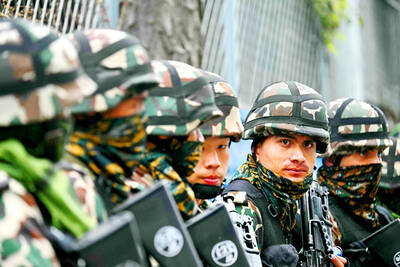
Counting was under way in Nepal yesterday, after a high-stakes parliamentary election to reshape the country’s leadership following protests last year that toppled the government. Key figures vying for power include former Nepalese prime minister K. P. Sharma Oli, rapper-turned-mayor Balendra Shah, who is bidding for the youth vote, and newly elected Nepali Congress party leader Gagan Thapa. In Kathmandu’s tea shops and city squares, people were glued to their phones, checking results as early trends flashed up — suggesting Shah’s centrist Rastriya Swatantra Party (RSP) was ahead. Nepalese Election Commission spokesman Prakash Nyupane said the counting was ongoing “in a peaceful manner”


 RSS
RSS