


Some conservative commentators seized on US President Barack Obama’s deep bow to Japanese Emperor Akihito in Tokyo over the weekend, accusing the US commander in chief of groveling before a foreign leader.
The bow was not without precedent. and appeared to be well within US State Department guidelines for foreign service officers working in other countries.
US presidents from both political parties have often been criticized for their attempts at culturally sensitive greetings to high-ranking foreigners. Former president George W. Bush was mocked for holding Saudi Crown Prince Abdullah’s hand, a traditional sign of friendship in the Middle East, as they strolled together in 2005.
Former president Richard Nixon can be seen in a Life magazine photo from 1971 bowing to Akihito’s father, emperor Hirohito, who ruled when Japan bombed Pearl Harbor in 1941.
But Obama’s encounter mixed a bow with a handshake — something not normally done.
It wasn’t the first time the president, a Democrat in office less than a year, has been criticized for his greeting of a foreign leader. Critics accused him of genuflecting to Saudi King Abdullah at a G20 summit earlier this year.
An online video posted by the University of Connecticut College Republicans juxtaposed a series of upright handshakes between Akihito and other world leaders and Obama’s low bow.
Andrew Malcolm, in a blog on the Los Angeles Times Web site, asked: “How low will the new American president go for the world’s royalty?”
Obama’s bow was compared with photos of former US vice president Dick Cheney giving Akihito a straight-backed handshake and the late General Douglas MacArthur, who oversaw the post-World War II occupation of Japan, standing with his hands on his hips next to Hirohito.
State Department spokesman Ian Kelly told reporters on Monday that the bow was “a sign of respect.”
An online State Department posting from 2007 titled “Protocol for the Modern Diplomat,” advises envoys to be aware of greeting rituals such as kisses or bows and to follow a country’s tradition.
“Failure to abide with tradition may be interpreted as rudeness,” it says.
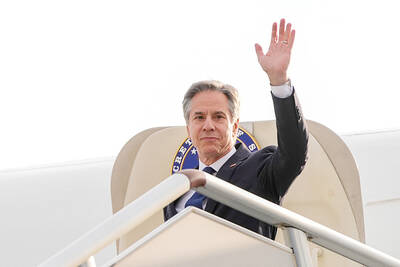
‘IN A DIFFERENT PLACE’: The envoy first visited Shanghai, where he attended a Chinese basketball playoff match, and is to meet top officials in Beijing tomorrow US Secretary of State Antony Blinken yesterday arrived in China on his second visit in a year as the US ramps up pressure on its rival over its support for Russia while also seeking to manage tensions with Beijing. The US diplomat tomorrow is to meet China’s top brass in Beijing, where he is also expected to plead for restraint as Taiwan inaugurates president-elect William Lai (賴清德), and to raise US concerns on Chinese trade practices. However, Blinken is also seeking to stabilize ties, with tensions between the world’s two largest economies easing since his previous visit in June last year. At the
Nearly half of China’s major cities are suffering “moderate to severe” levels of subsidence, putting millions of people at risk of flooding, especially as sea levels rise, according to a study of nationwide satellite data released yesterday. The authors of the paper, published by the journal Science, found that 45 percent of China’s urban land was sinking faster than 3mm per year, with 16 percent at more than 10mm per year, driven not only by declining water tables, but also the sheer weight of the built environment. With China’s urban population already in excess of 900 million people, “even a small portion

UNSETTLING IMAGES: The scene took place in front of TV crews covering the Trump trial, with a CNN anchor calling it an ‘emotional and unbelievably disturbing moment’ A man who doused himself in an accelerant and set himself on fire outside the courthouse where former US president Donald Trump is on trial has died, police said yesterday. The New York City Police Department (NYPD) said the man was declared dead by staff at an area hospital. The man was in Collect Pond Park at about 1:30pm on Friday when he took out pamphlets espousing conspiracy theories, tossed them around, then doused himself in an accelerant and set himself on fire, officials and witnesses said. A large number of police officers were nearby when it happened. Some officers and bystanders rushed

Beijing is continuing to commit genocide and crimes against humanity against Uyghurs and other Muslim minorities in its western Xinjiang province, U.S. Secretary of State Antony Blinken said in a report published on Monday, ahead of his planned visit to China this week. The State Department’s annual human rights report, which documents abuses recorded all over the world during the previous calendar year, repeated language from previous years on the treatment of Muslims in Xinjiang, but the publication raises the issue ahead of delicate talks, including on the war in Ukraine and global trade, between the top U.S. diplomat and Chinese


 RSS
RSS