


The Indian government denied permits for foreign journalists to cover the Dalai Lama’s imminent visit to a northeast Indian state that China claims as its own after weeks of verbal jousting between the two countries.
Four passes to Arunachal Pradesh, previously given to foreign reporters, have been revoked. All other news organizations that applied for permits have been turned down.
“We are incredibly surprised and disappointed to learn that reporters’ visas to Arunachal Pradesh have been canceled ahead of the Dalai Lama’s visit,” said Heather Timmons, president of the Delhi-based Foreign Correspondents’ Club.
Indian journalists will be allowed to travel, but some Tibetans raised concerns that Delhi was kowtowing to China over the Dalai Lama. Tsewang Rigzin, of the Tibetan Youth Congress, said it was “disappointing that in a democracy as big as India’s foreign reporters cannot follow His Holiness on this trip.”
The Himalayan neighbors have a prickly relationship, with both seeking a bigger role on the world stage. Media reports of alleged incursions by Chinese soldiers have caused uproar in recent weeks. The chief of India’s army staff, General Deepak Kapoor, has appealed to the media not to overplay the issue. Last month the government announced it would launch a legal case against two Indian reporters after a report appeared claiming two Indian border police were injured after being fired at from the Tibetan-Chinese side.
Despite the claims of misreporting, there is no doubt India and China have sparred in recent weeks over a number of sensitive issues around Arunachal Pradesh, which Beijing calls Southern Tibet or Outer Tibet. Relations reached a new low last month when Beijing described the Indian prime minister’s visit to the state before elections as “provocative and dangerous.”
Arunachal Pradesh has been slowly integrated into the Indian state since Delhi sent troops in 1950 carrying papers signed by the Tibetan government in Lhasa, which transferred 91,000km² of the Himalayas to India. Beijing rejects Delhi’s claim, pointing out that no official from China signed the treaty.
Last week the Dalai Lama said China was “over-politicizing” his travels and said his decisions on where to go were spiritual in nature, not political.
Fu Xiaoqiang (傅小強), an expert on south Asia at the Chinese Institute of Contemporary International Relations, said: “The visit will make Sino-Indian relations more complicated and increase the difficulties of solving the border problem ... [which] must be solved before they can further develop their relationship.”
The neighbors have not agreed on the border. The 4,000km demarcation is known as the Line of Actual Control and is a source of continuing tension.
One remote town in the Himalayan foothills spruced up its monasteries to prepare for the Dalai Lama’s arrival today.
Residents in Arunachal Pradesh’s Tawang prepared excitedly on Friday for the Dalai Lama’s arrival — his first visit since 2003. Buddhist monks hung flags and banners with the Dalai Lama’s image, and decorative arches were erected across the town. A tent camp was set up for an expected influx of pilgrims to the town.
“This is a religious event for us. It is specially auspicious to have the Dalai Lama in our midst,” said Tulku Rinpoche, the head of the sprawling Tawang monastery.
But the visit to Tawang is especially galling to China.
The town is heavily linked to nearby Tibet and has one of the largest Tibetan Buddhist monasteries in the world. China briefly occupied Tawang during the 1962 war before pulling back to the informal border.
The sixth Dalai Lama was born in Tawang in the 17th century and China fears the current Dalai Lama might announce that his successor could come from this town or somewhere else outside Tibet — meaning outside of Chinese control. China expects to exercise a strong hand in choosing the next Dalai Lama and is increasingly sensitive about the region since deadly anti-government riots broke out in the Tibetan capital of Lhasa last year.
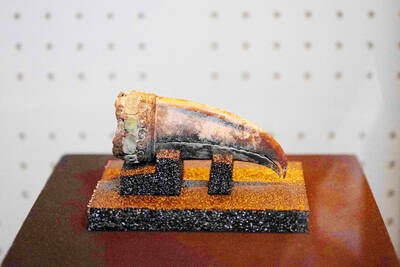
Archeologists in Peru on Thursday said they found the 5,000-year-old remains of a noblewoman at the sacred city of Caral, revealing the important role played by women in the oldest center of civilization in the Americas. “What has been discovered corresponds to a woman who apparently had elevated status, an elite woman,” archeologist David Palomino said. The mummy was found in Aspero, a sacred site within the city of Caral that was a garbage dump for more than 30 years until becoming an archeological site in the 1990s. Palomino said the carefully preserved remains, dating to 3,000BC, contained skin, part of the
‘WATER WARFARE’: A Pakistani official called India’s suspension of a 65-year-old treaty on the sharing of waters from the Indus River ‘a cowardly, illegal move’ Pakistan yesterday canceled visas for Indian nationals, closed its airspace for all Indian-owned or operated airlines, and suspended all trade with India, including to and from any third country. The retaliatory measures follow India’s decision to suspend visas for Pakistani nationals in the aftermath of a deadly attack by shooters in Kashmir that killed 26 people, mostly tourists. The rare attack on civilians shocked and outraged India and prompted calls for action against their country’s archenemy, Pakistan. New Delhi did not publicly produce evidence connecting the attack to its neighbor, but said it had “cross-border” links to Pakistan. Pakistan denied any connection to

TRUMP EFFECT: The win capped one of the most dramatic turnarounds in Canadian political history after the Conservatives had led the Liberals by more than 20 points Canadian Prime Minister Mark Carney yesterday pledged to win US President Donald Trump’s trade war after winning Canada’s election and leading his Liberal Party to another term in power. Following a campaign dominated by Trump’s tariffs and annexation threats, Carney promised to chart “a new path forward” in a world “fundamentally changed” by a US that is newly hostile to free trade. “We are over the shock of the American betrayal, but we should never forget the lessons,” said Carney, who led the central banks of Canada and the UK before entering politics earlier this year. “We will win this trade war and
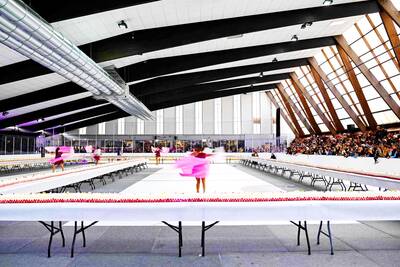
Armed with 4,000 eggs and a truckload of sugar and cream, French pastry chefs on Wednesday completed a 121.8m-long strawberry cake that they have claimed is the world’s longest ever made. Youssef El Gatou brought together 20 chefs to make the 1.2 tonne masterpiece that took a week to complete and was set out on tables in an ice rink in the Paris suburb town of Argenteuil for residents to inspect. The effort overtook a 100.48m-long strawberry cake made in the Italian town of San Mauro Torinese in 2019. El Gatou’s cake also used 350kg of strawberries, 150kg of sugar and 415kg of


 RSS
RSS