


Private First Class Marquest Smith, on his way to Afghanistan in January, was completing routine paperwork about a bee-sting allergy when the sounds erupted.
A loud, popping noise. Moans. The sudden, urgent shout of “Gun!”
Smith poked his head over the cubicle’s partition and saw an extraordinary sight: An Army officer with two guns, firing into the crowded room.
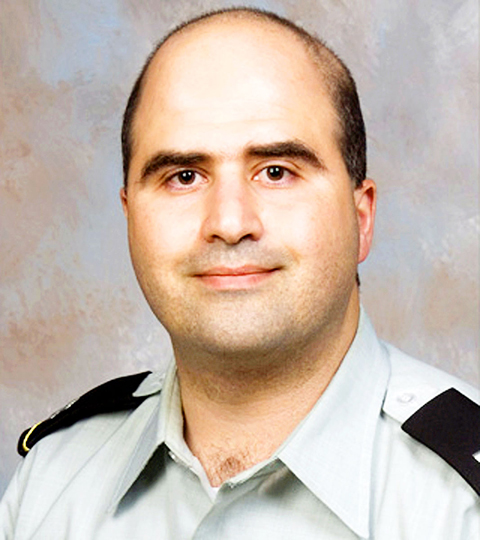
PHOTO: REUTERS
The 21-year-old Fort Worth native quickly grabbed the civilian worker who’d been helping him with his paperwork and forced her under the desk. He lay low for several minutes, waiting for the shooter to run out of ammunition and wishing he, too, had a gun.
After the shooter stopped to reload, Smith made a run for it.
Pushing two other soldiers in front of him, he made it out of the Soldier Readiness Processing (SRP) center — only to plunge into the building twice more to help the wounded.
Smith had survived the worst mass shooting on a US military base, a rampage of more than 100 shots that left 13 dead and 30 wounded, including the alleged shooter, Army psychiatrist Major Nidal Malik Hasan.
As a psychiatrist, Hasan, 39, had listened to soldiers’ tales of horror. Now, the US-born unmarried Muslim was facing imminent deployment to Afghanistan. In recent days, Hasan had been saying goodbye to friends. He had given away many of his possessions, including copies of the Koran.
At 2:37am on Thursday and again at around 5am, Hasan called neighbor Willie Bell. Bell could normally hear Hasan’s morning prayers through the thin apartment walls, but Hasan skipped the ritual on Thursday.
Bell didn’t pick up either time, but Hasan left a message.
“Nice knowing you, old friend,” Hasan said. “I’m going to miss you.”
About an hour later, surveillance cameras at a 7-Eleven across from the base captured images of a smiling Hasan, dressed in a long white garment and white kufi prayer cap, buying his usual breakfast — coffee and a hash brown.
At the processing center on the southern edge of the 40,000 hectare base, soldiers returning from overseas mingled with colleagues filling out forms and undergoing medical tests in preparation for deployment.
Around 1:30pm, witnesses say a man later identified as Hasan jumped up on a desk and shouted the words Allahu Akbar — Arabic for “God is great!” He was armed with two pistols, one a semiautomatic capable of firing up to 20 rounds without reloading.
Fort Hood Police Sergeant Kimberly Munley got the call of “shots fired.” The SRP isn’t on Munley’s beat; she was in the area because her vehicle was in the shop.
Munley, 34, was on the scene within three minutes.
Just over 150cm tall, Munley is an advanced firearms instructor and civilian member of Fort Hood’s special reaction team. She had trained on “active shooter” scenarios after the April 2007 mass shooting at Virginia Tech University. She didn’t wait for backup.
As Munley approached the squat, rectangular building, a soldier emerged from a door with a gunman in pursuit. The officer fired, and the uniformed shooter wheeled and charged.
Another officer, Senior Sergeant Mark Todd, also responded to the sound of gunfire. He arrived to find Hasan “just standing there, hiding behind a telephone pole.”
“He just looked like he was calm and he was just pointing,” he told CNN in an interview late on Friday.
Munley was hit at least three times in the exchange — twice through the left leg and once in her right wrist. Hasan was hit four times. It’s not clear whose bullets hit the suspect, but from the first shots to the last, authorities say the whole incident lasted less than 10 minutes.
Lieutenant Colonel Larry Masullo, an emergency room physician from Farmingdale, New York, was heading into a monthly meeting to review new doctors’ credentials when he heard of the shootings.
“Yeah, OK,” he said. “Multiple gunshot wounds. Is this a drill?”
In the next hour and a half, he would treat nearly two dozen soldiers.
For several hours, authorities feared there were several gunmen.
By the end of the day, it was clear Hasan had acted alone, they said.
Hasan, hooked up to a ventilator, was moved on Friday to a military hospital in San Antonio. The woman who stopped him, Munley, awaited surgery on Friday to remove the bullets from her leg. Her husband was flying in from Fort Bragg, North Carolina.
Her boss, Chuck Medley, was thankful.
“If an officer had to be close by to respond,” he said, “Kim Munley is someone we’d want to be there.”
Marquest Smith says some of the people he helped made it. But he knows others did not.
Afterward, Smith noticed a hole in the heel of his right combat boot.
A bullet had entered the boot, but he had somehow escaped physical injury.
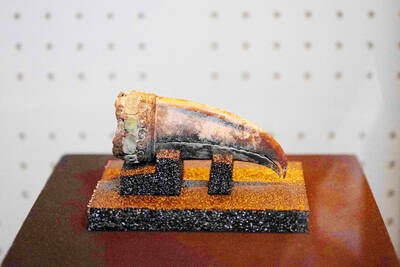
Archeologists in Peru on Thursday said they found the 5,000-year-old remains of a noblewoman at the sacred city of Caral, revealing the important role played by women in the oldest center of civilization in the Americas. “What has been discovered corresponds to a woman who apparently had elevated status, an elite woman,” archeologist David Palomino said. The mummy was found in Aspero, a sacred site within the city of Caral that was a garbage dump for more than 30 years until becoming an archeological site in the 1990s. Palomino said the carefully preserved remains, dating to 3,000BC, contained skin, part of the
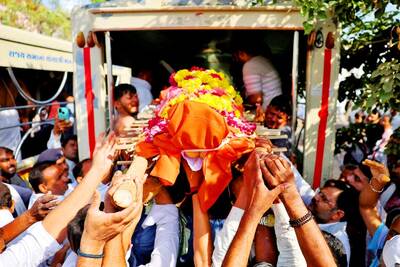
‘WATER WARFARE’: A Pakistani official called India’s suspension of a 65-year-old treaty on the sharing of waters from the Indus River ‘a cowardly, illegal move’ Pakistan yesterday canceled visas for Indian nationals, closed its airspace for all Indian-owned or operated airlines, and suspended all trade with India, including to and from any third country. The retaliatory measures follow India’s decision to suspend visas for Pakistani nationals in the aftermath of a deadly attack by shooters in Kashmir that killed 26 people, mostly tourists. The rare attack on civilians shocked and outraged India and prompted calls for action against their country’s archenemy, Pakistan. New Delhi did not publicly produce evidence connecting the attack to its neighbor, but said it had “cross-border” links to Pakistan. Pakistan denied any connection to

TRUMP EFFECT: The win capped one of the most dramatic turnarounds in Canadian political history after the Conservatives had led the Liberals by more than 20 points Canadian Prime Minister Mark Carney yesterday pledged to win US President Donald Trump’s trade war after winning Canada’s election and leading his Liberal Party to another term in power. Following a campaign dominated by Trump’s tariffs and annexation threats, Carney promised to chart “a new path forward” in a world “fundamentally changed” by a US that is newly hostile to free trade. “We are over the shock of the American betrayal, but we should never forget the lessons,” said Carney, who led the central banks of Canada and the UK before entering politics earlier this year. “We will win this trade war and

Armed with 4,000 eggs and a truckload of sugar and cream, French pastry chefs on Wednesday completed a 121.8m-long strawberry cake that they have claimed is the world’s longest ever made. Youssef El Gatou brought together 20 chefs to make the 1.2 tonne masterpiece that took a week to complete and was set out on tables in an ice rink in the Paris suburb town of Argenteuil for residents to inspect. The effort overtook a 100.48m-long strawberry cake made in the Italian town of San Mauro Torinese in 2019. El Gatou’s cake also used 350kg of strawberries, 150kg of sugar and 415kg of


 RSS
RSS