


She is attractive, effervescent and has an appealing voice. These qualities alone, however, would not have made Lou Jing (婁婧) the most famous TV talent show contestant in China and the subject of national debate in the world’s most populous country. The reason they are talking about Lou is because she is black.
The 20-year-old daughter of a Chinese mother and an African-American father who left the country before she was born, Lou was a highly unusual entrant to Shanghai-based Dragon TV’s Go Oriental Angel. Her appearances — she became one of five finalists — have provoked a storm of abuse on the Internet, a rare debate on racism in the media, and a bout of self-examination in a country where skin color is a notoriously sensitive subject.
Dragon TV initially had doubts about allowing Lou to perform, but then realized that her presence would do much to attract publicity for the show. Few executives, however, could have expected the fury contained in many of the blogs and online posts that accompanied her performances.
The Internet is the only place in China where the public can express views with near-freedom — although they are rapidly cut off by an army of state censors if they stray into territory that attracts official disapproval. The huge online interest in Lou clearly does not fall into this category.
“Ugh. Yellow people and black people mixed together is very gross,” was one representative post.
And Lou’s critics are incensed not only by her color, but also because she is apparently the product of an extramarital relationship.
Another blogger wrote: “Numb! This bitch still has the audacity to appear on television! I don’t know what to say! One cannot be shameless to this kind of level!”
Lou told Neteast News that the level of hostility had come as a shock.
“The whole thing was a big bomb to my family and me and it caused great harm,” she said. “I wish netizens could tolerate my particular parentage and let it go as soon as possible.”
She said that she is a true Shanghainese, an assertion underlined by her accent. There has been no official response to the racism, but public figures have been quick to join what has become an impassioned debate on the Chinese and race.
TRAITOR
Media commentator and author Hung Huang (洪晃) wrote on her blog: “In the same year that Americans welcome Obama to the White House, we can’t even accept this girl with a different skin color.”
The China Daily newspaper also published a sterling defense of the young theater student, written by one of its top columnists.
“There are two factors at work here,” wrote Raymond Zhou (周黎明), a China Daily editorialist. “Lou Jing is not a pure-blood Chinese and anyone who marries a foreigner is deemed a ‘traitor’ to his or her race. More relevant, Lou’s father is black.”
Zhou said: “It is high time we introduced some sensitivity training on races and ethnicities if we are going to latch on to the orbit of globalization.
People should realize that if you have a right to discriminate against another race, you have automatically given others the right to discriminate against you.”
Chip Tsao (陶傑), one of Hong Kong’s leading columnists and cultural commentators, believes that a child of a Chinese woman and a black person hits all the buttons that cause prejudice among Chinese.
“It’s an obnoxious novelty,” he said, adding that Chinese prejudice against black people was part of “prejudice against people less well-off than themselves.”
There was, he said, greater acceptance of Europeans because they were viewed as successful, but mixed Chinese/white European couples frequently attracted racist comment.
One leading actress, Jiang Ziyi (章子怡), who has an Israeli boyfriend, has routinely been accused of betrayal for consorting with a foreigner. A stark reminder of official racism came last year when Ding Hui (丁慧), of mixed Chinese and African parentage, was barred from representing his country in the national volleyball team.
TABOO
China officially lists 56 approved ethnic minorities within its borders, but discussion about ethnic differences is largely taboo. Racial tensions have recently broken out between the Muslim Uighur population, who look more like Europeans, and the “Chinese”-looking majority.
In the era of late Chinese leaderMao Zedong (毛澤東) there was much talk of China’s brotherhood with the developing world, which led to many African students arriving to study in Chinese universities and the export of many Chinese workers to Africa, to help with development.
Tsao said that although modern China invested in African raw material companies, it did not trust local workers and instead imported its own. Many Chinese remain unaware that certain forms of behavior and language are unacceptable in multicultural societies elsewhere.
Unsurprisingly shaken by the fallout from what was supposed to be a talent contest, Lou and her mother are contemplating legal action against a Shanghai newspaper that they claim fabricated an interview about her father. In two years she will graduate. After that she plans to study in Europe or the US.

DOUBLE-MURDER CASE: The officer told the dispatcher he would check the locations of the callers, but instead headed to a pizzeria, remaining there for about an hour A New Jersey officer has been charged with misconduct after prosecutors said he did not quickly respond to and properly investigate reports of a shooting that turned out to be a double murder, instead allegedly stopping at an ATM and pizzeria. Franklin Township Police Sergeant Kevin Bollaro was the on-duty officer on the evening of Aug. 1, when police received 911 calls reporting gunshots and screaming in Pittstown, about 96km from Manhattan in central New Jersey, Hunterdon County Prosecutor Renee Robeson’s office said. However, rather than responding immediately, prosecutors said GPS data and surveillance video showed Bollaro drove about 3km

Tens of thousands of people on Saturday took to the streets of Spain’s eastern city of Valencia to mark the first anniversary of floods that killed 229 people and to denounce the handling of the disaster. Demonstrators, many carrying photos of the victims, called on regional government head Carlos Mazon to resign over what they said was the slow response to one of Europe’s deadliest natural disasters in decades. “People are still really angry,” said Rosa Cerros, a 42-year-old government worker who took part with her husband and two young daughters. “Why weren’t people evacuated? Its incomprehensible,” she said. Mazon’s
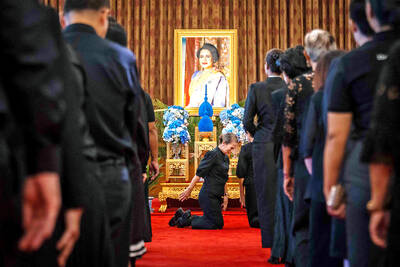
‘MOTHER’ OF THAILAND: In her glamorous heyday in the 1960s, former Thai queen Sirikit mingled with US presidents and superstars such as Elvis Presley The year-long funeral ceremony of former Thai queen Sirikit started yesterday, with grieving royalists set to salute the procession bringing her body to lie in state at Bangkok’s Grand Palace. Members of the royal family are venerated in Thailand, treated by many as semi-divine figures, and lavished with glowing media coverage and gold-adorned portraits hanging in public spaces and private homes nationwide. Sirikit, the mother of Thai King Vajiralongkorn and widow of the nation’s longest-reigning monarch, died late on Friday at the age of 93. Black-and-white tributes to the royal matriarch are being beamed onto towering digital advertizing billboards, on

With much pomp and circumstance, Cairo is today to inaugurate the long-awaited Grand Egyptian Museum (GEM), widely presented as the crowning jewel on authorities’ efforts to overhaul the country’s vital tourism industry. With a panoramic view of the Giza pyramids plateau, the museum houses thousands of artifacts spanning more than 5,000 years of Egyptian antiquity at a whopping cost of more than US$1 billion. More than two decades in the making, the ultra-modern museum anticipates 5 million visitors annually, with never-before-seen relics on display. In the run-up to the grand opening, Egyptian media and official statements have hailed the “historic moment,” describing the


 RSS
RSS