


After a three-year trial, a South Korean court is due to pass judgment today on a scientist hailed as a national hero until his apparently landmark stem cell research was ruled to be fake.
Prosecutors have demanded a four-year jail term for Hwang Woo-suk, who went on trial in June 2006 for embezzling funds and ethical lapses.
Hwang, 56, shot to fame in 2004 when he published a paper in the US journal Science claiming to have created the world’s first stem cell line from a cloned human embryo.
In a follow-up paper in 2005, he maintained that his team had developed 11 patient-specific embryonic stem cell lines.
The claims raised hopes of new treatments for diseases such as cancer, diabetes and Parkinson’s.
The government showered Hwang and his team from the prestigious Seoul National University (SNU) with money, models and other honors. Hwang was awarded the title of “supreme scientist.”
But his golden reputation was tarnished in November 2005 amid allegations that he had violated medical ethics by accepting human eggs from his own researchers.
Hwang apologized for the lapse, but the scandal widened with reports from local television network MBC that his entire research was fabricated.
His world came crashing down in January 2006 when an SNU investigative team published a damning report.
The report confirmed that Hwang’s findings were faked and said he produced no stem cells of any kind.
In one crumb of comfort, the experts validated his work in creating the world’s first cloned dog, Snuppy, or Seoul National University puppy.
Prosecutors began a criminal investigation and Hwang was stripped of his honors. He was charged with defrauding private donors of about 2 billion won (US$1.7 million) in research funds by exaggerating his research and with embezzling state donations.
Hwang was also accused of breaking a bioethics law that prohibits illegal human egg transactions.
Five other scientists were also charged.
Prosecutors say Hwang used bank accounts under names borrowed from friends to divert state research funds and private donations.
He has accepted broad responsibility for the faked research but denied ordering his researchers to fabricate results. He has insisted he could still prove he created the first cloned human stem cells.
Hwang also denies embezzling funds, blaming absent-mindedness to explain the flawed book-keeping of his research institute.
“How could I say in detail where the money went?” he told the court in October 2006, adding he had not taken a “single penny” for himself.
The scientist has said some of the funds were paid to Russians while he worked on projects to clone a Siberian tiger and the extinct woolly mammoth, as part of his research into growing new organs for human beings.
Hwang, who was free on bail during his trial, focused on animal cloning after losing his government license for human stem cell research. Last Thursday he presented two cloned dogs to a zoo in the town of Cheongju.
“Regardless of the verdict, Hwang will continue his research. We hope the court will make a wise decision,” said Hyun Sang-hwan, chief adviser to the Sooam Biotech Research Center led by Hwang.
The former supreme scientist has retained some loyal supporters who reject the allegations against him.
The court has received a series of petitions from them, including 55 lawmakers who called for leniency.
In May 2006, local Buddhists offered more than US$60 million to allow him to resume his research.
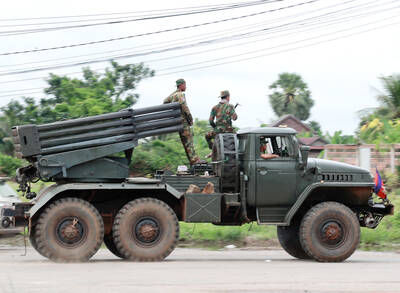
POLITICAL PATRIARCHS: Recent clashes between Thailand and Cambodia are driven by an escalating feud between rival political families, analysts say The dispute over Thailand and Cambodia’s contested border, which dates back more than a century to disagreements over colonial-era maps, has broken into conflict before. However, the most recent clashes, which erupted on Thursday, have been fueled by another factor: a bitter feud between two powerful political patriarchs. Cambodian Senate President and former prime minister Hun Sen, 72, and former Thai prime minister Thaksin Shinawatra, 76, were once such close friends that they reportedly called one another brothers. Hun Sen has, over the years, supported Thaksin’s family during their long-running power struggle with Thailand’s military. Thaksin and his sister Yingluck stayed
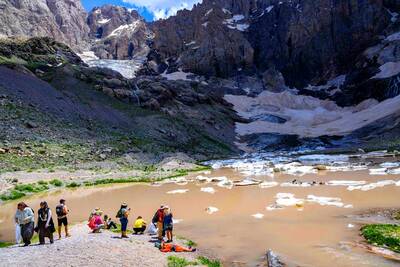
Kemal Ozdemir looked up at the bare peaks of Mount Cilo in Turkey’s Kurdish majority southeast. “There were glaciers 10 years ago,” he recalled under a cloudless sky. A mountain guide for 15 years, Ozdemir then turned toward the torrent carrying dozens of blocks of ice below a slope covered with grass and rocks — a sign of glacier loss being exacerbated by global warming. “You can see that there are quite a few pieces of glacier in the water right now ... the reason why the waterfalls flow lushly actually shows us how fast the ice is melting,” he said.
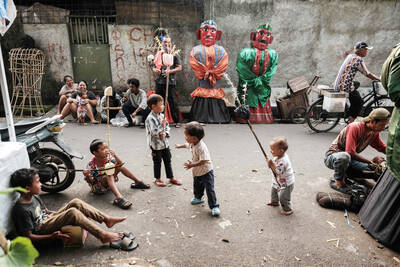
In the sweltering streets of Jakarta, buskers carry towering, hollow puppets and pass around a bucket for donations. Now, they fear becoming outlaws. City authorities said they would crack down on use of the sacred ondel-ondel puppets, which can stand as tall as a truck, and they are drafting legislation to remove what they view as a street nuisance. Performances featuring the puppets — originally used by Jakarta’s Betawi people to ward off evil spirits — would be allowed only at set events. The ban could leave many ondel-ondel buskers in Jakarta jobless. “I am confused and anxious. I fear getting raided or even
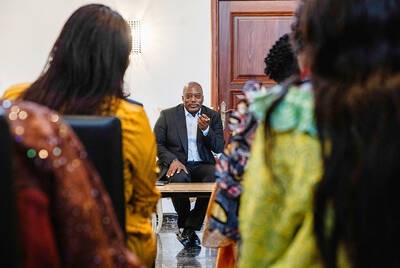
‘ARBITRARY’ CASE: Former DR Congo president Joseph Kabila has maintained his innocence and called the country’s courts an instrument of oppression Former Democratic Republic of the Congo (DR Congo) president Joseph Kabila went on trial in absentia on Friday on charges including treason over alleged support for Rwanda-backed militants, an AFP reporter at the court said. Kabila, who has lived outside the DR Congo for two years, stands accused at a military court of plotting to overthrow the government of Congolese President Felix Tshisekedi — a charge that could yield a death sentence. He also faces charges including homicide, torture and rape linked to the anti-government force M23, the charge sheet said. Other charges include “taking part in an insurrection movement,” “crime against the


 RSS
RSS