


Richard Wadani still remembers the sick feeling in his stomach the morning he left Hitler’s Wehrmacht in October 1944, knowing that as he crawled through a tangle of barbed wire as dawn broke that one wrong move would cost him his life.
Late on Wednesday, more than six decades after the end of World War II, Austria’s parliament agreed to rehabilitate deserters like Wadani who were criminalized by the Nazis for refusing to continue serving in the Third Reich’s armed forces.
“We’ve finally reached our goal,” the 87-year-old said in a recent interview. “From the beginning, we were seen as traitors.”
The blanket measure, which could become law within weeks, clears the names and reputations of men who were either sentenced to death or shunned by some in Austrian society after the war for standing up to Hitler and his followers.
Austria became part of a Greater Germany early on March 12, 1938, when Wehrmacht troops crossed into the country to ensure a smooth takeover in what became known as the “Anschluss.”
Austria’s two right-wing parties opposed the rehabilitation measure, which was backed by the governing coalition and Greens. In the weeks leading up to Wednesday’s vote, the right-wing parties argued that decisions to rehabilitate deserters should be made on a case-by-case basis.
Last month, Freedom Party chief Heinz-Christian Strache caused a stir when he argued that some deserters should not be rehabilitated because they may have killed comrades and other soldiers while trying to leave the force.
“One shouldn’t retrospectively make the mistake of glorifying these people,” Strache said in a local media interview. “They were often also murderers.”
But other politicians, such as Justice Minister Claudia Bandion-Ortner, called the blanket rehabilitation an important symbolic act.
To Wadani, honorary chairman of an Austrian association that seeks recognition for deserters, Wednesday’s late-night parliamentary action marked the end of a decades-long struggle.
“We have always been convinced that what we did was right,” Wadani said, adding that many deserters were “broken” by the negative reactions they received — sometimes even from their own families and loved ones.
Wadani sat in on the parliamentary session on Wednesday evening. At one point, lawmakers applauded him.
Experts say it is hard to estimate how many Austrian men deserted the Wehrmacht, since most may have been afraid to come forward publicly out of fear they or their families would be shamed.
At most, about 300 are still alive today, said Hannes Metzler, a political scientist who has researched the issue for years. During the Nazi era, between 1,200 and 1,400 are believed to have been executed for desertion, he said.
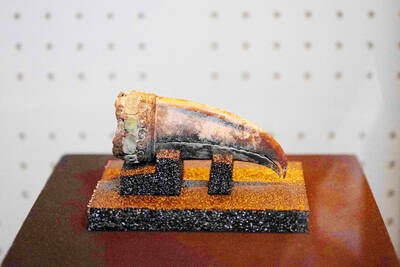
Archeologists in Peru on Thursday said they found the 5,000-year-old remains of a noblewoman at the sacred city of Caral, revealing the important role played by women in the oldest center of civilization in the Americas. “What has been discovered corresponds to a woman who apparently had elevated status, an elite woman,” archeologist David Palomino said. The mummy was found in Aspero, a sacred site within the city of Caral that was a garbage dump for more than 30 years until becoming an archeological site in the 1990s. Palomino said the carefully preserved remains, dating to 3,000BC, contained skin, part of the
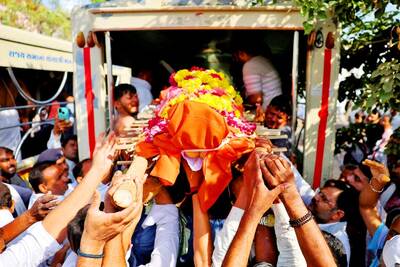
‘WATER WARFARE’: A Pakistani official called India’s suspension of a 65-year-old treaty on the sharing of waters from the Indus River ‘a cowardly, illegal move’ Pakistan yesterday canceled visas for Indian nationals, closed its airspace for all Indian-owned or operated airlines, and suspended all trade with India, including to and from any third country. The retaliatory measures follow India’s decision to suspend visas for Pakistani nationals in the aftermath of a deadly attack by shooters in Kashmir that killed 26 people, mostly tourists. The rare attack on civilians shocked and outraged India and prompted calls for action against their country’s archenemy, Pakistan. New Delhi did not publicly produce evidence connecting the attack to its neighbor, but said it had “cross-border” links to Pakistan. Pakistan denied any connection to

TRUMP EFFECT: The win capped one of the most dramatic turnarounds in Canadian political history after the Conservatives had led the Liberals by more than 20 points Canadian Prime Minister Mark Carney yesterday pledged to win US President Donald Trump’s trade war after winning Canada’s election and leading his Liberal Party to another term in power. Following a campaign dominated by Trump’s tariffs and annexation threats, Carney promised to chart “a new path forward” in a world “fundamentally changed” by a US that is newly hostile to free trade. “We are over the shock of the American betrayal, but we should never forget the lessons,” said Carney, who led the central banks of Canada and the UK before entering politics earlier this year. “We will win this trade war and

Armed with 4,000 eggs and a truckload of sugar and cream, French pastry chefs on Wednesday completed a 121.8m-long strawberry cake that they have claimed is the world’s longest ever made. Youssef El Gatou brought together 20 chefs to make the 1.2 tonne masterpiece that took a week to complete and was set out on tables in an ice rink in the Paris suburb town of Argenteuil for residents to inspect. The effort overtook a 100.48m-long strawberry cake made in the Italian town of San Mauro Torinese in 2019. El Gatou’s cake also used 350kg of strawberries, 150kg of sugar and 415kg of


 RSS
RSS