


Press freedom has improved in the US in the last year and the country jumped 20 places to No. 20 on this year’s international ranking by Reporters Without Borders (RSF) released on Tuesday.
The media watchdog said US President Barack Obama taking up the presidency in January brought a new approach in Washington after eight years under former US president George W. Bush, while some European countries fell in the group’s Press Freedom Index.
RSF expressed concerns about US attitudes toward the media in Iraq and Afghanistan, where it said journalists had been injured or arrested by the US military.
“President Obama may have been awarded the Nobel Peace Prize, but his country is still fighting two wars,” the group said. “Despite a slight improvement, the attitude of the United States towards the media in Iraq and Afghanistan is worrying.”
The US came in just behind Britain on the press freedom index of 175 countries, while China was at No. 168. Afghanistan No. 149 and Iraq at No. 145.
As the Taipei Times reported yesterday, Taiwan’s press freedom ranking slipped by 23 spots to 59th this year from 36th last year. RSF attributed the slide to the Chinese Nationalist Party’s (KMT) interference in state and privately owned media and violence by “certain activists.”
Reporters Without Borders said that in the US the House of Representatives this year backed legislation to allow journalists to protect their sources — it has not yet been voted on in the Senate — and the Obama administration had promised better access to public information.
The group said civil liberties were violated in the name of national security during the Bush era.
European countries hold the top 13 spots, led by Denmark, Finland, Ireland, Norway and Sweden. France fell eight spots to No. 43, Slovakia dropped 37 places to No. 44 and Italy fell five spots to No. 49.
“Europe should be setting an example as regards civil liberties. How can you condemn human rights violations abroad if you do not behave irreproachably at home?” said Reporters Without Borders secretary-general Jean-Francois Julliard.
Press freedom in France has been worsening for several years, the group said, with the authorities placing growing pressure on journalists to reveal sources and proposing legislation that could reduce their freedom.
In Italy, Reporters Without Borders said press freedom was being stifled by threats from the Mafia and various lawsuits being brought or considered by Italian Prime Minister Silvio Berlusconi against news organizations.
The group also drew attention to Israel, which fell 47 places to No. 93, losing its place as the top country for press freedom in the region and falling behind Kuwait at No. 60, Lebanon at No. 61 and the United Arab Emirates at No. 86.
“Israel has begun to use the same methods internally as it does outside its own territory,” said Reporters Without Borders, adding that journalists had been arrested and imprisoned and that military censorship also posed a threat.
But as a result of actions during Israel’s war against Hamas militants in the Gaza Strip in December and January, Reporters Without Borders ranked the country at No. 150 for its “extraterritorial actions.”
“The toll of the war was very heavy. Around 20 journalists in the Gaza Strip were injured by the Israeli military forces and three were killed while covering the offensive,” it said.
At the bottom of the list were Turkmenistan, North Korea and Eritrea, “where media are so suppressed they are nonexistent,” Reporters Without Borders said.
Iran dropped to No. 172 from No. 166, with Reporters Without Borders saying the disputed reelection of Iranian President Mahmoud Ahmadinejad had fostered a paranoia about journalists and bloggers.
“Automatic prior censorship, state surveillance of journalists, mistreatment, journalists forced to flee the country, illegal arrests and imprisonment — such is the state of press freedom this year in Iran,” the group said.
The ranking was compiled from hundreds of questionnaires completed by journalists and media experts around the world and reflecting press freedom violations that took place between Sept. 1 last year and Aug. 31 this year. The exact number of questionnaires completed was not immediately available.
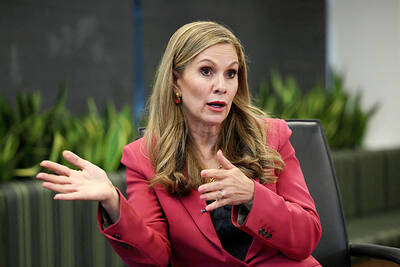
Australians were downloading virtual private networks (VPNs) in droves, while one of the world’s largest porn distributors said it was blocking users from its platforms as the country yesterday rolled out sweeping online age restriction. Australia in December became the first country to impose a nationwide ban on teenagers using social media. A separate law now requires artificial intelligence (AI)-powered chatbot services to keep certain content — including pornography, extreme violence and self-harm and eating disorder material — from minors or face fines of up to A$49.5 million (US$34.6 million). The country also joined Britain, France and dozens of US states requiring
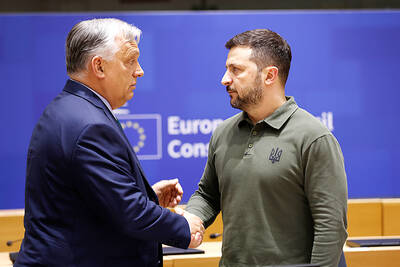
Hungarian authorities temporarily detained seven Ukrainian citizens and seized two armored cars carrying tens of millions of euros in cash across Hungary on suspicion of money laundering, officials said on Friday. The Ukrainians were released on Friday, following their detention on Thursday, but Hungarian officials held onto the cash, prompting Ukraine to accuse Hungary’s Russia-friendly government of illegally seizing the money. “We will not tolerate this state banditism,” Ukrainian Minister of Foreign Affairs Andrii Sybiha said. The seven detained Ukrainians were employees of the Ukrainian state-owned Oschadbank, who were traveling in the two armored cars that were carrying the money between Austria and
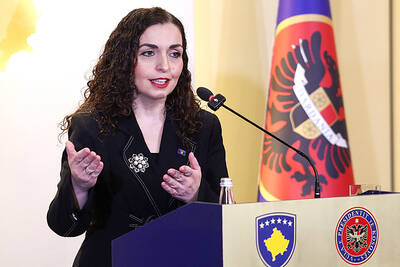
Kosovar President Vjosa Osmani on Friday after dissolving the Kosovar parliament said a snap election should be held as soon as possible to avoid another prolonged political crisis in the Balkan country at a time of global turmoil. Osmani said it is important for Kosovo to wrap up the upcoming election process and form functional institutions for political stability as the war rages in the Middle East. “Precisely because the geopolitical situation is that complex, it is important to finish this electoral process which is coming up,” she said. “It is very hard now to imagine what will happen next.” Kosovo, which declared

MORE BANS: Australia last year required sites to remove accounts held by under-16s, with a few countries pushing for similar action at an EU level and India considering its own ban Indonesia on Friday said it would ban social media access for children under 16, citing threats from online pornography, cyberbullying, online fraud and Internet addiction. “Accounts belonging to children under 16 on high-risk platforms will start to be deactivated, beginning with YouTube, TikTok, Facebook, Instagram, Threads, X, Bigo Live and Roblox,” Indonesian Minister of Communications and Digital Meutya Hafid said. “The government is stepping in so that parents no longer have to fight alone against the giants of the algorithm. Implementation will begin on March 28, 2026,” she said. The social media ban would be introduced in stages “until all platforms fulfill their


 RSS
RSS