


Global pirate attacks so far this year have already exceeded the number recorded last year, and attackers are much more likely to use firearms, a maritime watchdog said yesterday.
“The increase in attacks is directly attributed to heightened piracy activity off the Somali Coast ... and in the Gulf of Aden,” the International Maritime Bureau (IMB) said in a report.
Incidents off the coast of lawless Somalia rose to 47 during the first nine months of this year from 12 in the same period a year ago, while in the Gulf of Aden there were 100 attacks compared to 51.
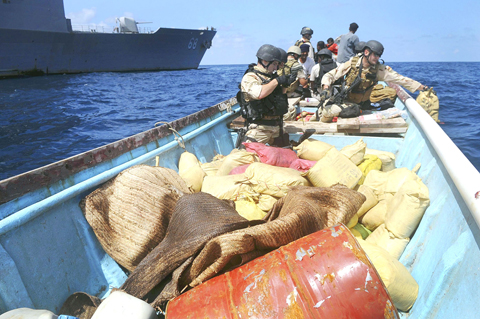
PHOTO: REUTERS
Globally, there were 306 incidents reported to the IMB’s piracy reporting center in Kuala Lumpur for the first nine months of the year, compared with 293 for the same period last year, and just below the record of 344 set in 2003.
However, the IMB said the rate of successful hijackings had dropped substantially this year, to an average of one in nine vessels targeted by pirates compared with one in 6.4 last year.
“In 2008 there were a lot of successful hijackings but in 2009, because of increased naval patrols, although the number of attacks has increased their success in getting the ships has decreased,” reporting center chief Noel Choong said.
However, the report showed that the number of incidents in which guns were used had risen by more than 200 percent so far this year, indicating that attackers were more determined than ever.
The IMB said Somali pirates have also extended their reach, “threatening not only the Gulf of Aden and the East Coast of Somalia but also the southern region of the Red Sea, the Bab el Mandab Straits and the East Coast of Oman.”
Since last year a flotilla of foreign warships has been patrolling the Gulf of Aden, one of the busiest maritime trade routes on the globe, which has been plagued by piracy in recent years.
“The naval vessels operating off the coast of Somalia continue to play a critical role in containing the piracy threat,” IMB director Pottengal Mukundan said.
“It is vital that regions in Somalia such as Puntland continue to take firm action in investigating and prosecuting the pirates. This will be a far better deterrent against Somali pirates than prosecution and punishment in a foreign country,” he said.
Elsewhere, the IMB said, Nigeria remains an “area of high concern” and that while 20 attacks had been recorded so far this year, the real figure was likely to be twice as high.
Chittagong port in Bangladesh has also seen a rise in attacks, with 12 this year compared with nine last year.
Also, “the South China Sea has once again proven to be an area of concern and enhanced risk, with 10 incidents reported so far in 2009. This is the highest recorded number of incidents in the corresponding period over the last five years,” the IMB said.
The watchdog said that globally, 114 vessels were boarded and 34 hijacked during the first nine months of the year. A total of 661 crew members were taken hostage, six were killed and eight are missing.
Attacks fell in the third quarter of the year compared with the first half of the year, but the IMB said the decrease was because of monsoon conditions that make the seas too rough for pirates to operate in their small boats.

The Bolivian government on Friday struck a deal with protesting miners, but was still grappling with blockades and demonstrations by other workers across La Paz. Other groups are still blocking access roads into the city, which is also the seat of the government. Police on Thursday prevented the miners from entering the main square by using tear gas, while the demonstrators hurled stones and explosives with slingshots. Protests against the policies of Bolivian President Rodrigo Paz have convulsed the Andean nation since early this month, and roadblocks were choking routes into La Paz throughout Friday, the national road authority said. Miners demanded that Paz

The Philippines said it has asked the country’s Supreme Court to allow it to arrest former Philippine president Rodrigo Duterte’s chief drug war enforcer to stand trial in an international tribunal. The International Criminal Court (ICC) last week unsealed an arrest warrant against Philippine Senator Ronald dela Rosa, accusing him along with Duterte and other “coperpetrators” of the “crime against humanity of murder.” Dela Rosa briefly sought refuge in the Philippine Senate last week while asking the Philippine Supreme Court to stop an ongoing attempt by government agents to arrest him. “By his own conduct, he has placed himself outside the protection of
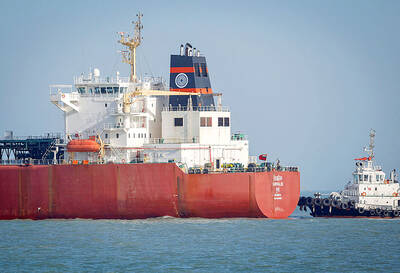
A ship anchored off the United Arab Emirates (UAE) was seized and taken toward Iran and another — a cargo ship near Oman — sank after being attacked, authorities said on Thursday, as tensions escalated near the Strait of Hormuz. It was not immediately clear who was behind these incidents, but they happened as a senior Iranian official reiterated his country’s claim of control over the waterway and another said it had a right to seize oil tankers connected to the US. The turmoil in the strait has been a sticking point for weeks in talks between the US and Iran to

The researchers in Ireland looked at their computer screen, marveling at a medieval book tracked down in a Roman library. They flipped through its digitized pages and found their sought-after treasure: the oldest surviving English poem. “We were extremely surprised. We were speechless. We couldn’t believe our eyes when we first saw that,” said Elisabetta Magnanti, a visiting research fellow at Trinity College Dublin’s school of English. The poem was also within the main body of Latin text, she said, calling it “extraordinary.” Composed in Old English by a Northumbrian agricultural worker in the 7th century, Caedmon’s Hymn appears within some copies of


 RSS
RSS