


More than 50 years after a major overhaul of the way in which Chinese characters are written, a far less ambitious project to simplify just a few dozen characters has sparked huge controversy in China.
The government has put forward proposals to change 44 characters out of the 3,500 most used, or 1.25 percent of the total, “to adapt to the requirements of the information era, the evolution of language and the development of society.”
After eight years of reflection and expert consultations in China and abroad, the education ministry and the State Language Work Committee called on members of the public for their opinions — a first for such a reform.
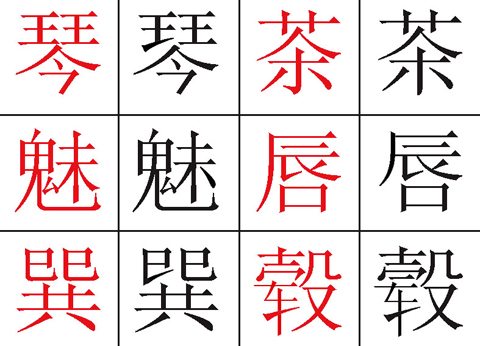
GRAPHIC: TAIPEI TIMES
The project was not expected to spark any major concerns, with just a few strokes removed from characters here and there.
For example, cha (茶), or tea, would lose a tiny upward stroke at its base — a change that is already noticeable on some shopfronts in Beijing. Xin (新), which means new, would also get rid of its little upward line.
Dissenting voices have run riot, however, particularly on the Internet. Polls by major Web portals or newspaper Web sites show that more than 80 percent of online users are opposed to the project.
They say the reform might only affect a few characters, but these are used often and their modification would have an important impact on dictionaries, school books, signs, publishers ... and the Chinese themselves.
“Chinese characters are a precious part of the cultural heritage left to us by our ancestors thousands of years ago,” one net user in Shandong Province said in a comment posted on sina.com. “We should respect them and protect them, not change them on a whim.”
Liu Jingbo, a calligraphy professional who organizes exhibitions in Beijing, said the changes would not go against the nation’s history.
“Chinese characters come from ancient history, but it is possible to reform them, respecting certain rules, if it helps to make life easier for people,” he said. “A lot of people, such as the elderly, are however opposed to this as they were used to these characters.”
In the 1950s, when the government decided to simplify more than 2,000 characters, the philologist Chen Mengjia (陳夢家) paid dearly for his opposition to this huge reform project.
Accused of being a “rightist” and sent to a labor camp in central China, he subsequently committed suicide in Beijing in 1966 after being subjected to public criticism sessions at the start of the turbulent Cultural Revolution.
Experts say the new controversy highlights strong attachment to the Chinese script — a unifying factor in a country that boasts many languages and dialects.
“Of the first measures taken by the first emperor after he defeated all other kingdoms, the unification of writing was not insignificant,” said Olivier Venture, a Beijing-based researcher for the French School of Asian Studies.
“It is extremely important — it is seen as the bond that unites Chinese culture, as part of the nation’s identity. A lot of things change, but people can always look to writing, even if in fact it always evolves,” he said.
Faced with the surge of protests on the Internet and in the press during the consultation phase in August, the ministry and the commission decided to wait, saying nothing had been decided and that discussions were ongoing.
“We are civil servants — our responsibility is to serve the people, and if the people are opposed, we will not budge,” Li Ningming, an official at the commission, said in comments broadcast on state TV.
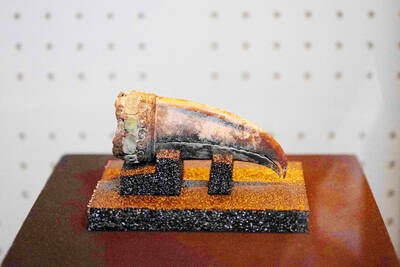
Archeologists in Peru on Thursday said they found the 5,000-year-old remains of a noblewoman at the sacred city of Caral, revealing the important role played by women in the oldest center of civilization in the Americas. “What has been discovered corresponds to a woman who apparently had elevated status, an elite woman,” archeologist David Palomino said. The mummy was found in Aspero, a sacred site within the city of Caral that was a garbage dump for more than 30 years until becoming an archeological site in the 1990s. Palomino said the carefully preserved remains, dating to 3,000BC, contained skin, part of the

‘WATER WARFARE’: A Pakistani official called India’s suspension of a 65-year-old treaty on the sharing of waters from the Indus River ‘a cowardly, illegal move’ Pakistan yesterday canceled visas for Indian nationals, closed its airspace for all Indian-owned or operated airlines, and suspended all trade with India, including to and from any third country. The retaliatory measures follow India’s decision to suspend visas for Pakistani nationals in the aftermath of a deadly attack by shooters in Kashmir that killed 26 people, mostly tourists. The rare attack on civilians shocked and outraged India and prompted calls for action against their country’s archenemy, Pakistan. New Delhi did not publicly produce evidence connecting the attack to its neighbor, but said it had “cross-border” links to Pakistan. Pakistan denied any connection to

TRUMP EFFECT: The win capped one of the most dramatic turnarounds in Canadian political history after the Conservatives had led the Liberals by more than 20 points Canadian Prime Minister Mark Carney yesterday pledged to win US President Donald Trump’s trade war after winning Canada’s election and leading his Liberal Party to another term in power. Following a campaign dominated by Trump’s tariffs and annexation threats, Carney promised to chart “a new path forward” in a world “fundamentally changed” by a US that is newly hostile to free trade. “We are over the shock of the American betrayal, but we should never forget the lessons,” said Carney, who led the central banks of Canada and the UK before entering politics earlier this year. “We will win this trade war and
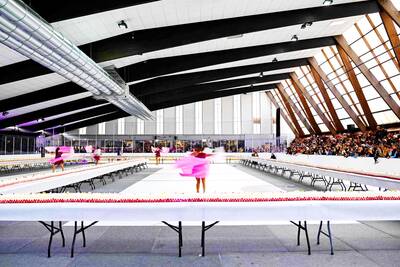
Armed with 4,000 eggs and a truckload of sugar and cream, French pastry chefs on Wednesday completed a 121.8m-long strawberry cake that they have claimed is the world’s longest ever made. Youssef El Gatou brought together 20 chefs to make the 1.2 tonne masterpiece that took a week to complete and was set out on tables in an ice rink in the Paris suburb town of Argenteuil for residents to inspect. The effort overtook a 100.48m-long strawberry cake made in the Italian town of San Mauro Torinese in 2019. El Gatou’s cake also used 350kg of strawberries, 150kg of sugar and 415kg of


 RSS
RSS